Get Full Government Meeting Transcripts, Videos, & Alerts Forever!
Get email alerts on the Medicaid Coverage Transition topic
No spam. Unsubscribe anytime.
DC committee hears warnings that proposed Medicaid, Alliance changes and BHP transition could disrupt coverage for tens of thousands
Summary
Witnesses at the Committee on Health oversight hearing warned that Mayor Bowser's FY26 budget proposals — including moving some Medicaid enrollees into a Basic Health Program (BHP) and phasing out parts of the DC Health Care Alliance — could lead to coverage losses and administrative disruptions for thousands of district residents.
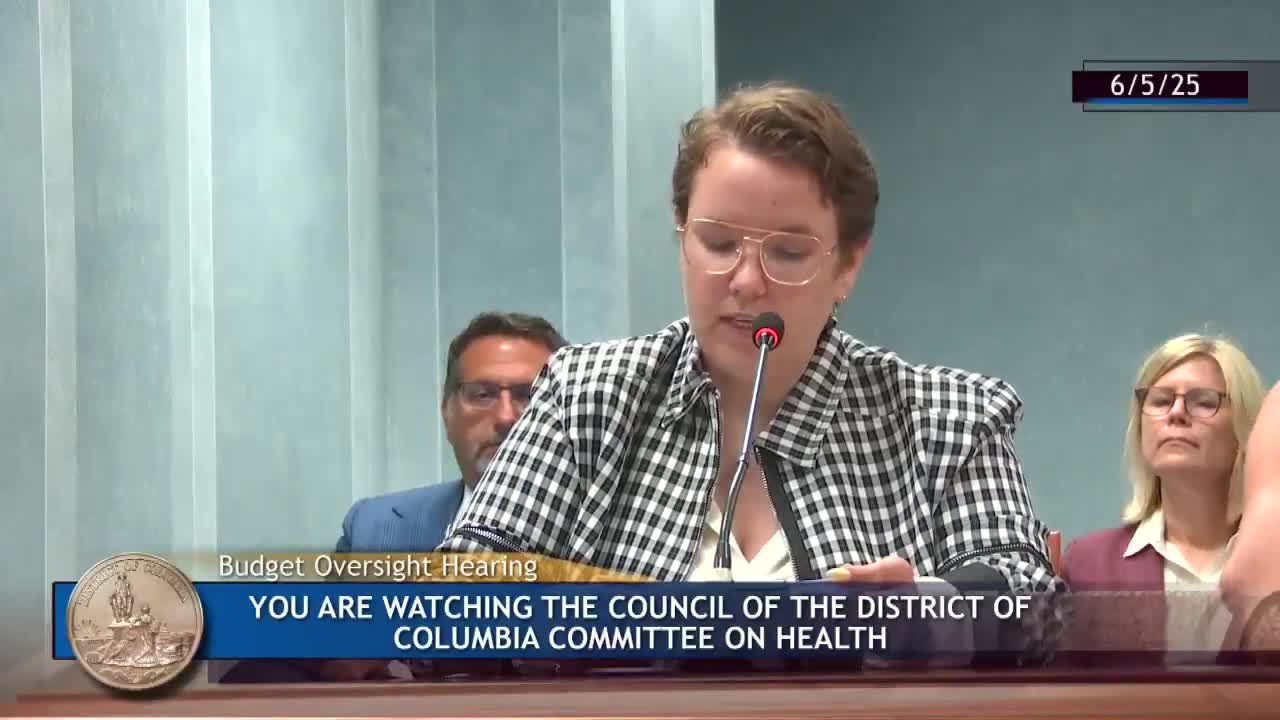
The Committee on Health heard broad warnings June 5 that proposed FY26 budget changes for Medicaid, the DC Health Care Alliance and a planned Basic Health Program (BHP) transition could disrupt coverage or reduce benefits for tens of thousands of District residents. Witnesses representing legal services, child and family advocates, hospitals and consumer groups urged the Council to slow or mitigate the proposed changes.
Legal and policy witnesses said the administration’s plan to move certain adults out of Medicaid and into a BHP, and to narrow Alliance eligibility, risks leaving people without equivalent benefits and creates a short timeline for a complex transition. "DHCF would have to make $182,000,000 in cuts to slow the growth of the Medicaid program," Leah Casales, senior policy attorney at the Children's Law Center, told the committee, citing agency projections.
Supporters of the current programs said objecting to the changes was not abstract. Claire Hiaasen, a senior policy analyst who chairs a DC Exchange advisory working group, warned that some people would face higher premiums and lose services such as non‑emergency medical transportation, adult dental and vision if moved off Medicaid. "A 40‑year‑old with an annual income of around $30,000 would go from free Medicaid coverage to owing between $145 and $168 per month for a silver benchmark plan in the marketplace," she said, citing national averages used in exchange modeling.
Legal aid and immigrant‑focused advocates also urged the council to reject reinstating more burdensome recertification rules for the Alliance or to require in‑person renewals. "When these same policies were implemented in 2011 it led to a precipitous drop in Alliance coverage," Andrew Patterson of Legal Aid DC said, noting the administrative barriers and long lines that previously caused eligible people to lose coverage.
Hospital and provider representatives told the committee they were preparing outreach and operational plans in case the changes proceed, but they warned of service disruptions. Jackie Bowens, president and CEO of the DC Hospital Association, said hospitals and the exchange were coordinating an outreach campaign for people who would move off Medicaid, and that members were standing by to assist, but she urged caution: "We can't afford to let anyone fall through the cracks."
Several witnesses asked the Council to attach explicit protections to any transition. Recommendations included: requiring the BHP to match Medicaid reimbursement rates for providers; preserving adult dental and vision benefits; ensuring continuous retroactive coverage; funding robust enrollment assistance; and staging the transition more slowly to avoid administrative churn. Ruth Pollard of the DC Primary Care Association urged that any BHP pay at Medicaid rates and include dental and vision benefits.
Council Chair Christina Henderson and members asked DHCF and the Health Benefit Exchange Authority to provide plans and benchmarks for the transition, emphasizing the need for seamless enrollment and for protections if the federal premium tax credit enhancements expire. Witnesses repeatedly called for contingency planning because federal policy uncertainty could make marketplace coverage less affordable.
The hearing record includes dozens of individual accounts from Alliance enrollees describing challenges with prior recertification rules and the consequences of coverage lapses. Advocates said the political and enforcement climate at the federal level — including immigration enforcement concerns — would likely deter some immigrants from attending in‑person recertifications if they were reinstated.
The committee recessed the hearing until government witnesses appear on Monday, June 9; members said they would continue oversight and ask detailed follow‑up questions about transition timelines and consumer protections.