Lifetime Citizen Portal Access — AI Briefings, Alerts & Unlimited Follows
Council hearing on Rental Act spotlights sharp split over TOPA reforms
Loading...
Summary
At a Committee on Housing public hearing May 28, council members, tenant advocates and developers debated changes to the Tenant Opportunity to Purchase Act (TOPA) proposed in multiple bills, with developers urging broad exemptions to restore investment and tenant advocates warning exemptions would erode tenant agency and risk displacement.
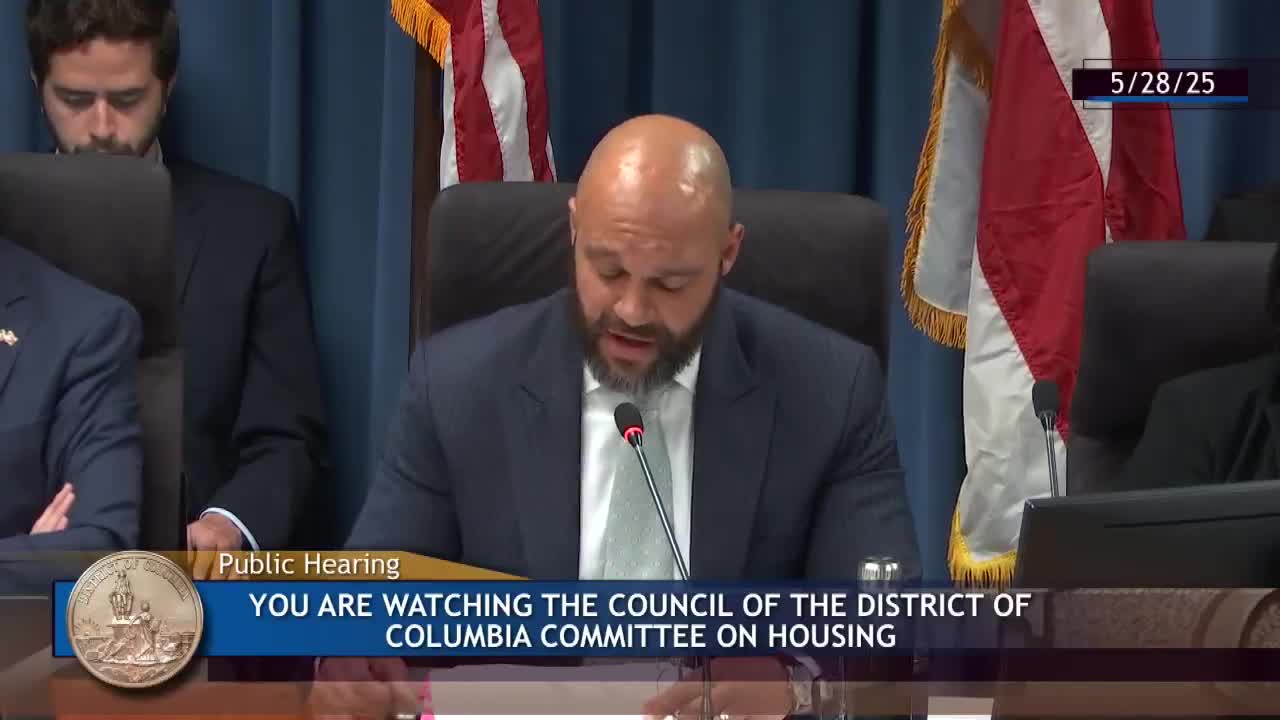
Washington — The D.C. Committee on Housing spent much of its May 28 public hearing parsing proposals to change the Tenant Opportunity to Purchase Act, or TOPA, as developers, nonprofit housing providers and tenant advocates clashed over exemptions and timelines in the Rental Act (B26‑164) and companion TOPA bills (including B26‑228 and Councilmember Nadeau’s Common Sense TOPA reform bill).
The debate opened with Committee Chair Robert White (Councilmember at‑large) saying the city faces “a housing crisis that’s pushing families to the brink” and that TOPA “is an amazing program” that nevertheless may not be working as originally intended (Chair Robert White, Committee on Housing). White listed the Rental Act and several related bills at the hearing’s start and set public testimony rules.
Why it matters: TOPA gives tenants a formal role when their buildings are sold. Proponents of the Rental Act and a separate TOPA-clearing bill told council that long, unpredictable TOPA timelines and legal uncertainty have driven capital away from D.C., reduced new housing production and stalled projects that could fund affordable housing preservation. Opponents said the proposals would strip tenants of bargaining power and could increase displacement, especially for low‑income households.
Developers and industry groups urged exemptions and longer carveouts. Liz DeBarros, CEO of the D.C. Building Industry Association, said Title 4 of the Rental Act “modernizes TOPA with three narrow, impactful exemptions” and urged extending a proposed new‑construction exemption to 25 years to align with investment cycles. Erica Watlington (DCBIA) said a three‑year exemption is “not sufficient” and asked for something closer to 25 years to allow investors to stabilize projects. Several private developers, including Robert Murphy (MRP Realty) and Jair Lynch (Jair Lynch Real Estate Partners), warned institutional capital is redirecting investments to neighboring jurisdictions.
By contrast, tenant and preservation advocates warned proposed exemptions would undercut TOPA’s core protections. Maya Brennan, chief housing officer at the Coalition (formerly CNHED), said the coalition supports some reforms but “do not support new subparagraphs R and S in title 4 of the Rental Act.” Vic Goncalves of Mi Casa/Mikasa and other mission providers pressed that TOPA remains essential to preventing displacement and enabling tenant purchases or assignments to community‑minded buyers.
Points of contention
- Length of any new‑construction exemption. Industry witnesses recommended 3–25 years; some developer witnesses said 25 years would align with investment timelines while preservation groups argued that 3–5 years could be adequate for stabilization and that 25 years is too long.
- Covenanted affordable properties. Some developer testimony supported exempting properties that already carry long‑term affordability covenants; tenant advocates and legal commenters warned that covenants alone do not guarantee resident protections and that exemptions would remove tenants’ agency.
- Process clarity, data and enforcement. Title companies and the D.C. Policy Center urged clearer statutory definitions (tenant, consideration, timelines) and restoring or clarifying an administrative certification process at DHCD so buyers, sellers and lenders are not exposed to unpredictable litigation risk.
Evidence and examples offered at the hearing
- The D.C. Policy Center said TOPA activity is concentrated in older, rent‑controlled buildings and estimated that the Rental Act as drafted would exempt a small share (about 6%) of properties currently subject to TOPA activity.
- Nonprofit developers such as Preservation of Affordable Housing and NHP Foundation said TOPA can work for preservation deals but that transactional delays and uncertainty can make preservation infeasible without additional public funding and clearer procedures.
- Brokers, title agents and market analysts described deals that took more than a year or 400 days because of TOPA timelines or uncertainty, often freezing capital until compliance issues were resolved.
What was asked of council
Witnesses on both sides asked the Committee on Housing to make drafting changes: tighten statutory definitions, shorten or clarify TOPA timelines, create enforceable penalties for bad actors and provide better data collection on TOPA outcomes. Several affordable housing providers urged additional public preservation funding alongside process reforms so tenant‑led or nonprofit acquisitions remain feasible.
Looking ahead
Committee Chair White said the hearing would inform a markup process. The hearing produced no formal votes. Members signaled they want more data on transaction timing and who would be affected by exemptions before adopting any final language.