Get Full Government Meeting Transcripts, Videos, & Alerts Forever!
Get email alerts on the Higher Education Free Speech topic
No spam. Unsubscribe anytime.
UMass counsel: IHRA definition can be used as guidance without trumping First Amendment protections
Summary
David A. Lowy, UMass general counsel and former Massachusetts Supreme Judicial Court justice, told the special commission that the IHRA working definition of antisemitism is nonbinding and can be used in trainings and policy guidance without automatically limiting lawful criticism of Israel or academic freedom.
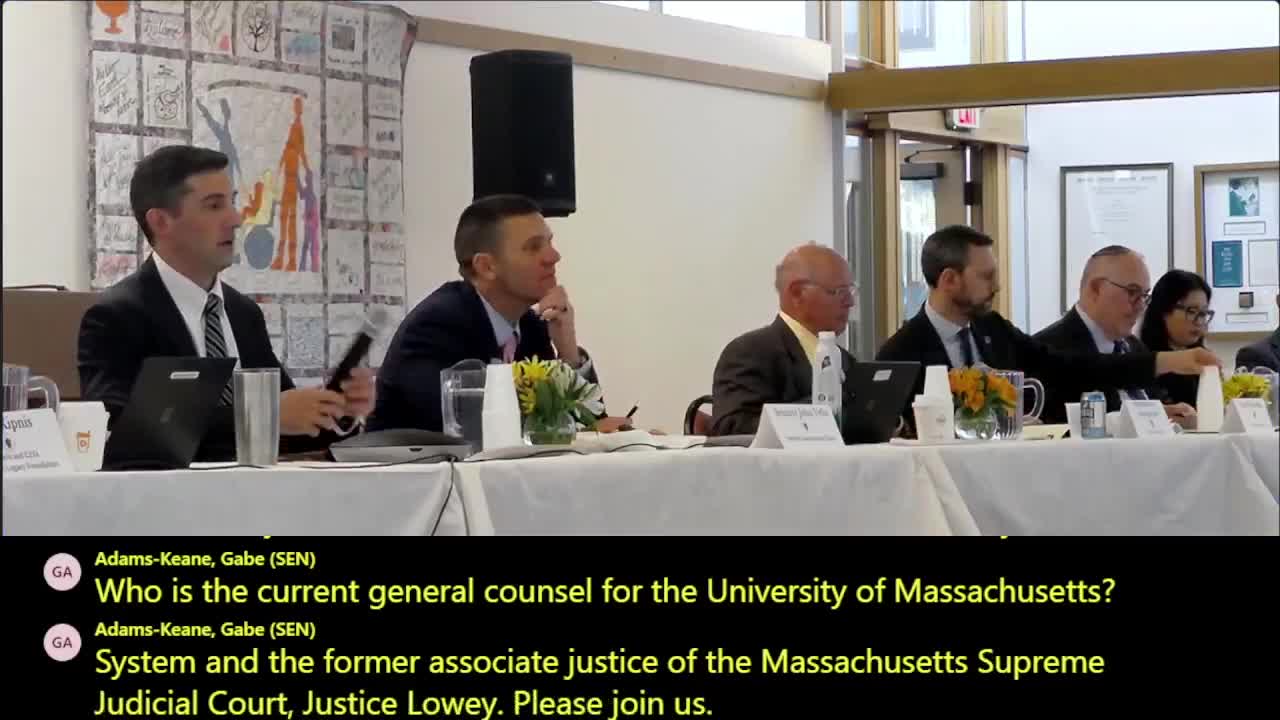
Justice David A. Lowy, general counsel for the University of Massachusetts system and a former associate justice of the Massachusetts Supreme Judicial Court, told the state's Special Commission on Antisemitism on Oct. 26 that the International Holocaust Remembrance Alliance (IHRA) "working definition" should be treated as nonbinding guidance and can be included in trainings and administrative guidance without violating free-speech protections.
Lowy said the IHRA definition itself explicitly states it is not legally binding and that its illustrative examples are often conflated with the definition. "Including that definition in the marketplace of ideas, it's hard to see how that... would bridge free speech or First Amendment concerns," he told commissioners, adding that the illustrations accompanying the IHRA text usually acknowledge that criticism of Israel may be legitimate in academic and public contexts.
The former justice said universities must strike a balance between protecting free expression and preventing harassment that undermines students' ability to participate in campus life. Lowy described several UMass initiatives he said the system uses to address campus climate: Office of Equity and Inclusion trainings, faith engagement strategies, campus climate programs and community dialogue initiatives. He said UMass intervened recently in an academic conference that sought institutional boycott policies, and the university pressed the organization to suspend those policies because they conflicted with UMass nondiscrimination rules.
Commissioners questioned whether the IHRA definition, when used in K'12 training or agency policy, risks chilling speech. Lowy replied that vigorous debate over the definition is healthy and that use of the definition for training and guidance does not, in and of itself, silence lawful speech. He recommended that institutions rely on the text's four corners and be careful not to equate illustrative examples with per se prohibitions.
Lowy urged college leaders to use time, place and manner rules carefully to protect both protest and students' access to education. He recommended that university and school leaders reinforce rules ensuring protests do not block others' ability to learn or participate.
Commission discussion referenced recent incidents at Massachusetts campuses and asked Lowy for best practices; he urged continued trainings, robust campus climate programs and clear guidance for academic settings. Lowy also agreed to provide supplemental materials the commission requested.
Ending: Lowy told commissioners he is available to provide written follow-up materials and emphasized the need for continued institutional attention to both free-speech protections and protections against harassment.