Lifetime Citizen Portal Access — AI Briefings, Alerts & Unlimited Follows
Leaders open Financing for Development conference in Seville; Spain offers 'House of the United Nations' in Madrid
Loading...
Summary
Spanish Prime Minister Pedro Sánchez opened the Financing for Development conference in Seville and announced a planned “House of the United Nations” in Madrid and a national Seville plan to strengthen multilateral institutions.
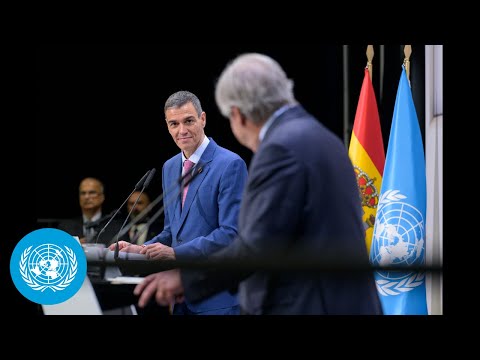
Spanish Prime Minister Pedro Sánchez opened the Financing for Development conference in Seville on the first day of the summit and announced that Spain will host a new “House of the United Nations” in Madrid and present a Seville plan to strengthen the multilateral system.
“1 of them is basically, the opening in Madrid, Spain, of the, house of the United Nations,” Sánchez said, describing the planned site as “a new headquarters situated in the capital of Spain, which will be home to various teams from UN agencies.” He said details of the Seville plan would be released on Tuesday.
United Nations Secretary‑General António Guterres, attending the press conference, framed the summit as a moment to rebuild international cooperation and urged concrete finance reforms. “As we meet, the world is falling behind in its commitments to advance the sustainable development goals,” Guterres said, adding that achieving the goals “will take an investment of more than 4,000,000,000,000 US dollars a year.” He also warned that developing countries are burdened by rising debt service, which he said has reached about 1,400,000,000,000 annually.
Guterres and Sánchez described two broad approaches discussed at Seville to increase financing for development: mobilizing more domestic and private finance and using existing public funds to leverage greater borrowing capacity. Guterres said conference participants approved measures “to triple the lending capacity of multilateral development banks,” and he urged wider use of special drawing rights through the International Monetary Fund and other mechanisms to multiply available resources.
Both leaders emphasized turning summit commitments into action. Sánchez said the conference’s outcome document — described at the press event as the civil commitment — was adopted by consensus in preparatory meetings and that a Civil Platform for Action would be launched to translate agreements into specific instruments. Sánchez said the platform and Spain’s Seville plan would help ensure commitments “are not just a piece of paper, but actually… specific instruments.”
On implementation and accountability, a journalist asked how the conference would ensure commitments reach citizens in the global South rather than remain rhetorical. Guterres acknowledged deep divisions and systemic resistance but said there is “a solid will of the bulk of the international community to change the system” and pointed to immediate proposals from the conference, including a borrowers forum and dozens of practical initiatives within the platform being launched.
Participants and organizers highlighted the scale of the summit: Sánchez said the event brings together representatives of 70 international organizations and 170 countries and will include about 400 events and more than 200 official delegations.
On specific national commitments, Sánchez said Spain plans to increase contributions to vaccination and disease‑prevention efforts, describing an increase “by more than 130,000,000,000” toward vaccines and prevention announced after a recent NATO meeting; the currency for that figure was not specified during the press conference. He also reiterated Spain’s broader pledge to defend and strengthen multilateralism.
Guterres used part of his remarks to call for immediate political solutions in several conflicts, saying the conference must not ignore parallel humanitarian crises. He called for “an immediate ceasefire in Gaza, the immediate release of all hostages, and any impeded humanitarian access” as steps toward a two‑state solution; he also urged a just and lasting peace in Ukraine, and an end to the violence in Sudan.
Leaders said the Civil Platform for Action being announced at Seville contains “dozens of new practical initiatives” and includes an immediate proposal to establish a borrowers forum for countries negotiating debt management and restructuring. Sánchez said more than 100 project ideas will take concrete steps worldwide under the platform.
The conference opening in Seville follows the previous Financing for Development meeting in Ethiopia in 2015, when the 2030 Agenda for Sustainable Development was adopted. Sánchez and Guterres repeatedly cast the Seville summit as an effort to renew commitments made under the 2030 Agenda and to shore up the United Nations’ role in a period they described as marked by geopolitical mistrust.
Organizers said further details of Spain’s Seville plan and the Civil Platform for Action would be released in subsequent sessions during the conference.