Get Full Government Meeting Transcripts, Videos, & Alerts Forever!
Get email alerts on the Treatment And Toxicology topic
No spam. Unsubscribe anytime.
Hospitals and public labs warn of xylazine and testing gaps as advocates press for more MAT access
Summary
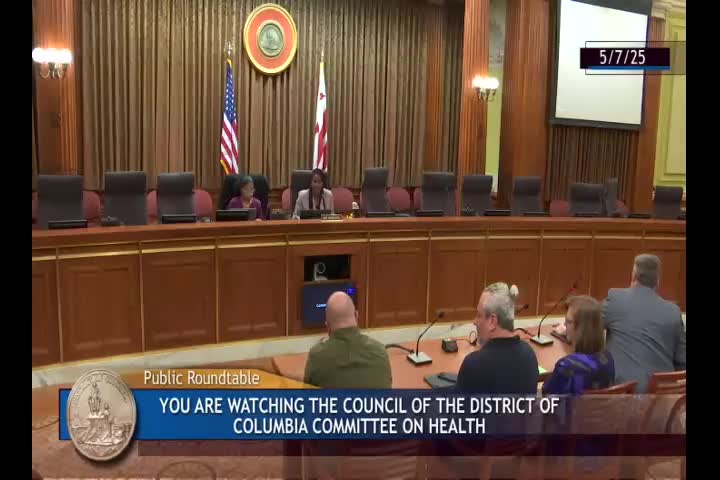
Clinicians, forensic staff and reentry advocates at the Committee on Health roundtable described increasing detections of xylazine and other nonopioid adulterants, limits of bedside testing, and barriers to medication for addiction treatment for older patients on Medicare.
Clinicians, forensic laboratory staff and reentry advocates told the Committee on Health that the District’s illicit drug supply is changing and that hospitals and labs need more resources to test, treat and follow people who survive overdoses.
Thaddeus Winston, overdose survivor outreach coordinator at MedStar Georgetown University Hospital, told the committee that clinicians have seen a surge in a presentation in which patients are unresponsive despite naloxone. He said this pattern is consistent with the spread of alpha‑2 agonist adulterants such as xylazine and related compounds. "I'm ringing the alarm: in the past two months we've seen 40 of these identical presentations," Winston said, and he recommended expanded toxicology testing and consideration of different treatment approaches in the emergency setting.
Hospital and emergency medicine witnesses said little bedside testing can detect some alpha‑2 agonists because they metabolize quickly. "Xylazine is nearly impossible to detect at bedside," Winston said; he urged funding for rapid testing and for OCME and public labs to build analytic capacity.
The Office of the Chief Medical Examiner and Department of Forensic Science testified that settlement and OAC funding has supported expanded toxicology capacity. OCME staff said enhanced reference libraries and laboratory upgrades are essential because novel synthetic additives regularly emerge and forensic testing must update instrument libraries to identify them. OCME witnesses said the laboratory aims to finalize most postmortem toxicology reports within 60 days, but complex cases and new substances can lengthen that timeframe.
On treatment access, providers said older patients present distinct challenges. Dr. Edwin Chapman and health‑system witnesses described higher MAT dosing needs among patients exposed to potent illicit fentanyl mixes and noted that insurance rules — especially Medicare Part D prior authorization practices — can limit access to higher buprenorphine doses for older or dual‑eligible patients.
Joshua Lynch, chief medical officer of the MATTERS program, described an electronic referral and telemedicine model that provides same‑day buprenorphine prescriptions, real‑time appointment slots and follow‑up to reduce gaps after an ED visit or jail release. "Real time electronic referrals to high quality treatment providers that provide appointment slots that are accessible 24/7," Lynch said, summarizing key components the program offers to prevent people from falling through the cracks.
Why this matters: providers and lab staff told the committee that faster and broader testing for adulterants, along with funding to expand MAT capacity and to negotiate reimbursement rules for older patients, are immediate priorities to reduce fatal and nonfatal overdoses.
Ending: Witnesses recommended targeted OCME and public‑lab funding, rapid distribution of xylazine test strips and piloting hospital‑based same‑day telemedicine MAT models. Committee members asked agencies to return with concrete plans and budgets to scale toxicology and MAT access.