Get AI Briefings, Transcripts & Alerts on Local & National Government Meetings — Forever.
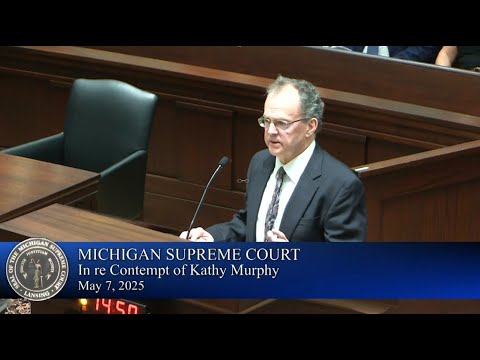
Michigan Supreme Court hears arguments in Kathy Murphy contempt appeal over record, double jeopardy
Loading...
Summary
At oral argument, advocates disagreed whether a judge’s failure to place factual findings on the record in a summary contempt proceeding requires acquittal under double jeopardy or instead permits remand for non‑summary proceedings before a different judge.
At an oral argument before the Michigan Supreme Court, lawyers for attorney Kathy Murphy and for the 30th District Court disputed whether double jeopardy bars retrying Murphy after a judge found her in summary contempt without placing factual findings on the record.
Tim Holloway, representing Kathy Murphy, told the justices the circuit court and Court of Appeals correctly concluded the district court record is insufficient to support the contempt finding and that the failure to place the factual basis on the record requires relief. Holloway argued summary contempt can lead to the same severe burdens as other criminal convictions — including immediate jail — and said courts must require a record showing to permit appellate review. He cited Fisher v. Pace and other authorities, and argued that because no party beyond Murphy cross‑appealed the appellate outcome, the insufficiency finding should stand and preclude further prosecution.
Counsel for the 30th District Court, Chris Trebelcock, countered that summary contempt differs from ordinary criminal proceedings and that the Legislature and court rules recognize that difference. Trebelcock argued the remedy is remand for a non‑summary contempt proceeding — typically before a different judge — where the parties can present evidence and an impartial factfinder can weigh it. He said the circuit court’s ruling reflected a procedural deficiency rather than a substantive acquittal and that double jeopardy would not attach. He also noted concerns about leaving judges without an immediate tool to maintain courtroom order if summary contempt were treated the same as other criminal convictions.
Throughout the argument several justices pressed both sides on practical and constitutional consequences. One justice observed that in a summary contempt the judge functioned as prosecutor, witness and factfinder, which complicates appellate review if no transcript or findings exist. Another justice asked whether remanding for a non‑summary proceeding is “futile” when the appellate court already found the record insufficient; Holloway said futility could support relief for Murphy, while Trebelcock said remand permits a different judge to develop an adequate record.
The attorneys debated how double jeopardy tests from Jackson v. Virginia, Blockburger and related cases apply in summary contempt contexts; the advocates disagreed about whether cases such as Dixon and Burks control here and whether an acquittal occurred when an appellate court finds the district court made no sufficient factual findings. Trebelcock referenced People v. Smith and other state decisions to argue the Legislature intended courts to retain internal contempt authority.
The record shows the contempt at issue derived from courtroom conduct during a criminal preliminary examination and that Murphy received two days in jail as part of the summary contempt disposition. Both sides acknowledged the limited record available to appellate review — the district court’s verbatim transcript either did not capture the judge’s factual basis or the judge failed to place that basis in a written order — and the justices questioned whether that absence requires a judgment of acquittal, a remand for a new non‑summary proceeding, or another remedy tied to supervisory authority.
The court submitted the case after argument; no decision was announced at oral argument.