Get AI Briefings, Transcripts & Alerts on Local & National Government Meetings — Forever.
Senate advances omnibus transportation bill after votes on memorial namings, funding shifts and policy changes
Loading...
Summary
The Minnesota Senate advanced House File 2438, the Omnibus Transportation Finance and Policy Bill, on May 1 after hours of debate and roll‑call votes on memorial namings, funding shifts and several policy provisions, including proposals affecting rail funding, the highway user tax distribution fund and traffic‑safety enforcement.
The Minnesota Senate on May 1 advanced House File 2438, the Omnibus Transportation Finance and Policy Bill, after hours of debate and votes on multiple amendments including bridge namings, funding adjustments and several policy changes.
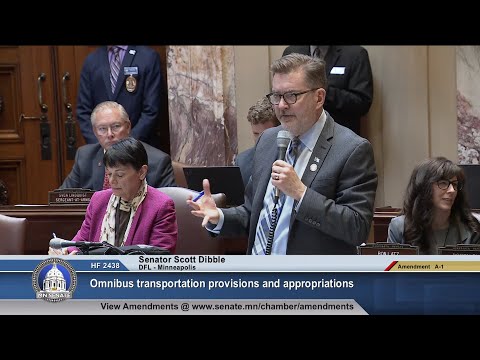
Senator Scott Dibble, chair of the Senate Transportation Committee, opened the debate by describing the measure as “the Omnibus Transportation Finance and Policy Bill,” and summarized the committee’s approach to meet legislatively assigned budget targets while preserving local road funding and advancing a mix of capital and policy items. The bill’s fiscal strategy included pausing some previously planned transfers and using new electric‑vehicle registration surcharges to backfill highway funds.
The bill’s provisions discussed on the floor included: pause of the multi‑year migration of the auto‑parts sales tax for one cycle to meet spending targets; cancellation or reduction of capital appropriations for some rail corridor projects including unspent Northern Lights Express (NLX) and portions of light‑rail extension funding; an increase to the EV registration surcharge; new trunk‑highway bond authority and debt service appropriations; modest operating increases for MnDOT operations and state patrol aviation; reimbursement for deputy registrars; and technical and regulatory changes at Driver and Vehicle Services.
Debate repeatedly returned to the bill’s approach to the Highway User Tax Distribution Fund (HUTDF) and the definition of “highway purposes.” Senator Jasinski warned that broadening that definition could “dilute those funds that can be used for highway purposes,” saying, “we are about $1,000,000,000 a year short on maintaining our roads and our bridges.” Supporters, including Senator Dibble, said the changes allow a more holistic approach to mobility and give MnDOT and local partners flexibility to plan corridors that serve multiple users.
Lawmakers voted on dozens of amendments during the session. A number of memorial namings passed unanimously or with strong bipartisan voice votes. Senator Patricia Mohammed’s amendment to name a Minneapolis project the “Majority Leader Carrie Dietzic Memorial Bridge” was introduced on the floor by Mohammed and supported across both parties; the amendment was adopted. Senator Port’s amendment to rename the Burnsville Parkway bridge as the “Elmstra, Finseth and Ruggie Heroes Memorial Bridge,” honoring first responders killed in the line of duty, passed by roll call with a recorded tally of 65 ayes and 0 nays.
The bill also carried contested amendments on transit and rail. Senator Croon offered an amendment to cancel remaining light‑rail extension and NLX funds and redirect them to local road accounts; proponents described that change as prioritizing road maintenance after large rail projects significantly increased in cost, while opponents said halting rail funding would undermine regional mobility and long‑term planning. That Croon amendment was debated and defeated on the floor.
Lawmakers also debated traffic‑safety policy changes. The bill contained language that would restrict when officers could issue jaywalking citations; Senator Howe offered an amendment to preserve police discretion to cite unsafe pedestrian crossings, which the Senate rejected on a roll call. Senator Housley’s amendment to increase penalties for repeat school‑bus stop‑arm violations (second offense to $700, third to $950) passed after debate; supporters said larger penalties would deter repeat offenders and protect children, while opponents argued better education and cameras are more effective than increasing fines.
Several finance amendments were also offered to alter the bill’s handling of the auto‑parts sales tax migration and other transfers into the HUTDF. Senator Jasinski proposed reducing the size of the pause on the auto‑parts sales tax migration; Senator Dibble and others opposed the change, saying it would make balancing targets harder. A related amendment to forbid using highway funds for some nonhighway projects (the so‑called “leakage” amendment) failed on a close roll call.
Senator Dibble and other proponents stressed the bill balanced trunk highway investments, local assistance, traffic‑safety programs, and targeted policy changes. Opponents repeatedly cautioned that expanding the scope of “highway purposes” without clear fiscal offsets could reduce funding available for pavement and bridge maintenance.
The Senate completed second and third reading action on HF 2438 on May 1; many amendments were disposed of on the floor and the bill will move to conference with the House for negotiation on remaining differences.
Votes at a glance (selected actions recorded on the floor) - A22 (Mohammed) — designation of Carrie Dietzic Memorial Bridge: adopted (roll call; amendment adopted on floor). Senator Mohammed offered the amendment; it received bipartisan support on the floor and the amendment was adopted. - A27 (Port) — rename Burnsville Parkway bridge to Elmstra/Finseth/Ruggie Heroes Memorial Bridge: adopted (roll call; recorded tally 65 ayes, 0 nays). Sponsor: Senator Port; outcome: adopted. - A11 (Croon) — cancel unspent Blue Line extension and remaining NLX funding and redirect to local roads (remove $185,655,000 from rail, redirect to city/county road accounts): rejected on the floor after roll call. Sponsor: Senator Croon; outcome: not adopted. - A9 (Jasinski) — restrict HUTDF uses / prohibit certain arts/cultural uses and close “leakage”: rejected on roll call (recorded: 31 ayes, 33 nays). Sponsor: Senator Jasinski; outcome: not adopted. - A1 (Howe) — restore officer discretion on jaywalking enforcement (remove proposed limitation): not adopted (roll call; 27 ayes, 38 nays). Sponsor: Senator Howe; outcome: not adopted. - A2 (Housley) — increase repeat school bus stop‑arm fines ($700 second, $950 third): adopted (roll call). Sponsor: Senator Housley; outcome: adopted.
What happens next HF 2438 passed third reading on the Senate floor with multiple adopted and rejected amendments; unresolved differences between the House and Senate versions will be handled in a conference committee. The bill contains a mix of finance fixes, targeted new spending, and policy language that lawmakers from both parties said they intend to refine during conference.