Get Full Government Meeting Transcripts, Videos, & Alerts Forever!
Get email alerts on the Violence Intervention Programs Merger topic
No spam. Unsubscribe anytime.
D.C. roundtable advances merger plan for two violence‑intervention programs, witnesses press for worker pay, training and data
Summary
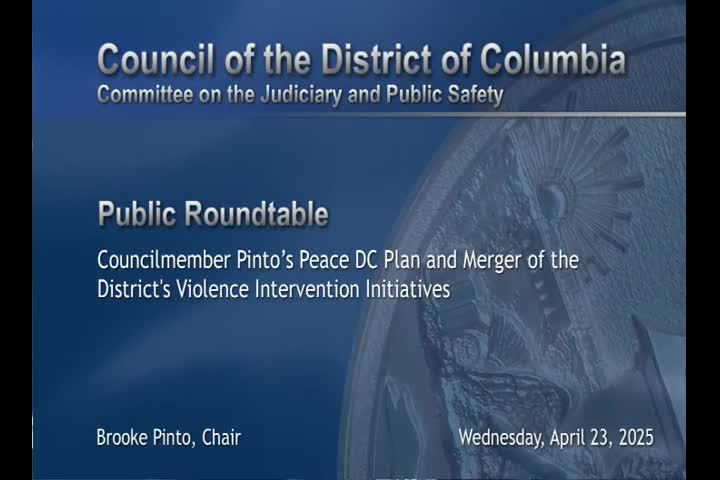
Councilmember Brooke Pinto opened a public roundtable April 23 to discuss merging the Office of Neighborhood Safety and Engagement’s violence‑intervention work with the Office of the Attorney General’s Cure the Streets program.
Councilmember Brooke Pinto, chairwoman of the Committee on Judiciary and Public Safety, opened a public roundtable April 23 to discuss a proposed merger of the District’s two main community violence intervention (CVI) programs: the Office of Neighborhood Safety and Engagement (ONES) and the Office of the Attorney General’s Cure the Streets program.
"I believe in violence interruption as a model and as a critical part of our public safety ecosystem," Pinto said, framing the merger as a way to coordinate services, speed referrals and reduce duplication.
The discussion brought together community‑based organization leaders, frontline workers, researchers and residents. Most public witnesses told the committee they support consolidating street outreach programs under a single agency but urged the council to spell out implementation details before transferring operations, including who will sit on the transition advisory team, how frontline workers will be paid and trained, and how the city will protect ongoing services during the change.
Why it matters: Witnesses warned that a rushed or poorly resourced merger could disrupt services to high‑risk residents and undermine public trust. They also flagged an immediate federal development: Pinto and several witnesses said a recent Department of Justice change affecting violence‑intervention grant guidance has created uncertainty for local programs and heightened the stakes for a clear, locally funded plan.
Support for merger, plus caveats
Researchers who have evaluated CVI locally backed a single coordinating agency. Dr. Joseph Richardson, professor at the University of Maryland and co‑director of the UMD Progress Initiative, testified: "Our merger of the 2 main CVI programs in the city could lead to a stronger and more coordinated system of support for those experiencing violence." Dr. Daniel Webster of Johns Hopkins urged the city to concentrate resources where shootings are most concentrated and to build a systematic shooting‑review process to inform strategy and evaluation.
Community groups and frontline representatives echoed that, but pressed for concrete protections. Kirby Garrity, senior fellow for community safety at the Greater Washington Community Foundation, recommended preserving Cure the Streets’ data and funding processes in any new structure and said capacity supports for ONES will be essential to scale the work without losing effective practices.
Frontline inclusion, compensation and training
Several witnesses asked that the transition advisory team include frontline violence interrupters as well as CBO leaders. Reverend Rob Keithan of the Washington Interfaith Network said planners must "include people who do this work, not just management," adding that small amounts of emergency aid often make a major difference for clients and should be standardized through the new program.
Multiple witnesses pressed for better pay and benefits. Dr. Richardson recommended livable wages, health and dental insurance, mental‑health supports, timely reimbursements and career advancement pathways for violence interrupters, noting the physical danger and emotional toll of front‑line work.
Training was another recurring demand. Peace for DC operates the DC Peace Academy, a privately funded 14‑week, roughly 120‑hour curriculum that several witnesses described as a model for citywide certification. Panelists estimated the current academy model costs about $10,000 per student, and urged the council to consider how a city‑funded academy could be scaled and sustained.
Model, metrics and service scope
Witnesses debated how strictly the city should adopt an off‑the‑shelf CVI model such as Cure Violence/Cure the Streets versus adapting practices to D.C.’s local context. Dr. Webster said the Cure model has shown effects in some places but that the city needs a data‑driven, focused deployment: "To really move the dial you have to be intensive enough," he said.
Panelists also urged clarity on age limits and prevention work. Dr. Richardson noted that some frontline workers already engage young people under 18 despite formal restrictions and recommended expanding prevention work directed at younger, high‑risk populations. He and others pointed to school absenteeism and early‑age disengagement as upstream problems that increase risk of later violence.
Operational cautions and capacity
Several witnesses warned that a merger could harm services if ONES lacks infrastructure to absorb Cure the Streets’ practices and data systems. Del McFadden of the National Association for the Advancement of Returning Citizens, which operates Cure‑aligned work locally, urged the committee to preserve OAG’s site‑visit, data and accountability practices and to ensure ONES has comparable technical capacity.
Concerns about a ward‑based award approach surfaced repeatedly. Some witnesses worried a purely ward‑based allocation could leave hot‑spot neighborhoods or cross‑ward conflicts underserved; others argued for a hybrid model that allows rapid, targeted deployments during spikes in violence while maintaining neighborhood‑based credibility.
No formal votes
The roundtable was a fact‑finding and community‑input session; panelists and the committee discussed options but took no formal vote. Pinto said the committee will hold future hearings with government witnesses and keep the public record open for written submissions through May 7.
What’s next
Committee members said they will draft implementation language and continue consultations with researchers, CBOs and frontline workers. Witnesses recommended: publishing the proposed advisory‑team roster in advance; specifying staffing, compensation and training standards; ensuring data continuity; and building a shooting‑review and prevention governance structure that includes independent researchers and community partners.
Pinto closed by committing to continued engagement: the committee will hold additional sessions with government witnesses and iterate on the Peace DC plan and merger outline before moving forward on budget and legislative steps.
Ending: The committee did not adopt a final policy at the roundtable but recorded broad consensus on the merger’s strategic goal: unify the city’s CVI work while preserving effective practices, protecting frontline staff and ensuring continuity of services for at‑risk residents.