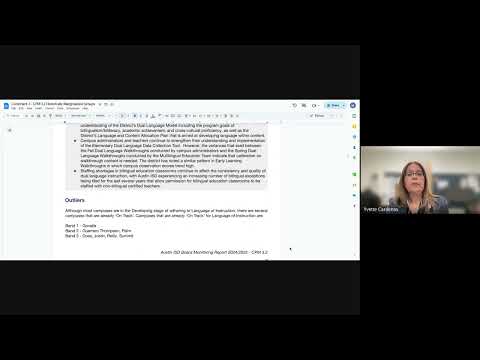
Austin ISD baseline: 83% of elementary dual-language programs at ‘developing’ level on language-of-instruction measure
Summary
Austin ISD presented baseline 2024–25 findings for Constraint Progress Measure 3.2 showing 49 elementary dual-language programs (83.1%) scored at a “developing” level for language of instruction; district plans include increased professional learning, a bilingual academy, and tracking staffing and certification to reduce bilingual exceptions.
Marian Maxwell, assistant superintendent of elementary academics for Austin Independent School District, and Yvette Cabanas, director of elementary multilingual education, presented baseline 2024–25 findings on Constraint Progress Measure 3.2, which tracks language-of-instruction implementation in elementary dual-language programs.
"This school year is a baseline year, so we are collecting data in the 2024-25 school year to set as a baseline to use for future setting yearly targets through the 2028-29 school year," Maxwell said, introducing the district scorecard constraint that seeks to prevent academic disparities for historically marginalized student groups.
The district reported that, after averaging fall 2024 and spring 2025 walkthrough scores, 3 dual-language programs (5.0%) scored at the Emerging level, 49 programs (83.1%) scored at the Developing level and 7 programs (11.9%) scored On Track on the language-of-instruction element of the locally developed dual-language data collection tool, Cabanas said.
The measure isolates a single element of the district’s dual-language walkthrough rubric: language of instruction. The district’s walkthroughs were conducted by campus administrators in the fall and by Multilingual Education Team (MET) specialists in the spring; the presentation noted a consistent pattern in which campus administrators’ fall scores trended higher than MET spring scores, indicating a need for calibration.
Cabanas described three specific indicators within the language-of-instruction element: (1) the teacher maintains language of instruction according to schedule, (2) the teacher uses a visual marker to identify the language of instruction, and (3) each language is represented in print and marked by a respective color. The seven programs classified as On Track had more than 50% of teachers demonstrating all three indicators.
The presentation highlighted examples from campuses scored On Track: classrooms using clothespins or colored beads as language markers, student work displayed in both languages, journals used for writing in both languages, choral responses to maintain language flows, and instruction conducted in Mandarin without translation at some campuses.
The district identified root causes including the need to deepen campus administrators’ and teachers’ understanding of the district’s dual-language model and language- and content-allocation plan, inconsistent implementation of the dual-language walkthrough tool, and staffing shortages. Presenters said Austin ISD has seen an increasing number of bilingual exceptions filed in recent years that permit hiring non–bilingual-certified teachers in bilingual classrooms.
To address these issues, Maxwell and Cabanas described actions the district will pursue: more frequent, calibrated professional learning for principals and assistant principals on the walkthrough tool; cross-training MET and content teams on content‑based language instruction; a four‑day Bilingual Academy to support teachers seeking bilingual certification; tracking inventory and sustainability of bilingual materials; and monitoring whether staffing efforts reduce bilingual exceptions and raise bilingual certification rates.
The presenters cited prior partial implementation of the walkthrough tool in 2023 and referenced research underscoring fidelity to language-of-instruction schedules as important to dual-language program quality. They said the district’s early learning initiative is linked to this constraint measure and that the 2024–25 data will serve as the baseline for future targets.
No formal board action or vote was recorded in the presentation; the presenters concluded by noting the report would be discussed at the board meeting on the evening of May 8.
As presented, the data and next steps are district-directed plans and professional-learning commitments rather than adopted policy changes or budget approvals.
AI generated
The text on this page is AI generated. Summaries, highlights, analysis, and video transcripts are all produced from the original source material.
AI can make mistakes, so if you spot one, and we will fix it for everyone.
Note: the source content is unaltered by us. Any content source we link to, be it a video, an audio recording, or a document, is presented exactly as its publisher released it. That publisher is usually a government body, sometimes an individual official or another organisation.