Get AI Briefings, Transcripts & Alerts on Local & National Government Meetings — Forever.
Franklin College PUD concept for 250-acre Innovation Park wins Planning Commission approval
Loading...
Summary
The City of Franklin Planning Commission approved a concept plan for a 250-acre planned unit development (PUD) proposed by Franklin College. The approval advances the project to a detailed-plan stage, where specific lot sizes, architecture and infrastructure will be decided and subject to further public review.
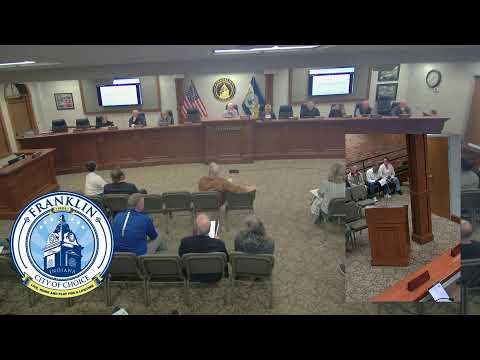
The City of Franklin Planning Commission on Oct. 21 approved a concept plan for a 250-acre planned unit development called Innovation Park, a mixed-use project proposed by Franklin College and development partner Patch Development.
The commission voted to approve case PC-25-27 by roll call; the recorded vote was unanimous among members present (Michelle Stringer, Norm Gabor, Mike Spongberg, Irene Nalley, John Kemski and Bill Carson). The approval is for the concept plan only; the petitioner must file a detailed PUD plan within one year for further review and public hearings.
The concept plan lays out detached single-family lots, attached housing, multifamily, office/innovation space and areas reserved for potential college uses. Tim Oakes, an attorney with Ice Miller representing Franklin College, said the college returned to the commission after an earlier concept approval expired. "This project had been before plan commission last year...that detailed plan had not been submitted within that year time. Therefore, the original approval has expired," Oakes said. He described the current submission as a revised concept with a new development partner and without the previously anticipated Eli Lilly Foundation grant funding.
Joanna (city staff) summarized the process and the limits of a concept-plan review, noting why details would be addressed later. "According to our zoning ordinance, any approval of a concept plan is valid for 1 year, in order for them to submit for a detailed plan," she said. Joanna and other staff explained that the detailed plan stage is when lot sizes, setbacks, landscaping, parking and architectural standards will be specified and publicly reviewed.
Neighbors who spoke at the public hearing expressed support for Franklin College but raised concerns about lot sizes, home quality, buffering, traffic and drainage. Lehi Karlstrand, speaking for area homeowners, said they "support Franklin College" but sought "commitments that this project is not gonna greatly adversely impact our neighborhood." Andy Kinsey, another nearby resident, urged the commission and developer to "trust but verify," asking for a larger buffer and clarity about where traffic would flow during and after construction.
Oakes and Carrie Prather, president of Franklin College, said the college and its partner intend to follow the city's process and that many neighborhood questions will be answered at the detailed-plan stage. Prather described the kinds of businesses the college hopes to attract: "The industries that are being pursued are ones that lend themselves to collaboration with what we're doing academically...the initial commitments that we have are exclusively life sciences and other high-tech businesses," she said.
Key development standards noted at the concept stage include a 25-foot baseline perimeter buffer (adjusted to a 50-foot setback where lots back up to existing homes), a minimum lot size for lots within 100 feet of the northern boundary of about 12,500 square feet, and minimum living areas of about 1,600 square feet for ranches and 1,800 square feet for two-story homes. Staff said architectural and anti-monotony standards, traffic studies and drainage plans will be developed and reviewed during the detailed plan, primary plat and site development plan reviews.
The commission and staff emphasized process limits: concept-plan approval does not guarantee later approvals. Joanna noted that the detailed plan will return to the commission for recommendation and then to City Council for rezoning and public hearing. Staff said traffic studies and site-by-site drainage reviews will be required at later stages; staff added that modern city drainage standards generally require post-development runoff to be no greater than pre-development conditions.
With the concept approval, the petitioner and staff expect to prepare the detailed PUD submittal within the one-year period required by ordinance; staff estimated the submittal and internal review could come back to the commission in early 2026 depending on the applicant's schedule. Documents related to the case will be posted to the city's public portal when the detailed submittal is filed.
The commission's action advances the Innovation Park concept to the next, more detailed review steps where many of the community's concerns about home styles, buffering, traffic routing and stormwater management will be examined and subject to further public hearings.