Get Full Government Meeting Transcripts, Videos, & Alerts Forever!
Get email alerts on the Double Jeopardy topic
No spam. Unsubscribe anytime.
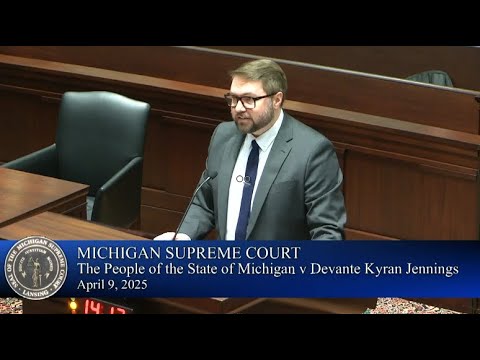
Michigan high court hears argument over retrial after prosecutor's misconduct in People v. Jennings
Summary
The Michigan Supreme Court heard oral argument in People v. Jennings on whether the state should bar retrial after a mistrial caused by prosecutorial misconduct, with the defense asking the court to adopt a Poole-style test and vacate Jennings' conviction and the prosecutor urging retention of the federal Kennedy standard.
The Michigan Supreme Court heard oral argument in People v. Jennings over whether a defendant may be retried after a mistrial that defense counsel says was intentionally caused by prosecutorial misconduct. Jason Iger, attorney for Michael Jennings, told the court, “We're asking this court to reject the Kennedy standard, to adopt the Poole standard and to vacate Mr. Jennings' conviction and sentence.”
The issue arises from a trial in which the prosecutor used Jennings' silence during cross-examination and closing argument, conduct the defense says is a clear and intentional violation of the right to remain silent that prompted the trial judge to declare a mistrial. The defense contends that retrial should be barred when a mistrial results from prosecutorial or judicial overreaching.
In its briefs and at oral argument, the defense characterized the Poole standard as better aligned with the protections of the double jeopardy clause as understood when Michigan's 1963 constitution was adopted and as offering a workable, objective rubric to distinguish mere error from intentional misconduct. Iger told the justices the Poole test identifies intentional, known-to-be-improper conduct pursued for an improper purpose and therefore would deter serious prosecutorial misconduct and relieve defendants of the burdens of repeated prosecutions.
Jonathan Mysick, counsel for the People, conceded that the prosecutor's comments in the Jennings trial were error and that the prosecutor “certainly should have known better,” but urged the court to follow the federal Kennedy standard. Mysick said Kennedy's focus on whether the prosecutor intended to goad the defendant into moving for mistrial strikes a workable balance between protecting the defendant's double jeopardy rights and preserving the State's interest in a trial.
Both sides cited out-of-state authorities and prior state decisions. Counsel referenced Kennedy (U.S. Supreme Court), Poole (Arizona), decisions the parties called Dennets and Anderson, and a recent New Mexico decision, State v. LaGrave, as examples courts have used to frame the test that should be applied. The parties also debated how to define and prove a prosecutor's specific intent and whether a judge sitting through a trial is well placed to draw reasonable inferences about intent from the record.
Several justices pressed both sides on how a standard would be applied in practice: how to draw a line between "mere" error and misconduct serious enough to bar retrial; whether a standard focused on intent is sufficiently concrete for judges to apply; and whether returning to pre-Kennedy case law or adopting a Poole-like test would create disparities between defendants who moved for mistrial and those who preserved the issue on appeal. Counsel for Jennings responded that the Poole test's language effectively specifies what "bad faith" means in this context, and that courts routinely infer intent from words, actions and context.
No vote or decision was announced from the bench. At the close of argument the court took the case under advisement: "Case will be submitted," the clerk said, and the court recessed until 1:00 p.m. for its next sitting.
The court will decide (a) whether Michigan should adopt a test different from Kennedy to determine when double jeopardy bars retrial after a mistrial brought about by prosecutorial or judicial overreaching, and (b) whether, under the standard the court adopts, Michael Jennings' conviction and sentence should be vacated.