Get Full Government Meeting Transcripts, Videos, & Alerts Forever!
Get email alerts on the Education Artificial Intelligence topic
No spam. Unsubscribe anytime.
House education panel reviews 3-year pilot to use AI for conversational English in Puerto Rico public schools
Summary
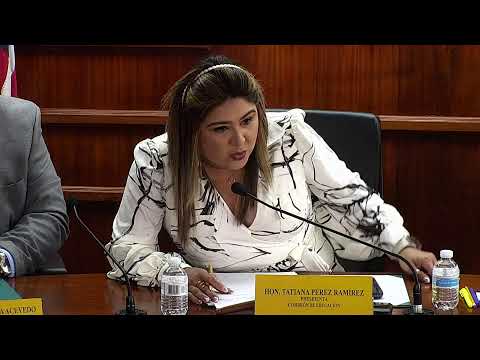
The House of Representatives Commission on Education held a public hearing April 21, 2025, on House Bill 427, filed by Representative Tatiana Pérez Ramírez, to pilot artificial‑intelligence tools for conversational English instruction in public schools.
The House of Representatives Commission on Education held a public hearing April 21, 2025, on House Bill 427, filed by Representative Tatiana Pérez Ramírez, which would create a three‑year pilot to integrate artificial intelligence into conversational English instruction across Puerto Rico’s public schools. Department of Education officials and the director of Puerto Rico Innovation and Technology Services (PRITS) told the commission the project could provide individualized practice and data for policy but raised questions about cost, connectivity, data privacy and teacher training.
Why it matters: The measure proposes a structured pilot and an evaluation committee to test AI tools for conversational English in public schools. If implemented at scale, the initiative could change classroom practice, require recurring funding from the commonwealth, and implicate federal program rules and student‑data protections.
Department of Education testimony said the bill aligns with the department’s strategic goals and the agency’s internal manual on educational AI, and recommended designing the pilot to preserve the teacher’s central role. “La formación docente garantiza que la IA no sustituya la labor del maestro, ... sino que actúe como un complemento pedagógico,” said Saraí Ruiz Maisonet, appearing for Secretary Eliezer Ramos Paredes. Ruiz Maisonet described the bill as a three‑year pilot prioritizing rural and hard‑to‑reach schools, with an evaluation committee to monitor implementation and make evidence‑based adjustments.
PRITS Director Antonio Ramos Guardiola told lawmakers PRITS supports the pilot and urged rigorous scientific and ethical standards for data collection and evaluation. He recommended including the University of Puerto Rico and specialists in linguistics and neurolinguistics in the project design and adding a technology expert to the evaluation committee. “Pritz está completamente de acuerdo con el proyecto y estamos listos para asumir las funciones que nos asignan,” Ramos said.
Costs and scale: Education officials provided preliminary cost estimates the department had compiled for planning purposes. For a systemwide rollout covering the department’s active enrollment of about 235,819 students, the estimated licensing cost would be roughly $22.4 million. Focused deployments would cost less: approximate estimates given at the hearing were $9.4 million for grades 4–5 (enrollment cited as 99,041), $5.3 million for grades 6–8 (56,268 students) and $7.6 million for grades 9–12 (80,151 students). Department staff said per‑student licensing costs observed in market searches range from $40 to $150, and the department had used an illustrative average of $95 per student for planning. The department told the commission it will need an assigned recurring budget if a statutory obligation is created.
Connectivity, devices and readiness: Officials stressed that most schools have a connection at the school site but that distribution and reliability vary. Mario Ortiz, the department’s chief information officer, said about 830 schools were currently fully online and 27 schools were reported as offline at the time of testimony; he also estimated roughly 30,000 of some 300,000 devices issued during the pandemic were out of service. Ortiz said the department plans to use federal E‑Rate and other funds to replace cabling and to procure shared devices for school use (a procurement under review by the fiscal oversight board). He said the department plans to buy devices for roughly 60% of a school’s enrollment for in‑school shared access.
Federal funding and legal limits: Witnesses flagged potential constraints on using federal grants. Department testimony cautioned that statutorily requiring a specific statewide AI platform could limit use of some federal funds, which are intended to supplement rather than supplant state obligations, and mentioned the Every Student Succeeds Act (ESSA) as a relevant federal framework. The department recommended structuring statutory language to avoid unintentionally disqualifying eligible federal funding. Officials also said the pilot would need to comply with student‑privacy laws (mentioned as FERPA and related cybersecurity requirements) and the department’s internal AI manual.
Teacher training and program design: The department described teacher preparation efforts tied to the bilingual education strategy. Officials said 725 teachers were being recertified in bilingual education as an initial cohort, while the system has about 857 schools overall. The department emphasized the pilot’s training component and that the AI tools are to be pedagogical complements, not replacements for teachers. “Nuestro manual del uso de la inteligencia artificial en el sistema educativo está centrado en el ser humano y valora el rol del maestro,” said Beverly Monro Vega, subsecretary for academic affairs.
Evaluation and governance: PRITS and department witnesses urged a competitive procurement based on clearly defined technical and pedagogical requirements, along with robust evaluation metrics. Antonio Ramos said an evaluation should include standardized test results and measures of conversational fluency and recommended forming an IRB‑style oversight group for research ethics if the pilot collects detailed student data.
Requests from the commission and next steps: Committee members asked the department and PRITS to provide additional materials within five business days, including a detailed fiscal impact breakdown, a list of schools currently lacking reliable internet service, clarification about how statutory language could affect federal funding eligibility, and recommendations for evaluation criteria and committee composition. There was no committee vote at the hearing.
The hearing closed with lawmakers emphasizing the need to balance innovation with equity and fiscal caution as they consider whether to advance the measure to the full House.