Lifetime Citizen Portal Access — AI Briefings, Alerts & Unlimited Follows
France, Saudi Arabia push two-state solution; France to recognize Palestinian state at U.N. in September
Loading...
Summary
At a joint press briefing in New York, France and Saudi Arabia outlined a coordinated diplomatic push for a two-state solution, with France announcing its intent to recognize the State of Palestine at the next U.N. General Assembly in September and both countries calling for an immediate end to the Gaza war and unimpeded humanitarian access.
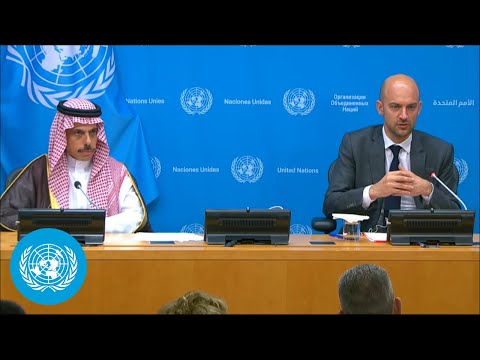
France and Saudi Arabia used a joint press briefing to present a coordinated international effort seeking a pathway to a two-state solution for Israel and Palestine and to press for an immediate end to violence in Gaza. France’s minister for Europe and foreign affairs said President Emmanuel Macron has decided to recognize the State of Palestine at the upcoming U.N. General Assembly in September. Prince Faisal bin Farhan, Saudi Arabia’s foreign minister, backed the initiative and said regional normalization with Israel is contingent on the establishment of a Palestinian state.
The announcement came at a conference that France said brought together 125 countries, with about 50 represented at the ministerial level in New York. The French minister said the conference was convened urgently because "the clock is not on our side," citing what he called "a horrendous" situation in Gaza and the humanitarian suffering of civilians and hostages. He said the goal is to provide a political horizon that would make a ceasefire and a post-conflict stabilization plan possible.
The briefing emphasized three strands the organizers said emerged from the mobilization: a common vision for Gaza after the war based on international stabilization, Arab and Muslim states' condemnation of the Oct. 7 terror attacks and calls for Hamas disarmament, and willingness among some Western states to recognize a Palestinian state. The French minister noted recent statements by Palestinian Authority President Mahmoud Abbas, including a June 9 letter in which Abbas condemned the Oct. 7 attacks, called for hostage releases and signaled plans for Palestinian elections and governance reforms.
Prince Faisal said the conference reflected a broad international consensus that a two-state solution, based on the Arab Peace Initiative, U.N. resolutions and the principle of "land for peace," is the path to ending violence and establishing a Palestinian state. "It is time to end this conflict and to establish a Palestinian state and to achieve lasting and comprehensive peace that preserves security and sovereignty for all peoples of the region," he said. He added that Saudi normalization with Israel "can only come through the establishment of a Palestinian state."
Both ministers urged an immediate ceasefire, the release of hostages, withdrawal of Israeli troops from Gaza and unimpeded humanitarian access. The Saudi minister "categorically reject[ed] any attempt to separate Gaza from the rest of the Palestinian territories" or to forcibly displace Gaza's population. The French minister called on the European Commission and the European Union to press Israel on specific issues he listed, including lifting financial restrictions and reversing certain settlement moves; he cited, as he described it, an outstanding amount of c2 billion the Israeli government owes the Palestinian Authority and singled out the E1 plan for 3,400 housing units as a territorial threat to a future Palestinian state.
Organizers said the conference process is supported by working groups (the French minister referenced 17 co-chairs of thematic working groups; another speaker referenced 18 working groups) that are preparing an outcome document intended to map reconstruction, stabilization and political steps after the war. The French minister described the decisions and commitments under discussion as steps that would be formalized in New York and carried to the General Assembly in September.
Reporters pressed both ministers on whether international pressure, including sanctions, should be used to advance Israeli acceptance of a two-state framework and whether U.S. engagement under former President Donald Trump could help end the Gaza war. The French minister said the European Union should "express what our expectations are" of the Israeli government and use incentives. Both ministers said U.S. engagement is important; the French minister credited prior U.S. efforts in facilitating a ceasefire and urged ongoing U.S. involvement.
The ministers also highlighted actions by regional partners: they urged support for Qatari, Egyptian and U.S. efforts to reactivate a ceasefire plan that would include hostage releases and unimpeded humanitarian deliveries. They pledged to support Palestinian Authority reforms and the reconstruction of Gaza according to an Arab-Muslim plan described at the conference.
Next steps identified at the briefing include finalizing the conference's outcome document, continued diplomatic outreach to countries that have not yet recognized a Palestinian state, and collective mobilization ahead of the U.N. General Assembly in September when France said its recognition will be formalized. The ministers framed the conference and the planned recognition as a way to restore momentum toward a two-state solution and to create political conditions for post-conflict stabilization and regional integration.
Less central details discussed during the briefing included references to internal Palestinian reforms and elections, and initiatives to bolster the Palestinian Authority's governance capacity. Journalists asked technical and political follow-ups, but ministers limited further specifics on the outcome document and implementation timelines to continuing diplomatic consultations.
The briefing lasted about 30 minutes and concluded with a final round of questions from Associated Press, Le Monde and Sky News Arabia.