Get email alerts on the Code Enforcement topic
No spam. Unsubscribe anytime.
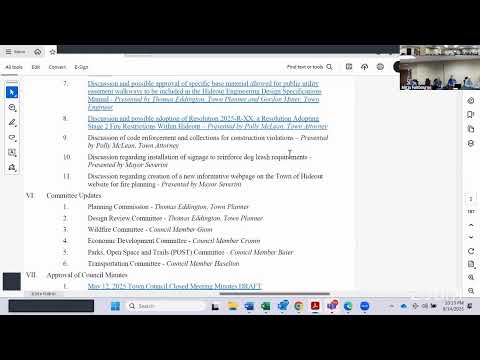
Council discusses building out code-enforcement program and collections process; staff to return with options
Summary
Council discussed options for creating a code-enforcement program to address construction and parking violations, including part-time enforcement staff, coordination with sheriff/county, administrative hearings and collections; staff will review costs and operational models.
Council discussed establishing a more formal code-enforcement and collections process after staff and legal counsel described current limitations and administrative steps required to issue and collect fines.
Town staff and the town attorney outlined three broad enforcement approaches: (1) hire a part-time compliance officer trained to issue administrative citations and follow up with notices and collection; (2) contract with or request periodic assistance from the county sheriff or local police to perform enforcement (noting sworn officers’ higher hourly cost and role limits); and (3) pursue administrative hearings and default-judgment processes to move unpaid violations into collections. Legal counsel noted the town’s code authorizes criminal, civil and administrative remedies but that the town’s current summons forms need correction (they currently lack a clear payment address) and that collections require administrative process and record-keeping.
Council members discussed pros and cons of a part-time hire versus leveraging county law enforcement. Staff reported preliminary cost expectations: a fully trained enforcement officer could cost the town more per hour than an entry-level part-timer due to travel and training; county/sheriff assistance may be more expensive per hour but would supply trained officers. Several council members emphasized the need to impose consequences to change behavior and discussed targeting general contractors and developers who repeatedly have noncompliant sites. Legal staff cautioned against imposing strict liability without fault, which can raise due-process concerns.
Council directed staff to return with two proposed implementation options and cost estimates: a part-time town compliance/enforcement model and a contract/coordination model with county enforcement, plus proposed updates to the town’s summons and collection forms and a recommended administrative-appeals procedure.
AI generated
The text on this page is AI generated. Summaries, highlights, analysis, and video transcripts are all produced from the original source material.
AI can make mistakes, so if you spot one, and we will fix it for everyone.
Note: the source content is unaltered by us. Any content source we link to, be it a video, an audio recording, or a document, is presented exactly as its publisher released it. That publisher is usually a government body, sometimes an individual official or another organisation.