Get Full Government Meeting Transcripts, Videos, & Alerts Forever!
Get email alerts on the Fy2026 Budget topic
No spam. Unsubscribe anytime.
D.C. Council adopts FY2026 budget after last‑minute disputes, CFO standoff and multiple floor amendments
Summary
The Council approved the FY2026 Local Budget Act, Budget Support Act and related supplemental actions after a prolonged session that included an unusually public dispute with the Chief Financial Officer over available revenue, a list of contingency restorations, and targeted preservation and program funding changes.
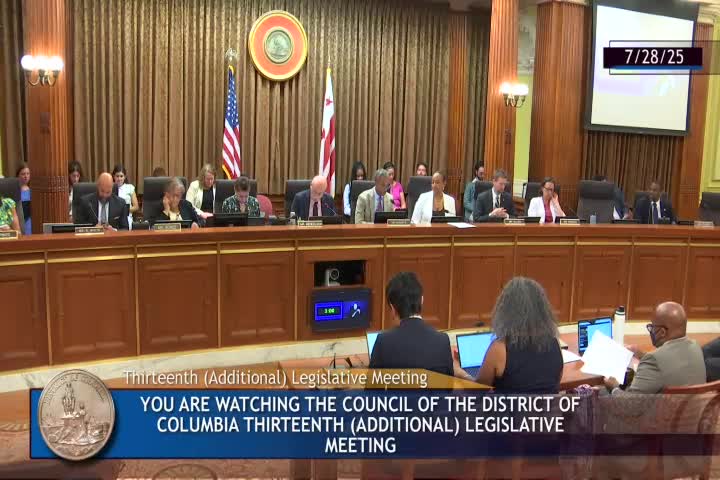
The Council of the District of Columbia approved the fiscal year 2026 Local Budget Act (LBA) and Budget Support Act (BSA) in final votes Monday, concluding a two‑day, high‑stakes budget process that included a public disagreement with the Chief Financial Officer (CFO), late amendments, and multiple floor votes to shift or restore funding.
Why it matters: The action sets the District’s spending and tax policy framework for FY2026. Lawmakers reshuffled tens of millions of dollars under pressure from the CFO and inserted a series of targeted restorations and policy changes that will affect programs from housing preservation to child care subsidies and public safety initiatives.
Chief points from the meeting - CFO dispute and appropriations reserve: Council Chair Phil Mendelson said he was forced to insert an amendment that rescinded roughly $29.98 million from the fiscal year 2026 budget into a new “Appropriation of Additional Resources” line after the CFO publicly demanded that the council leave roughly $244 million uncommitted to cover overspending and to replenish contingency reserves. Mendelson described the move as made "under duress" and argued it preserved the council's appropriating authority while meeting the CFO's certification requirement. - Contingency prioritization: Members negotiated an ordered list of priorities for how newly available revenues should be allocated if later revenue estimates and close‑of‑year overspending figures permit restoration. Councilmember Nadeau led a reordering of that contingency list on the floor; the list prioritized child care subsidies, early childhood educator pay equity, housing preservation, in‑house DNA testing at the Department of Forensic Science, and emergency rental assistance among other items. - Housing preservation funding: Councilmember Robert White successfully moved an amendment to dedicate $20 million from the Housing Production Trust Fund (HPTF) to preservation in FY2026 (with an allowance to increase up to $30 million if additional HPTF allocations apply). The amendment also provides preference for projects at risk of default on preservation bridge loans.
Roll‑call and notable floor actions - Amendment to appropriate additional resources (Chairman Mendelson): Adopted (floor action). Mendelson said the change was necessary to certify the budget in light of the CFO's revised revenue estimate and requests that certain funds remain available to the executive. - Housing preservation amendment (Councilmember Robert White): Adopted (unanimous as recorded on the floor) to allocate $20 million to preservation in FY2026 and to prioritize at‑risk preservation bridge loans. - Parker capital gains surcharge / revenue amendment (Councilmember Trayon Parker): Proposed a graduated surcharge on wealth‑generated income (capital gains) to fund a set of program restorations including the child tax credit, additional supportive housing vouchers, and mobile crisis services. The amendment failed on a roll‑call vote (result recorded as 5 yes, 7 no).
Program restorations and contentious items - Childcare and child tax credit proposals: Councilmember Pinto circulated amendments proposing to reallocate funds to a District child tax credit and to child care subsidies; some proposals were withdrawn or reshaped after floor negotiations. Pinto later withdrew a high‑profile amendment after intensive debate and further negotiations with colleagues. - Access to Justice funding: Pinto and Parker proposed restoring and expanding funding for Access to Justice programs and moving some funds to DNA testing at the Department of Forensic Science and child subsidies; the proposal prompted a long debate. Several councilmembers warned that cutting Access to Justice would remove legal aid for thousands of residents. The Council did not adopt the large substitution proposal that would have cut ATJ to fund those items on the floor vote. - Other restorations: A range of smaller amendments adjusted funding for schools, public safety programs, event funding, and the Office of Clean City; some were adopted after debate and roll‑call votes.
What supporters and critics said - Supporters of Mendelson’s approach argued compliance with the CFO’s certification was necessary to produce a legally attested budget, even if the CFO’s demands were contentious. Mendelson said the CFO was "directing" the council to leave funds available and that the council had no legal authority to cede appropriations, but he accepted a compromise amendment to satisfy certification requirements. - Critics argued the CFO was overstepping by requiring the council reserve funds to cover overspending and that forcing cuts as a remedy was politically and procedurally fraught. Several members urged creation of an independent commission to examine spending and revenue structures.
Clarifying details recorded on the floor - Mendelson said the CFO revised the revenue estimate to indicate an additional $243.7 million is "not available" for appropriation and stated that the CFO demanded leaving $244 million available to him to cover overspending and replenish reserves. - The council’s appropriations adjustment removed $29,983,207 from the FY2026 budget contingency lines to meet the CFO's certification; Mendelson characterized the step as compelled by the CFO's certification requirement. - White’s housing preservation amendment is written as a one‑time FY2026 dedication of $20 million from HPTF to preservation projects with preference language for at‑risk loans; it was described as a targeted preservation strategy rather than a fixed percentage of the HPTF.
Next steps and implementation - The budget measures approved on final reading become the District’s spending plan for FY2026, subject to any applicable mayoral actions and the statutory certification process. Several restorations are conditional on future revenue and on administrative implementation steps by executive branch agencies.
Ending: The Council approved the budget package after long debate, last‑minute amendments and public dispute with the CFO. Lawmakers signaled additional oversight and possible follow‑up reviews in the fall on spending controls and revenue assumptions.