Get Full Government Meeting Transcripts, Videos, & Alerts Forever!
Get email alerts on the Flood Warning Systems topic
No spam. Unsubscribe anytime.
Bexar County directs funding to accelerate next‑generation flood warning system
Summary
After a commissioners court meeting, Bexar County officials said the county will move forward to fund and accelerate a countywide next‑generation flood warning system, directing the San Antonio River Authority to implement predictive modeling, sensors and barriers with an estimated $21 million system cost.
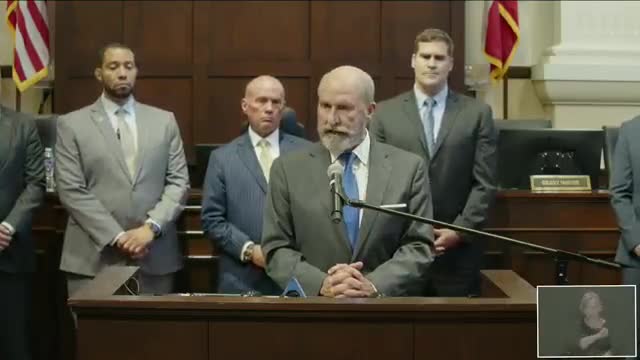
BEXAR COUNTY, Texas — Bexar County leaders said at a press conference that the commissioners court has moved to fund and accelerate a next‑generation flood warning system to expand predictive modeling, sensors and low‑water crossing protections countywide.
County Judge Sakai and County Manager David Smith said the court directed the San Antonio River Authority to implement the system and that the authority "will have the $21,000,000 it needs," a figure officials gave as the combined estimate for county and city components.
The project combines updated hydrologic modeling, additional rain and stream gauges, automated and manual low‑water crossing barriers, solar lighting and public alerting. David Smith, Bexar County manager, credited the San Antonio River Authority’s modeling work after the June 12 floods and said the authority’s models could be expanded countywide so officials can predict which crossings will flood and alert responders in time to close roads.
Why it matters: Officials said the system is intended to reduce deaths and high‑water rescues by giving emergency responders and the public better, more timely information about where and when floodwaters will make roads impassable.
How it would work: Derek Baze, general manager of the San Antonio River Authority, described a network of rain gauges and stream gauges feeding a central predictive model. Those data feed triggers tied to warning levels and, as resources allow, automated or manually deployed barricades and targeted public alerts. Baze said, "You can never eliminate risk. You can, work towards mitigation, but you can never fully eliminate the risk." Art Reinhardt, Bexar County public works director, told reporters the county region tracks roughly 200 gauges and water crossings and said about 30 gauges are inactive for reasons including maintenance and vandalism.
Cost and funding: Officials gave a two‑part cost estimate during the briefing: the San Antonio River Authority estimated roughly $10 million would cover the county’s unincorporated areas and suburban cities, and roughly $11 million would cover the city of San Antonio, for a combined estimate of $21 million. Judge Sakai said the court’s direction is that the river authority will have the money it needs whether the funds come from the county, the city, the state or other partners. Jeff Coyle, assistant city manager for the City of San Antonio, said the project was not yet in the city’s budget but that the city supports the direction and will continue partnership discussions.
Timeline and phasing: Steve Metzler of the San Antonio River Authority outlined a multi‑phase schedule: restore and bring offline gauges back online and refine triggering elevations within the first three to six months; expand gauges and bring an updated predictive model to operational readiness in six to 12 months; and aim for full implementation, including automated gates where feasible, within about 24 months.
Integration and public information: The river authority said updated data will feed publicly accessible tools such as bearflood.org and, where possible, navigation apps like Waze to alert motorists about hazardous crossings. Officials also emphasized public education and outreach to address warning fatigue and ensure people respond to alerts. Commissioner Moody said the initiative should prioritize "the protection of human life." Jim Campbell, chairman of the San Antonio River Authority board, said the authority will work with FEMA on updated flood maps and will lead the technical work.
Context and history: Speakers repeatedly referenced the June 12 flooding event and past floods in 1998 and other years. One county commissioner who represents the Parambidal/Parham Corridor called the barricade work an important quick step while urging continued investment in larger drainage projects and land planning to reduce downstream impacts. Officials noted the county has previously invested in flood control work in the past decade and beyond; county speakers described that prior investment as substantial.
What was decided and what remains: The court directed that funding be provided to secure the estimated $21 million for the system and to prioritize the county’s initial $10 million share for unincorporated areas and suburban cities. The city has not finalized a budget contribution. Officials said details about exact funding sources, contracting and deployment remain to be worked out in the coming weeks and months.
Quotes (selected): "If that modeling could be done beforehand... alerts, signals can be sent out," David Smith, Bexar County manager. "We agreed 100% that this is the direction we need to go. It will immediately save lives in the next major weather event," Jeff Coyle, assistant city manager, City of San Antonio. "San Antonio River Authority today stands with Bexar County and the City of San Antonio in committing to bringing the best available early flood warning technology and resources to our communities," Jim Campbell, chairman, San Antonio River Authority. "A lot of the improvements we were gonna make... we had been budgeting for for a couple of months prior to the... flood event on June 12," Steve Metzler, San Antonio River Authority.
Next steps: Officials said they will proceed with instrument maintenance, siting and upgrades, work with the river authority on triggering levels and modeling, continue partner outreach to the city and neighboring counties, and begin public outreach on how alerts will be pushed and what residents should do when they receive warnings.