Get email alerts on the Buffers And Tree Mitigation topic
No spam. Unsubscribe anytime.
Marion County advances proposed buffer, tree-mitigation and landscape-certification changes
Summary
County staff proposed wider buffer standards, new planting and opacity requirements, a two-year buffer performance certification and changes to tree-protection exemptions. Commissioners asked for incentives, clearer enforcement and coordination with HOAs and the Land Development Regulation Commission.
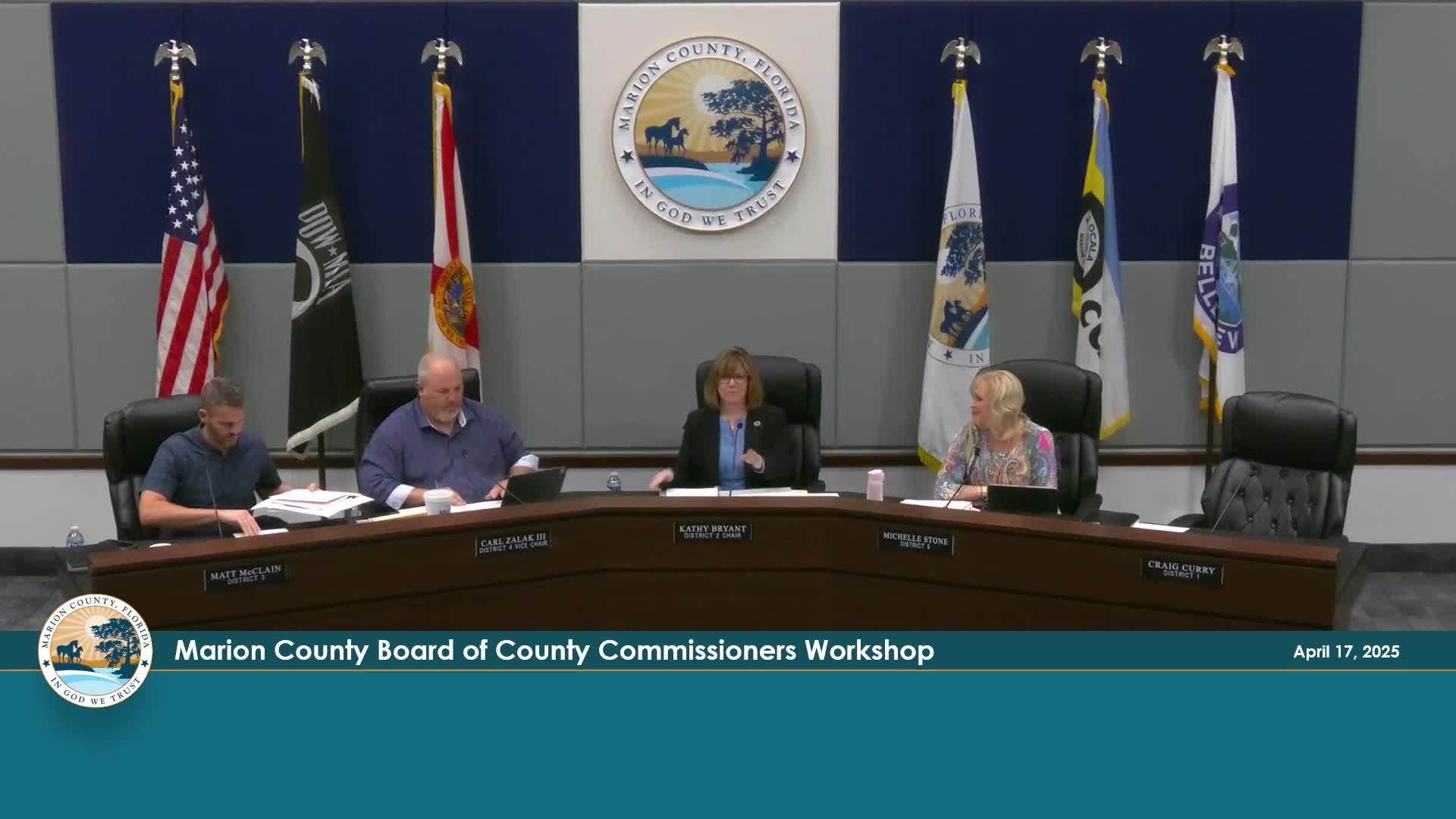
Marion County commissioners heard detailed proposals March 2025 to tighten buffer and tree-mitigation rules, increase planting standards and create a post-installation certification process intended to keep roadside and development landscaping healthy over time.
The measures, presented by Chuck Fariden, director of Growth Services, and Jim Coolard, parks and recreation director, would revise buffer-width categories, raise plant-size and opacity targets, require landscape-design professionals for buffer plans and create a two-year performance certification that property owners would file with the county.
The changes are aimed at improving screening between incompatible land uses, protecting rural and equine character in parts of the county, and reducing the number of buffers that mature poorly after initial installation. "I know it's exciting, riveting stuff, but... it is important," Growth Services Director Chuck Fariden told the board as he opened the workshop.
Why it matters: Commissioners said poorly maintained or undersized buffers are visibly common along major corridors and reduce the value of original landscape conditions. County staff said the proposed code edits respond to prior workshops and public feedback and are intended to preserve community character, reduce long-term maintenance failures and give clearer, enforceable standards.
Key proposals and standards - Buffer classifications: Staff proposed increasing minimum widths for the most protective category (type A) from 30 feet to 50 feet as a default; applicants could propose a reduced 30-foot width only with a corresponding increase in planting density and shrub/understory counts. Jim Coolard explained the approach as a trade-off: narrower widths require more plant material. - Equine-themed buffers: A new "C" buffer option would allow a 25-foot planted buffer that includes an agriculturally themed equestrian fence (described in the presentation as a 3- or 4-rail wooden fence and a minimum height reference in the presentation). Staff proposed applying that option within farmland-preservation areas and on scenic collectors in the county’s western and northwestern areas. - Planting and material standards: Staff proposed year-round screening use of evergreen or semi-deciduous trees for specified buffers, required continuous hedges planted as 7-gallon material with a minimum 24-inch height (replacing smaller 3-gallon minimums), and minimum shade-tree caliper of 3.5 inches for street/front-yard trees. - Opacity/performance targets: Where no wall is present, buffers would be expected to achieve 80% opacity within 12 months; where a wall exists, the target would be 50% within 12 months. "If no wall, 80% within 12 months," Coolard said, outlining the performance goal. - Design and inspection: Buffer plans for significant projects would be required to be prepared by a landscape architect, and staff said they will require pre-construction tree-protection barricades and site inspections during construction. - Two-year certification and ongoing maintenance: Staff proposed a post‑installation certification to be provided by a design professional two years after installation, confirming the buffer still meets the approved design and performance standards; if certification is not provided or the buffer fails to meet standards, the matter could move toward code enforcement. - Front-yard trees: A new residential requirement would place front-yard shade trees between 5 and 20 feet of the right-of-way line, spaced roughly 100 feet apart on both sides of the street, with a minimum caliper of 3.5 inches.
Tree protection, specimen trees and mitigation - Specimen-tree definition and credit: Staff proposed defining specimen trees as 36 inches DBH or larger (DBH = diameter at breast height) that are in good condition, and offering credit toward shade-tree requirements if a developer retains specimen trees (presentation example: one 36-inch specimen could provide multiple shade-tree credits). - Replacement baseline: Existing county practice cited in the presentation allows replacement up to 100 inches of DBH per acre as a measure used historically; staff plan to retain and clarify that approach. - Tree-mitigation fund and spending: Staff reported the county’s tree-mitigation fund balance near $700,000 with an additional proposed pay-in of roughly $370,000 from an applicant. Under current practice mitigation fees are used to plant trees on public property; staff asked the board to consider modestly broadening allowable uses (for example, shade structures or park amenities tied to tree projects) while requesting a short financial projection before any ordinance change.
Loophole and exemptions discussion Staff identified a recurring problem where property owners clear wooded lots under a bona fide-agriculture exemption and then submit development applications soon after, avoiding mitigation that would otherwise be required. The presentation proposed removing a sentence in Section 6.7.0.2 of the code that had limited the exemption in some cases; commissioners debated tightening the timeline and keeping a 5-year waiting period before accepting applications after an exempted tree removal to discourage clearing to avoid mitigation.
Board reaction and follow-up Commissioners broadly supported raising standards but raised concerns about enforcement, long-term maintenance and the economics for developers and HOAs. Commissioner Stone asked whether city gateway standards could be coordinated with county plans for interstate corridors. Commissioner McLean questioned how opacity would be judged and urged that staff provide readily usable planting examples developers can adopt so minimums do not result in "cookie-cutter" low-performing buffers.
Staff outlined next steps: incorporate commissioner feedback, cross-check related code sections (Divisions 7 and 8), prepare an LDRC submittal and continue one-on-one briefings with commissioners before formally bringing amendments to the Land Development Regulation Commission. Jim Coolard and Growth Services staff also said they will prepare a recommended plant list, refine construction-buffer language (with Hernando County examples shared in the packet), and develop processes for the proposed two-year certification and pre/post construction inspections.
What commissioners did not decide: No formal ordinance amendments or votes were taken at the workshop. The board asked staff for additional analysis — including a projection of county landscaping obligations and a clearer inventory of pending mitigation needs — before changing how mitigation funds can be spent. Staff said they would return to the LDRC and then to the board after further refinements.
Background and context The county framed the changes as follow-ups to prior workshops and to a 2012 set of landscaping standards (including Florida-friendly landscaping and groundwater protection guidance). Staff said the proposed changes respond to repeated examples where buffers were installed to meet minimal code but failed within a few years because of irrigation shutdown, poor maintenance or inadequate initial planting sizes. The revisions are intended to align planting performance standards, enforcement tools and incentives so buffers mature as intended.
Looking ahead Staff indicated an updated draft and technical exhibits (detailed buffer tables, typical cross-sections and proposed plant lists) will be circulated to commissioners and the LDRC. The board did not set a final adoption schedule but instructed staff to continue refining the proposals and to return with code language, an analysis of mitigation-fund obligations and sample planting palettes for each buffer type.
No formal votes or ordinance adoptions were recorded at the workshop.
AI generated
The text on this page is AI generated. Summaries, highlights, analysis, and video transcripts are all produced from the original source material.
AI can make mistakes, so if you spot one, and we will fix it for everyone.
Note: the source content is unaltered by us. Any content source we link to, be it a video, an audio recording, or a document, is presented exactly as its publisher released it. That publisher is usually a government body, sometimes an individual official or another organisation.