Get AI Briefings, Transcripts & Alerts on Local & National Government Meetings — Forever.
Board approves Mental Health SF ordinance on first reading; funding still unsettled
Summary
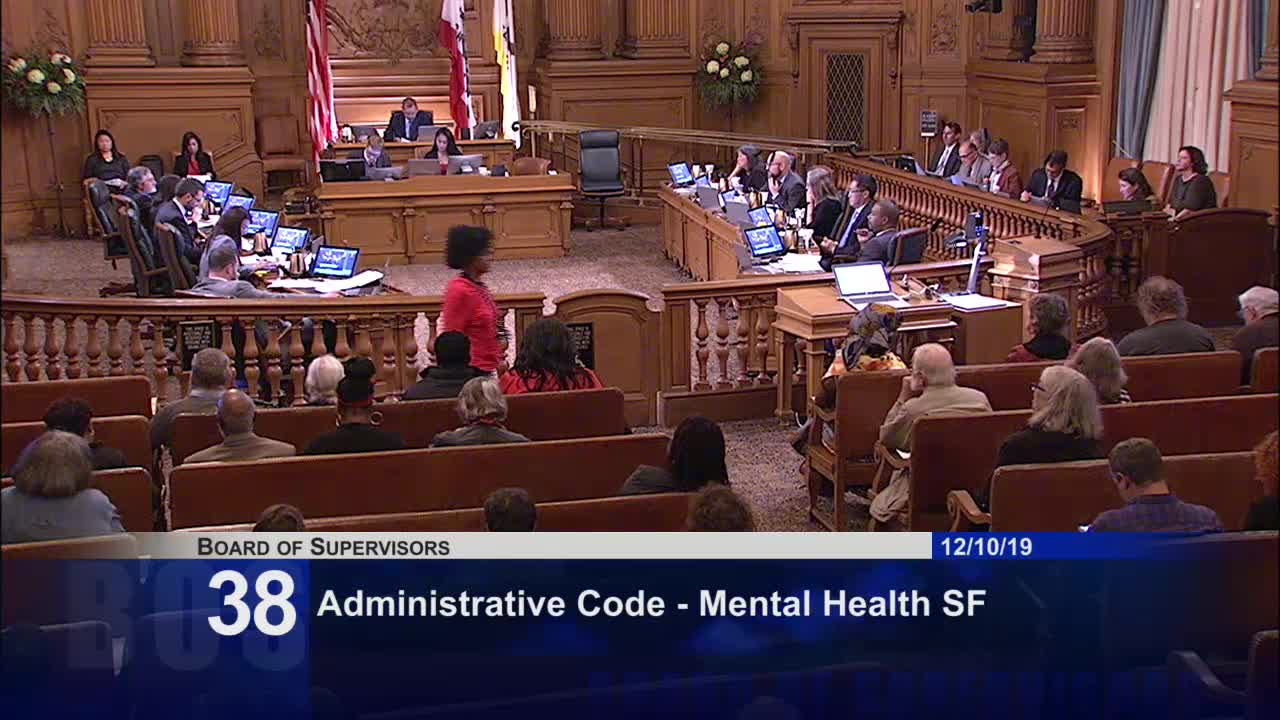
The San Francisco Board of Supervisors on Dec. 10 passed on first reading an ordinance creating "Mental Health SF," a plan to expand mental-health and substance-use services for vulnerable adults who are homeless, uninsured or on Medi-Cal.
The San Francisco Board of Supervisors on Dec. 10 passed on first reading an ordinance creating "Mental Health SF," a comprehensive program designed to expand mental-health services, substance-use treatment and psychiatric medications for adults who are homeless, uninsured or enrolled in Medi-Cal or Healthy San Francisco.
Supporters said the ordinance creates an integrated system that includes a 24/7 service center, sobering center capacity, more inpatient and outpatient treatment beds and case managers for every eligible resident. The board voted unanimously to advance the ordinance on first reading.
Why it matters: Backers said Mental Health SF is aimed at addressing the city's growing crisis at the intersection of homelessness, behavioral health and substance use. Supervisor Matt Haney said the measure provides a blueprint for a system of care and an implementation working group; Supervisor Shamann Walton and others said it responds to frontline worker concerns and will require sustained oversight to succeed.
Key details: The ordinance directs the Department of Public Health and other agencies to expand the city's behavioral-health infrastructure and to form an implementation working group. Supervisor Ronen, who introduced the ordinance, credited months of negotiation with the mayor's office and the Department of Public Health and thanked labor unions and advocates for their input. The mayor committed to hiring a director for Mental Health SF in 2020 and to expedite renovations of an existing behavioral health access center to serve as a 24/7 intake site.
Funding: Supporters said the program cannot begin at scale without a long-term revenue source. Supervisors and the mayor discussed the need to identify "at least $100 million per year" to fully fund Mental Health SF, and they said they would explore every option, including local revenue measures. The ordinance itself does not include a final funding plan; supporters described the vote as the policy and structural approval needed before detailed budgeting and implementation work.
Next steps: The ordinance passed on first reading and will return for a second reading and final vote after committee and budget work. Supporters said the city will form the implementation working group early next year and the mayor will hire a director to begin operational planning.
Context and reactions: Supervisors who co-sponsored the measure praised its scope and the multi-stakeholder development process. Supporters emphasized that passage represents a step from planning to implementation but repeatedly acknowledged the need to secure stable revenue before full roll-out.
Outcome: Ordinance passed on first reading unanimously; final funding mechanism not specified in the ordinance.