Lifetime Citizen Portal Access — AI Briefings, Alerts & Unlimited Follows
Board adopts successor-agency ordinance on first reading after amendments amid calls for added oversight
Loading...
Summary
The Board of Supervisors approved on first reading an ordinance establishing a successor agency commission to complete development and affordable-housing obligations left after redevelopment dissolution, adding amendments to preserve Board budget oversight and require plan amendment review and a 120-day implementation roadmap.
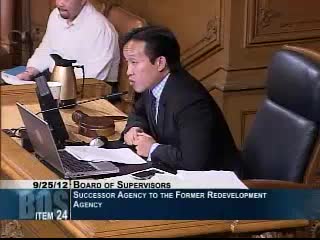
The San Francisco Board of Supervisors approved, on first reading and as amended, an ordinance creating a separate successor agency commission to wind down enforceable obligations left after the state dissolved redevelopment agencies. The measure lays out the commission’s narrow role — completing surviving obligations connected to major project areas such as Mission Bay, Transbay and the Hunters Point Shipyard — and addresses governance, staffing and fiduciary procedures under the amended state dissolution law (AB 1484).
City Administrator Naomi Kelly opened the Committee-of-the-Whole discussion with a summary of the legal constraints placed on the city after the state’s redevelopment-dissolution statutes changed in 2012. Tiffany Bohi, director of the City’s successor agency office, told the Board the ordinance creates a focused commission to complete long-term affordable housing and infrastructure obligations that remain in the recognized obligations payment schedules (ROPS) and to coordinate with the existing Oversight Board and the State Department of Finance.
The Board’s deliberations centered on the balance of executive and legislative authority, representation from project-area communities, the commission’s delegation powers and transparency. Supervisor Cohen — a co-sponsor of the ordinance as amended — told the Board the commission’s scope should remain narrow and that the Board of Supervisors must retain budgetary review authority. Supervisor Campos pressed for split appointments or more direct supervisor involvement to strengthen local accountability. Several speakers from Bayview-Hunters Point, Mission Bay and housing and civic organizations urged speedy action so major projects and promised affordable housing can proceed.
Amendments adopted during the hearing clarified three main points: first, the Board retained explicit review and approval authority over the successor agency’s operational budget; second, material amendments to redevelopment plans or community-benefit commitments must be returned to the Board of Supervisors for its consideration; and third, the successor agency was directed to deliver a clear road map to the Board within 120 days describing staffing, governance and implementation steps to complete enforceable obligations. The Board also adopted a separate change creating at least two seats on the successor commission that reflect the project-area constituencies (as amended, the commission should include representatives tied to the supervisorial districts that contain the major project areas).
A proposal by Supervisor Campos to strike language in the draft that permits the commission to delegate any of its duties to an executive director drew extended debate. Supporters of the delegation language argued it is consistent with existing city practice and necessary for efficient administration; opponents warned that unconstrained delegation could remove oversight from a public, appointed body. The Board voted and the proposal to delete the delegation clause failed. A motion to require the city to return with further clarifying language and to preserve Board oversight of collective bargaining and budget decisions was included in the adopted amendments.
Public comment was lengthy and divided: community speakers from Bayview-Hunters Point and Mission Bay urged that community voices be represented and that former redevelopment employees not automatically control the successor agency; the Chamber of Commerce and business groups urged a single agency to maintain continuity so projects and private investments can proceed; nonprofit housing and neighborhood groups asked the Board to preserve long-standing community benefits and contract compliance structures.
The Board considered, but rejected, a short continuance motion. Subsequent roll calls adopted the suite of amendments reported to the Board and then passed the ordinance as amended on first reading (final recorded vote on the ordinance as amended: 10 ayes, 1 no). The Board scheduled return steps and directed the successor agency to produce the 120-day roadmap and to follow the reporting and budget-approval steps outlined in the amendments.
What the ordinance does and does not do: the commission is expressly limited to completing surviving enforceable obligations and the ordinance acknowledges the continuing role of the Oversight Board and the State Department of Finance in reviewing recognized obligations payment schedules. The ordinance permits the successor commission to select an executive director and handle personnel matters for the successor agency entity; the Board’s adopted amendment preserves Board authority over final adoption of the successor agency’s annual budget and requires Board review for material changes to redevelopment plans or community-benefit commitments.
Next steps: successor agency staff will prepare the 120-day roadmap for Board review, confirm staffing and personnel arrangements consistent with AB 1484 and the ROPS process, and continue collaboration with the Oversight Board and state finance reviewers.