Get AI Briefings, Transcripts & Alerts on Local & National Government Meetings — Forever.
Neighbors press planning commission on second‑home proposal in Rimrock West; hearing continued for further evidence
Summary
A contentious hearing on April 14 about a proposed second detached dwelling at 659 Northwest Silverbuckle was continued by the Bend Planning Commission; the record was left open so neighbors, technical specialists and the applicant can add written evidence on CC&Rs, fire access, stormwater and wetlands.
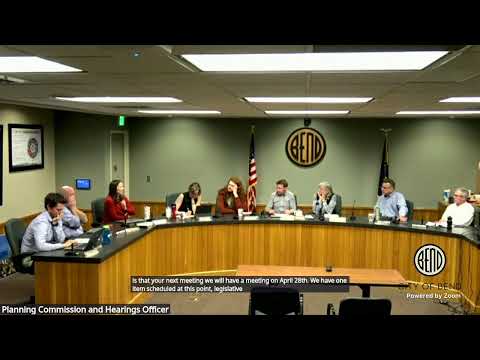
BEND, Ore. — A public hearing that drew residents, engineers, lawyers and the city fire marshal ended without a final decision April 14 after the Bend Planning Commission continued the quasi‑judicial review for a proposed second detached single‑unit dwelling at 659 Northwest Silverbuckle.
The commission left the written record open under a 7‑7‑7 schedule (seven days for new written evidence, seven days for public rebuttal, followed by seven days for the applicant’s final rebuttal) and set a deliberation date of May 12. The commission also set a subsequent city council date for any final action.
Aaron Henson, planner for the planning division, introduced the project as a request to add a second detached dwelling on a 1.23‑acre site within the waterway overlay zone. Henson said the site extends to the river’s center line, contains wetlands, and touches multiple subzones with different setbacks and design review criteria — including a 50‑foot riparian setback and a 40‑foot design review setback in this stretch of the river.
Staff flagged numerous technical issues that apply at different stages. Henson said the project must comply with waterway overlay criteria about tree removal, riparian vegetation, area of special interest setbacks and floodplain provisions, and that some technical details (stormwater design, building‑code fire access) are typically addressed in the building‑permit review rather than the planning hearing.
“The failure to address an issue with sufficient specificity may preclude an appeal on that issue to the Land Use Board of Appeals,” Henson reminded the commission as part of the quasi‑judicial procedure statement.
Applicant engineer Derek Marie presented a preliminary stormwater approach that sized an infiltration gallery for a 25‑year, 60‑minute storm event, and said the gallery was placed near the proposed building footprint with provisions to move or deepen the system before building permit issuance. “I designed this for a 25 year event,” Marie said in summarizing the preliminary stormwater calculations.
Neighbors and technical consultants urged greater scrutiny. Several residents and the Rimrock West homeowners association argued the property is subject to private covenants (CC&Rs) that prohibit multiple dwellings on a single lot or that require association approval for drive and common‑area work. The applicants’ attorney disputed that legal reading and said the property was consolidated into a single tax lot in 1996; opponents countered that a separate amendment and easement history leave unresolved questions of what land is governed by the CC&Rs.
Legal counsel for some neighbors cited case law that can require review of private restrictions if those restrictions make compliance with applicable public approval criteria impossible. Neighbors also asked the commission to consider public‑safety effects of adding a home to a subdivision with one entrance/egress. Local attorneys and the homeowners association said the Oregon fire code and local minimum development standards together effectively limit fire access in areas with a single access point and that the addition of another dwelling could increase the subdivision’s exposure during a fire.
The city’s fire marshal appeared and summarized the fire code standard: when the local code applies, officials review access and available water supply for firefighting at the building permit stage. The fire marshal told commissioners that the code requires two points of access for some subdivisions with certain numbers of dwellings; the marshal said departments may work with applicants on alternatives, but such decisions are made at building permit review.
Stormwater experts flagged technical constraints. Consultant Dan Capozzola, who described himself as a stormwater specialist, said the site sits over dense basalt and that typical infiltration galleries will not perform as designed without extensive subsurface work; he suggested the applicant may require an underground storage solution or treatment measures to meet Department of Environmental Quality requirements.
Ecological concerns were raised, too. Witnesses noted a slow side channel and wetlands on or adjacent to the property that support riparian vegetation and could provide habitat for amphibians such as spotted frogs; those commenters urged fuller state and federal permitting checks if construction would affect those areas.
The applicant’s team said they revised the project after earlier iterations: the larger house originally proposed was reduced and moved farther from the river; proposed driveway extensions into homeowners association property were removed from the current scope because the applicant did not have HOA authorization. The applicant told the commission the current design meets the waterway overlay setbacks and that remaining technical issues could be resolved at the building permit stage.
Because parties asked for more time to submit written evidence (one letter filed that morning explicitly requested the record remain open), the commission agreed to leave the written record open and to set a detailed schedule. The commission member acting as chair asked planning‑division staff to package incoming materials and to return with the matter for deliberation on May 12. The commission’s continuation passed unanimously.
What the commission did and why it matters: The commission did not decide the application; instead it gave all parties an extended opportunity to submit written evidence and rebuttal before the commission deliberates in public. That schedule preserves parties’ rights to make the record while ensuring the commission will have time to weigh technical materials, legal memoranda about CC&Rs and easement history, and any updated stormwater, arborist or fire‑access engineering analyses.
Next steps: The commission left the written record open (first submission period through April 21), allowed a rebuttal period (through April 28), and gave the applicant final rebuttal time (through May 5). The commission will deliberate on May 12 based on the written record and will not reopen testimony at that meeting. If the commission issues a decision, it could be appealed to the Land Use Board of Appeals.
Provenance: Staff’s quasi‑judicial hearing statement, the applicant’s engineer presentation, multiple public comments raising CC&R, fire access, stormwater and habitat concerns, and the commission’s continuation motion are recorded in the meeting transcript.