Get Full Government Meeting Transcripts, Videos, & Alerts Forever!
Get email alerts on the Downtown Redevelopment topic
No spam. Unsubscribe anytime.
Pompano Beach staff update commission on downtown master plan, City Hall relocation and financing options
Summary
City staff, the CRA and master developer RocaPoint Partners updated the City Commission and CRA board May 7 on the downtown redevelopment master plan, recent property acquisitions and financing options; no approvals were requested at the meeting.
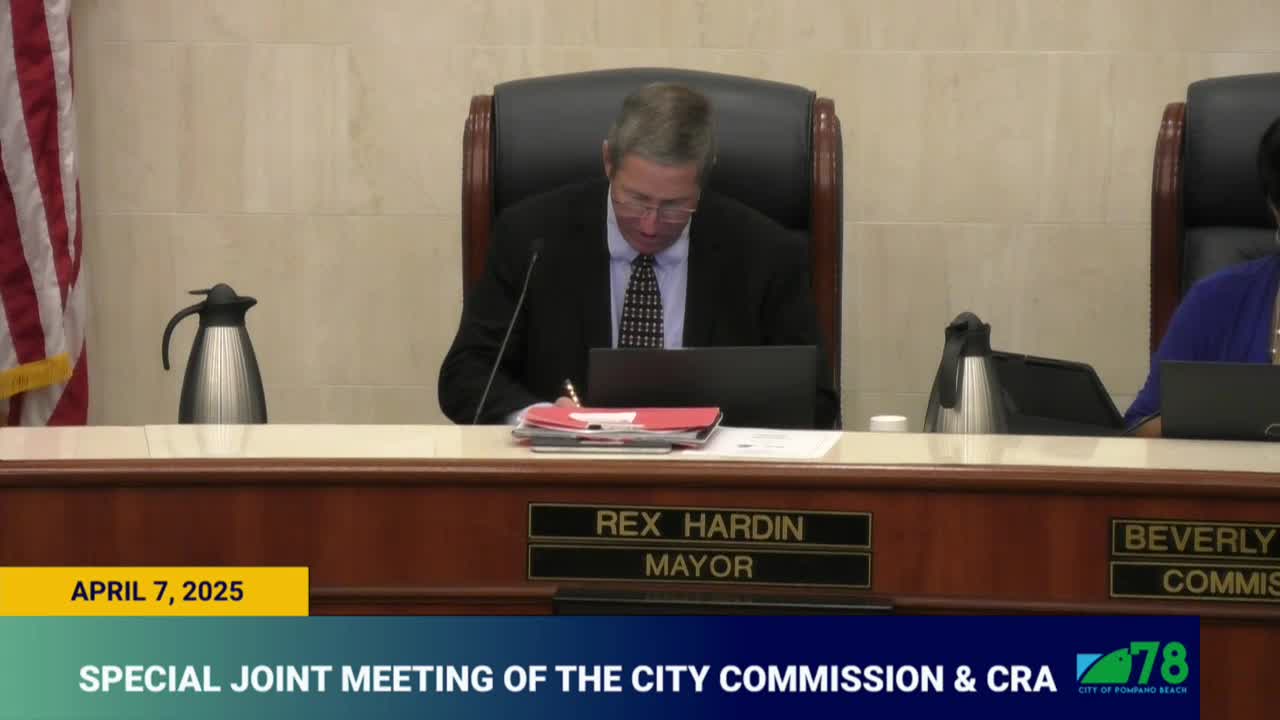
POMPANO BEACH, Fla. — City staff, the Pompano Beach Community Redevelopment Agency and master developer RocaPoint Partners presented updates May 7 on the downtown redevelopment master plan, including recent property acquisitions, a revised site layout that places a proposed new City Hall on the eastern edge of the project, and preliminary financing options to pay for civic buildings.
Staff emphasized that the meeting was informational: “we're not requesting any approvals for any items we discuss this evening,” Assistant City Manager Suzette Sibyl said at the start of the session. RocaPoint and the city said they will return with any proposed amendments to the master development agreement for formal approval at a later date.
The update covered three main areas: land assembly and design changes, civic programming and procurement, and funding options. Nguyen Tran, who led the acquisitions presentation, said the CRA acquired 18 parcels in the past nine months and that the purchases were typically from “willing sellers.” Danielle Handy of RocaPoint described a reimagined master plan that she said would concentrate City Hall on the eastern side of the redevelopment to place the municipal building near the Northeast Transit Center and a planned commuter-rail station: “This entire redevelopment project … contemplates about 4,000,000 square feet of retail office, multifamily, and civic and government type uses,” Handy said.
Architects from HOK presented initial programming for a potential new City Hall and parking structure. HOK said its early target for the new administrative facility is about “16,288 gross square feet” based on stakeholder interviews and a 20-year staffing forecast. Building official Michael Rada said the current City Hall is about 34 years old, “it's really seen its useful life,” and cited roof leaks, storage shortages and FEMA vulnerability as drivers for replacement or major renovation.
Staff also summarized procurement and consultant work completed to date. Sibyl said the city issued four RFQs since the master development agreement was signed in June 2024, and that the city selected Keith Engineering for civil and survey work and HOK for City Hall and parking-deck design. Jonathan Ray of HOK described community engagement planned for April and May and said HOK expects a concept-level design by June.
On funding, staff presented two broad approaches discussed in prior negotiations: (1) a developer/tenant-lease model in which a private partner finances civic buildings and the city leases them; and (2) a city self-finance approach using certificates of participation (COPs). Sibyl summarized earlier estimates presented to the commission: the city’s planned civic program cost was cited around $111.5 million under a self-finance scenario; the prior developer-lease scenario had a higher long-term cost estimate because of financing assumptions. City staff said self-financing could lower the assumed financing rate and reduce the 30-year total payment from roughly $386 million under the private-lease assumption to about $224 million under public financing, an illustrative difference staff described as “savings of a hundred and 52,000,000 over 30 years.” Sibyl said the city will provide more detailed cash-flow and financing analysis at a workshop scheduled for April 24.
Staff also flagged program-level choices that would change costs: adding a vocational-technical/career training kitchen and college resource center is currently estimated at about $6,000,000 (including furnishings and equipment), Sibyl said. RocaPoint said it would set aside a $500,000 community-benefits fund tied to development milestones, with disbursement to schools and nonprofit partners when infrastructure and occupancy milestones are reached.
Next steps and public schedule: staff listed upcoming public engagement sessions and decision points, including a joint workshop on April 24 to review funding and an April 30 joint meeting to review community input; staff said any proposed first amendment to the master development agreement and related bond documents would be presented for approval at a May 14 meeting.
Discussion-only items in the presentation included design concepts, proposed additional project elements, and suggested developer incentives; the commission did not make formal decisions at the May 7 meeting.
Ending: Staff and the master developer emphasized further public meetings and workshops over the next several weeks. Sibyl said the goal is to bring any recommended MDA amendments and financing documents back for formal vote on May 14 after additional community engagement and a workshop to review financing in detail.