Get AI Briefings, Transcripts & Alerts on Local & National Government Meetings — Forever.
Committee approves bill to standardize permitting for low-voltage commercial perimeter security devices
Loading...
Summary
The Local Government Committee voted 10-1 to pass an amended bill that clarifies technical standards and permits use of a low-voltage security device on commercial perimeter fences, sponsors said; a company representative described how the device operates.
The Local Government Committee voted to pass Senate Bill 127 as amended, allowing uniform permitting across the state for a low-voltage security device installed inside commercial perimeter fences. The committee recorded a 10-1 vote in favor of the amended bill.
Sponsor Representative Miller said the amendment — labeled amendment number 1 — contains cleanup and technical changes the Senate missed and makes conforming edits so the “security device conforms to industry standards in which it's listed and certified,” and that the bill’s effective date is changed to upon passage. “The amendment, which is amendment number 1, actually is some cleanup language, and some technical changes that were missed when the senate worked on this and passed it on to the house,” Miller said.
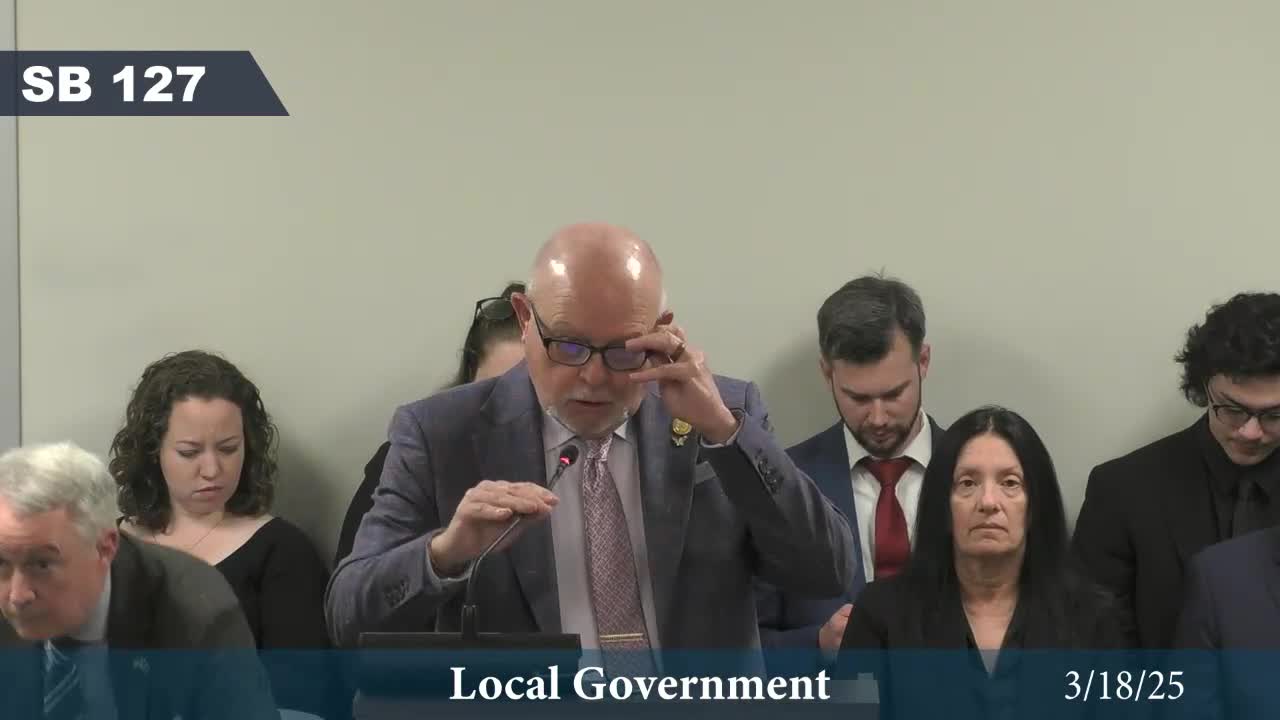
The device is intended for commercial uses only, not residential installations, Miller said. Michael Pate, a company representative who testified in support, described the system as a battery- and solar-powered perimeter sensor tied to an alarm panel and cameras. Pate said the unit runs on a 12-volt battery kept charged by small solar panels and is never tied to a site’s electrical infrastructure. “We were, you know, green before green was cool,” Pate said.
Pate explained the device’s operating cycle: an energizer amplifies the 12 volts up to 7,000 volts in 1.1 seconds to pulse an interior line, and the system performs a quick perimeter check every 1.1 seconds. If the alarm panel receives a negative return it counts consecutive negative returns; five consecutive negative returns trigger a local audible alarm and a silent alert to the company’s call center, which then follows a call list. Pate also said the system is paired with cameras so operators can view the fence line when an alarm is triggered.
Representative Borders asked the company for its website, which Pate provided as amarok.com. Committee chair Chairman May asked whether there were additional people signed up to testify; none were. After the presentation and questions, a committee member moved to pass the bill as amended; the motion received a second and a roll call produced a 10-1 approval.
The bill’s primary changes are technical: conforming language to industry listing/certification standards for the device and changing the effective date to upon passage. The committee did not attach additional operational restrictions in the hearing record. The committee’s vote advances the bill to the next step in the legislative process.