Get Full Government Meeting Transcripts, Videos, & Alerts Forever!
Get email alerts on the Capital Punishment Methods topic
No spam. Unsubscribe anytime.
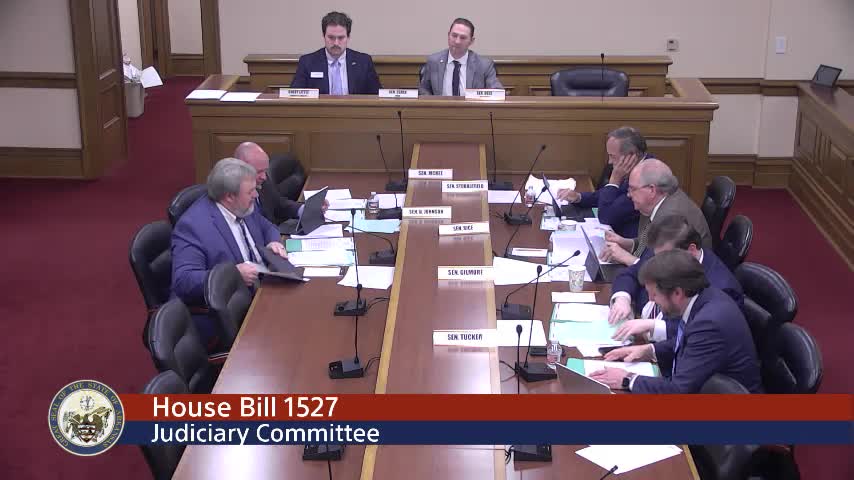
Senate committee advances bill allowing nitrogen hypoxia as execution method after hours of debate and testimony
Summary
The committee approved House Bill 1489 to authorize nitrogen hypoxia as an alternative method of execution. Sponsors said it provides an additional option where lethal‑injection drugs are unavailable; opponents cited ethical, legal and logistical concerns and warned of likely litigation.
Sen. Blake Johnson (District 21) presented House Bill 1489 to permit nitrogen hypoxia as an additional execution method. Johnson said the bill would provide another option for carrying out sentences where current methods are unavailable and framed the change as responding to long delays on death row.
"This will just allow us another method for the corrections to be able to go through the process that's been ordered by the courts," Johnson said and described the bill as an alternative method to bring certainty to long delays for people on death row.
Committee members and witnesses engaged in extended questioning and testimony. Questions focused on whether nitrogen hypoxia has been used elsewhere, its observed effects, and whether the method raised Eighth Amendment concerns (cruel and unusual punishment).
Sen. Matt Tucker, Sen. Ross and others asked whether there was a clear medical consensus about how quickly death occurs and whether there are documented botched or prolonged executions. Tucker cited accounts of the single documented U.S. use in Alabama and asked whether it had been peaceful. Witnesses described conflicting accounts and emphasized that circumstances of administration matter.
Kristen Wynne of Arkansas Public Policy Panel testified about economic concerns, saying expedited executions could increase costs due to litigation and drive prison‑system expense, and urged caution. Jeff Rosenzweig of the Arkansas Association of Criminal Defense Lawyers testified against the bill, arguing it raises separation‑of‑powers and delegation problems previously identified by the Arkansas Supreme Court in Hobbs v. Jones and related litigation. Rosenzweig warned the bill lacks specifics about delivery method, gas purity, chosen apparatus and decision criteria — omissions he said would be litigated.
Sarah Moore of the Arkansas Justice Reform Coalition and Kaleem Nazim (Decarcerate Little Rock) described humanitarian and ethical concerns and called the method experimental. Prosecutors and the Attorney General's Office answered some questions but acknowledged uncertainty and litigation risk.
After extended debate and public testimony, the committee voted by voice to adopt the bill. Committee members recorded both support invoking judicial processes and victims' needs and opposition invoking constitutional and implementation concerns.
Why it matters: The move would authorize a largely untested method in Arkansas; proponents cite delays and supply problems for lethal‑injection drugs, while opponents cite legal and humanitarian concerns and predict immediate litigation if enacted.