Lifetime Citizen Portal Access — AI Briefings, Alerts & Unlimited Follows
Consequent Capital Management briefs OHA trustees on market risks to Native Hawaiian Trust Fund
Loading...
Summary
A Consequent Capital Management consultant told the OHA investments committee that recent market volatility, driven by quarterly losses and tariff announcements, underlines the need to follow policy, maintain long‑term allocations to private markets, and consider risk‑mitigating diversifying strategies.
At the April 2, 2025 meeting of the Office of Hawaiian Affairs Committee on Investments and Land Management, Vijay Chatterjee of Consequent Capital Management briefed trustees on current market conditions and implications for the Native Hawaiian Trust Fund.
Chatterjee told trustees the first quarter of 2025 was ‘‘one of the worst quarters since 2022,’’ noting the S&P 500 was ‘‘down about 4.5%’’ and that U.S. stocks underperformed global stocks by nearly 9% in the period. He said markets were reacting to a mix of policy uncertainty, interest‑rate considerations and trade actions announced that day; in his remarks he summarized reported tariff figures he had seen as "about 10% across the board," with European tariffs around 20% and China as high as 34% pending final details.
Chatterjee framed the fund as a benchmark, long‑term investor and urged trustees to "stay the course" with policy‑driven allocations. He said roughly 70% of the portfolio is in growth‑oriented equity‑like investments, which explains much of the portfolio's sensitivity to the recent market drop. He recommended continuing the board's multiyear effort to build private‑market allocations, keeping diversified ‘‘risk mitigation’’ strategies in place, and preserving discipline around rebalancing rather than moving to cash in the midst of market stress. "Cash is an asset class," he said of how certain managers treat liquidity, but he cautioned that for benchmark asset owners cash is generally a performance drag.
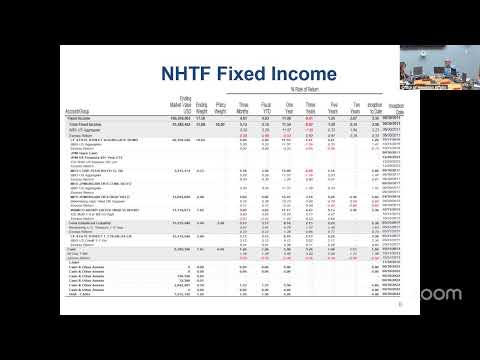
On the capital preservation portion of the fund (fixed income, enhanced liquidity and cash), Chatterjee said the allocation is slightly underweight at just under 20% with a policy target a little above 21%. He reviewed the portfolio's fixed income lineup in summary, noting a State Street aggregate bond fund provides broad passive bond exposure and that other managers (including short‑dated high yield and active bond managers) are in place for incremental return and liquidity. He noted that fixed income fees tend to sit between the low fees seen in passive equity index funds and the higher fees charged for actively managed strategies; fees overall have trended downward, he said, but staff review of fee structure remains appropriate.
In response to trustee questions about near‑term market moves after the tariff announcements, Chatterjee said he had no special ability to predict short‑term market direction and stressed that trustees should rely on policy to guide long‑term decisions. He emphasized that if trustees believed the policy or the global economic regime were changing in a persistent way, a board‑level conversation about asset allocation would be appropriate; otherwise, he recommended maintaining diversification and using rebalancing rules to buy into weakness rather than attempting to time markets.
Chatterjee also flagged private‑market exit challenges (fewer IPOs and slower exits) as a factor that can affect reported returns and liquidity in that asset class. He concluded by noting staff will provide a full quarterly performance report in the coming weeks that will present fund performance and drivers in detail.
No formal actions were taken during the briefing; trustees and staff will receive the quarterly report and may discuss allocation or policy adjustments at a subsequent meeting.