Lifetime Citizen Portal Access — AI Briefings, Alerts & Unlimited Follows
OHA trustees review Native Hawaiian Trust Fund allocations; private equity pacing and AI exposure discussed
Loading...
Summary
Consequent Capital Management and OHA staff briefed trustees Feb. 19 on the Native Hawaiian Trust Fund allocations and the investment policy statement the board adopted in November 2024, focusing on a plan to increase private-equity exposure over multiple years and how artificial intelligence fits across public and private holdings.
Office of Hawaiian Affairs trustees on Feb. 19 heard an investment briefing from independent consultant Vijay (Vijoy) Chatterjee of Consequent Capital Management and an update from endowment director Ryan Lee on the Native Hawaiian Trust Fund allocation and the investment policy statement approved by trustees in November 2024.
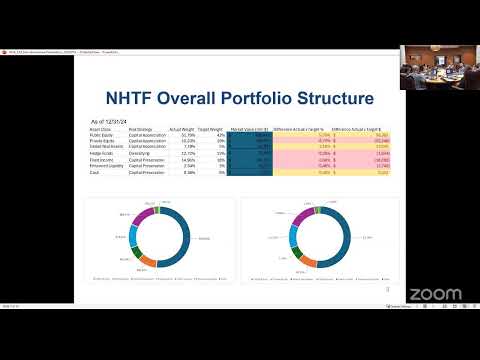
Chatterjee summarized the fund’s major asset classes — public equity, private equity, global real assets, hedge funds, fixed income and liquidity — and showed the fund’s current weights versus policy targets. He and staff noted that the fund is currently overweight in public equity and underweight in private equity relative to policy targets: public equity holdings were described as roughly $300 million while private equity holdings were described as about $60 million; the policy target for private equity is approximately 19% of the portfolio. Chatterjee and Ryan Lee said staff are executing a multi‑year plan to increase private-market commitments to approach the target.
“Getting to 19% may be a multiyear effort,” Lee said, describing a paced commitment schedule; Chatterjee explained that private-market commitments are typically made on a multi-year vintage schedule to avoid concentration in a single year and to address liquidity considerations.
Trustees asked about the portfolio’s exposure to emerging technology themes such as artificial intelligence. Chatterjee said AI exposure occurs through both public large-cap technology holdings (for example, companies that make the specialized chips that power AI) and through private‑market venture and growth allocations that target newer companies. When asked about a recent Chinese AI model often referenced in market discussions, Chatterjee said the development underscores the evolving, global nature of AI and that trustees should consider where exposure lives in the portfolio rather than treat AI as a single asset class.
Trustees also raised governance and ethics questions about discussing individual stocks in public sessions. Chatterjee and staff advised that the board’s role is to set policy — the investment policy statement and asset-allocation targets — while execution of stock selections, manager commitments and trading sits with staff, consultants and managers operating within trustee-approved mandates. “It’s okay to have conversations about opportunities,” Chatterjee said, “but implementation needs to be process-driven and reflected in policy when appropriate.”
Chatterjee outlined education opportunities for trustees, pointing to conferences and manager-sponsored sessions (Commonfund, Goldman Sachs, JPMorgan, PIMCO and others) and offering Consequent’s assistance with tailored trustee education. Trustees expressed interest in continuing education on portfolio structure, private markets, and technology themes.
Staff and Consequent said the next steps include continued use of trustee-approved authorities (including a “discretion in a box” framework staff have been using to make private-market commitments), further reporting on manager selections and pacing, and additional trustee education sessions. No formal policy changes were taken at the meeting; the briefing was informational.