Get email alerts on the 2016 Mobility Bond topic
No spam. Unsubscribe anytime.
Austin reports progress, technical challenges on 2016 mobility bond corridor projects
Summary
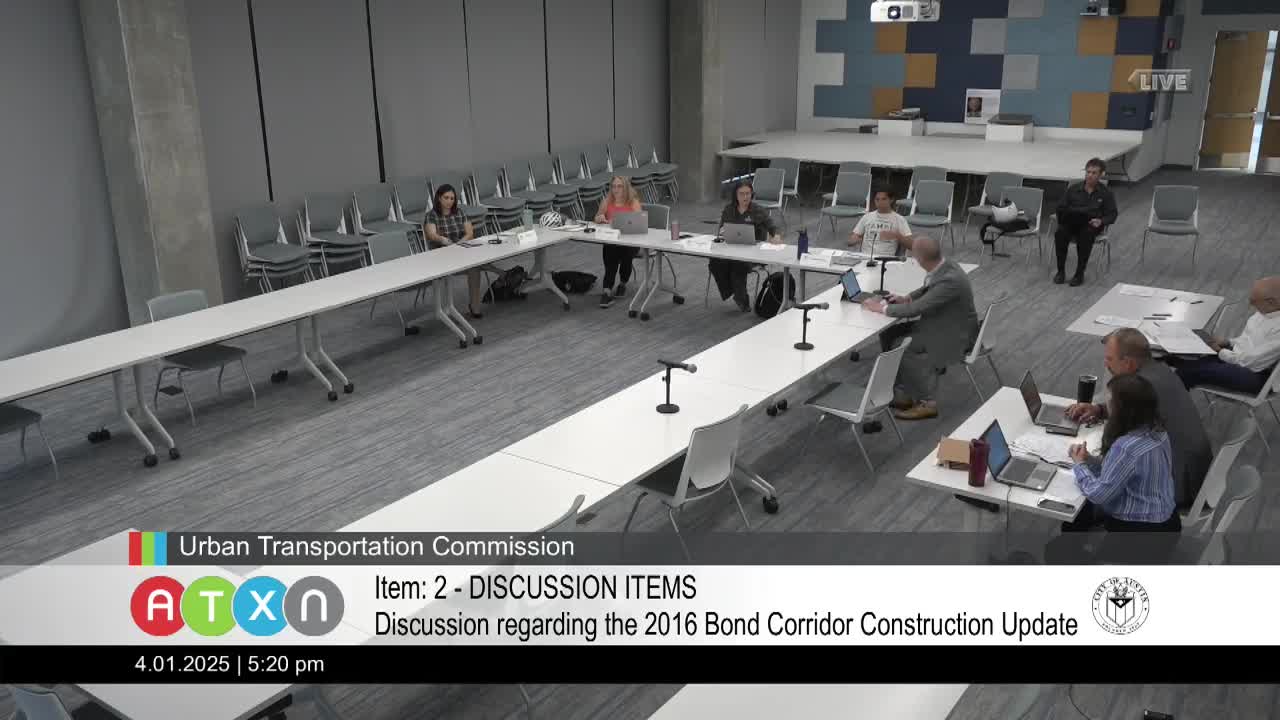
Austin Transportation staff told the Urban Transportation Commission on April 1 that projects funded by the 2016 Mobility Bond are increasingly moving into construction, but several corridors required scope changes, coordination with utility and drainage work, or have been deferred where regional transit work will reconstruct the roadway.
Austin Transportation staff told the Urban Transportation Commission on April 1 that projects funded by the 2016 Mobility Bond are increasingly moving into construction, but several corridors required scope changes, coordination with utility and drainage work, or have been deferred where regional transit work will reconstruct the roadway.
The update, presented by Eric Bailey, deputy director of Capital Delivery Services, detailed completed drainage work that enables corridor work on Burnet Road, active construction on William Cannon Drive and other signal/sidewalk fills, and planned advertising this year for more than $146 million in construction. Bailey said the program has reported about $265,000,000 in updated spending to date and roughly $100,000,000 in leveraged funds from grants and developers.
Bailey said many of the 2016 bond projects started as high-level concepts and during design were found to require additional work — for example, some projects evolved from relatively light transportation improvements into major storm-drain or watershed projects, which increased cost and schedule. Capital Delivery Services (CDS) and Austin Water/Watershed teams have been coordinating since 2023 to re-evaluate available budgets, prioritize work, and adjust scopes so projects can be delivered.
What’s under construction and planned - William Cannon Drive: Construction between Running Water and McKinney Falls is underway and Bailey said the project includes roadway widening over a creek and extensive underground utilities; the target completion window was described as early 2026. - Burnet Corridor: A completed drainage project tied to Burnet enables remaining work from 183 to MoPac. Bailey said portions will be delivered via an IDIQ (indefinite delivery/indefinite quantity) contract, with bidding planned in May for segments including Whitehorse Trail to 183 and Bright Verde to MoPac. - Airport Boulevard: Shared-use path work is currently under construction; an IDIQ model will continue pedestrian and bicycle work east of I-35 down to 183. - North Lamar: Signal improvements are complete in several locations; staff are filling sidewalk gaps where right-of-way and open-channel drainage constraints allow. Bailey noted North Lamar is particularly challenging because limited right-of-way and open drainage channels constrain where sidewalks can be placed. - Riverside Drive and Guadalupe Street: Bailey said the bulk of roadway improvements along Riverside and Guadalupe have been deferred because Project Connect’s alignment places high‑capacity transit in the median and will require major reconstruction; bond funds are not being used for maintenance work such as potholes. - Slaughter Lane: A construction contract was recently awarded for the section from MoPac to Brodie; construction is expected to begin in the next months with coordination planned near Bowie High School. - South Lamar: Staff described South Lamar from Barton Springs to Highway 71 as a major corridor project with extensive utility relocations, storm-water work and phased traffic control that will extend construction duration. Bailey said staff are pushing to advertise South Lamar before the end of the calendar year. - MLK Boulevard: The project reached 90% design; construction is expected to be performed by TxDOT with a start estimate of early 2026, pending TxDOT availability.
Timing and delivery goals Bailey said CDS aims to have most projects advertised for bid by the end of 2025 so contracts are in place (encumbered) this calendar year. He said construction typically represents 60–70% of program spending and much of that occurs late in a bond program. For TxDOT‑led projects staff have less direct control over schedule; those projects can extend beyond 2026. Bailey cited South Lamar as an example that may extend into 2027 because of complex phasing to maintain traffic during construction.
Commissioners pressed for more transparent, corridor-level spending and prioritization information as the city prepares the next bond cycle for 2026. Commissioner Daniel Kavalman asked whether staff perform preliminary engineering or surveys to develop accurate cost estimates for projects proposed for a future bond; Bailey said that is a key lesson from the 2016 program and the city plans to bring more detailed planning and cost estimates to the 2026 bond development so projects presented for ballot can be delivered on predictable timelines.
Why it matters Bailey and commissioners framed the update as part of a broader effort to learn from the 2016 bond delivery timeline: many projects were conceived at a high-level in 2016, and nearly a decade later some remain in design or early construction. The commission pressed staff to present corridor-level planned spend and staging at a future briefing so elected leaders and the public can assess what remains to be built and how it would be funded.
What’s next Bailey offered to return with corridor-by-corridor planned spending and clarified schedules at a future commission meeting to inform the 2026 bond process.
AI generated
The text on this page is AI generated. Summaries, highlights, analysis, and video transcripts are all produced from the original source material.
AI can make mistakes, so if you spot one, and we will fix it for everyone.
Note: the source content is unaltered by us. Any content source we link to, be it a video, an audio recording, or a document, is presented exactly as its publisher released it. That publisher is usually a government body, sometimes an individual official or another organisation.