Lifetime Citizen Portal Access — AI Briefings, Alerts & Unlimited Follows
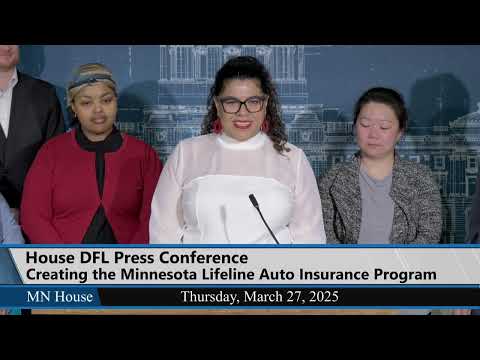
Supporters urge passage of House File 2215 to create Minnesota Lifeline low-cost auto insurance program
Loading...
Summary
Lawmakers heard testimony in Saint Paul supporting House File 2215, a proposal to create a state-run low-cost auto insurance option called Lifeline aimed at reducing uninsured driving and addressing price disparities tied to zip code and credit scoring.
Representative Athena Hollins testified in Saint Paul in support of House File 2215, a proposal to create a state-run, low-cost auto insurance program called Lifeline intended to expand access to affordable liability coverage for Minnesotans.
Supporters told legislators the program would reduce the number of uninsured drivers, curb practices they described as discriminatory (including premium differences tied to zip code and credit scores) and provide a lower-cost option for people priced out of the private market. "A state run program would ensure that all residents have access to affordable auto insurance," Representative Athena Hollins said. "Reducing the number of uninsured drivers on the road is good for all Minnesotans."
The St. Paul and Minnesota Foundation’s director of advocacy, community engagement and equity, Katya Cepeda, said the program could ease economic pressure in neighborhoods with high eviction rates. Cepeda cited city data identifying zip code 55106 as having one of the region’s highest eviction rates and said residents there also face some of the state’s highest auto insurance costs. She told the committee that even relatively small debts — she cited an average unpaid rent amount of $53 in the materials she referenced — can push families toward eviction and that lower insurance costs could help stabilize households.
The American Civil Liberties Union of Minnesota’s Munira Mohammed framed affordable coverage as a civil‑liberties and public‑safety concern. Mohammed said use of non‑driving factors in premium setting — including zip code and credit scores — disproportionately raises costs for Black and Brown Minnesotans and can force people to drive uninsured, exposing them to criminal penalties. "If we are going to impose criminal punishments on people who drive without insurance, we have an obligation to ensure that those people have the ability to obtain insurance," Mohammed said.
Speakers from community financial‑coaching networks and advocacy groups gave examples of the bill’s potential effects on individual households. Dave Snyder, statewide FAME program director at West Central Minnesota Community Action, described client stories in which surging premiums or lapses in coverage led to lost income, court appearances or long-term restitution obligations following accidents.
Anna Odegard of the Fines and Fees Justice Center said House File 2215 was heard the previous day in the House Commerce Committee and reported concerns raised by insurance industry representatives and the Minnesota Association for Justice. Odegard summarized cost estimates discussed in committee materials: she said the plan’s estimated administrative impacts would amount to an average increase of about "2.5 cents" on commercial market policies and that the bill included a proposed 10¢ surcharge per six‑month policy to fund outreach and marketing for Lifeline. "In exchange for that 2 and a half cents, the Lifeline program will lower uninsured driving rates in Minnesota," she said.
Committee members asked witnesses to clarify several technical points. One questioner cited literature in the handout and asked whether a driver with excellent credit and a DWI could pay less than a driver with poor credit and no DWI. Witnesses pointed to Consumer Reports and Consumer Federation of America studies showing that, for certain driver profiles, poor credit can lead to materially higher premiums than a recent DUI with excellent credit. As summarized by witnesses, those studies compare hypothetical quotes across major Minnesota insurers and report that drivers with poor credit have paid roughly two‑to‑three times what similar drivers with excellent credit pay, holding driving record constant.
Witnesses and advocates described current trends they said increase pressure on Minnesotans: speakers cited a large 2023–24 increase in average auto insurance rates (speakers referenced a 22% increase in 2023 followed by a 58–61% rise in 2024) and said Minnesota’s estimated uninsured driver rate is just under 10 percent; advocates stated that translates to roughly 400,000 uninsured drivers statewide, though exact official counts were not provided at this hearing.
No formal committee action or vote on House File 2215 was recorded at this public testimony session. Supporters asked lawmakers to advance the bill and expand access to coverage; opponents’ representatives were noted as having raised concerns in committee but did not present testimony at this hearing.
Supporters said Lifeline would aim to reduce uninsured driving, lower long‑term costs for all drivers by stabilizing the risk pool and correct what they described as inequitable pricing practices in the private market. Several witnesses acknowledged tradeoffs raised in committee — including potential small cost shifts to commercial policies — and said those costs would be outweighed by broader reductions in uninsured driving and related harms.
The bill’s next formal steps were not specified during this public testimony. Advocates thanked Representative Hollins and several co‑sponsors for advancing the measure and concluded by asking the committee to move the proposal forward.