Get Full Government Meeting Transcripts, Videos, & Alerts Forever!
Get email alerts on the South Sudan Conflict topic
No spam. Unsubscribe anytime.
U.N. envoy warns South Sudan risks relapse into civil war as violence, foreign troop deployments rise
Summary
Nicholas Haysom, the U.N. special representative for South Sudan, warned that recent militia attacks, aerial bombardment and the deployment of foreign forces risk plunging South Sudan back into civil war; he said at least 63,000 people have fled and U.N. evacuation helicopters were fired upon during medevac missions.
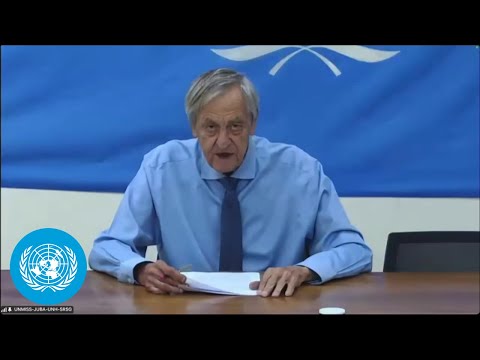
Nicholas Haysom, the U.N. special representative for South Sudan and head of the U.N. Mission in South Sudan (UNMISS), told reporters that the security and political situation in South Sudan “has significantly deteriorated” and that the country is “on the edge of a relapse into civil war.”
Haysom said fighting escalated after the White Army militia overran barracks previously held by the South Sudan People’s Defense Forces (SSPDF) in Nasir on March 4. He said communities across the country’s Upper Nile region have faced persistent aerial bombardment using improvised devices — including barrel bombs “allegedly containing a highly flammable liquid” — that have caused significant casualties and severe burn injuries among civilians, including women and children. “At least 63,000 people have fled the area,” Haysom said.
Haysom reported further mobilization of White Army forces and SSPDF units in areas he identified as Napa Nail, including allegations of children being forcibly recruited into armed formations. He also said foreign forces have recently entered South Sudan at the request of the government, specifically citing a “significant number of Ugandan regular armed forces.”
The U.N. envoy described growing political tensions as senior military and civilian officials affiliated with the Sudan People’s Liberation Movement (SPLM) in opposition have been removed from positions or detained, and said political speech is exacerbating ethnic divisions and fear. “If the peace agreement goes down, it’s difficult to see how the country can conclude its difficult transition,” he said, urging strict adherence to the revitalized peace agreement, immediate release or lawful treatment of detainees, and a return to consensus-based decision making.
Haysom also recounted attacks on U.N. evacuation flights. He said UNMISS and humanitarian partners made three medevac sorties into Nasir to evacuate wounded SSPDF soldiers, removing 15 people to Molokow. During the third sortie on May 3, he said a general agreed by parties to be removed from the scene and a U.N. crew member were shot dead; two U.N. crew were injured. Haysom said two aircraft participated in the mission, one of which was partially damaged. He added that a few days earlier an SSPDF helicopter had been downed.
On regional diplomacy, Haysom said UNMISS is engaging in “intense shuttle diplomacy” together with regional and international partners — including the African Union, the Intergovernmental Authority on Development (IGAD) and the reconstituted Joint Monitoring and Evaluation Commission (RJMEC) — to persuade parties to pull back from the brink. He said the U.N. Security Council and the African Union Peace and Security Council met recently and that IGAD heads of state had authorized a ministerial subcommittee for Juba. A planned visit by IGAD foreign ministers that was due to take place in Juba was, he said, postponed at the government’s request to April 3.
Haysom warned that once hostilities spread, the conflict would likely become ethnicized and pointed to “horrid hate speech circulating online,” singling out the risk of focused mobilization along Dinka and Nuer lines if large-scale fighting resumes. “We will take the threat of the ethnic transformation of the conflict very seriously,” he said.
The U.N. envoy and the U.N. mission urged restraint, the release of detainees held without clear justification and renewed engagement with the revitalized peace agreement. He said international and regional leaders have been contacting parties and that diplomatic outreach must be sustained to prevent a wider regional crisis.