Get Full Government Meeting Transcripts, Videos, & Alerts Forever!
Get email alerts on the Historic Preservation Burial Grounds topic
No spam. Unsubscribe anytime.
D.C. hearing advances case for Paul E. Sloughby Sr. preservation fund to protect historic African American burial grounds
Summary
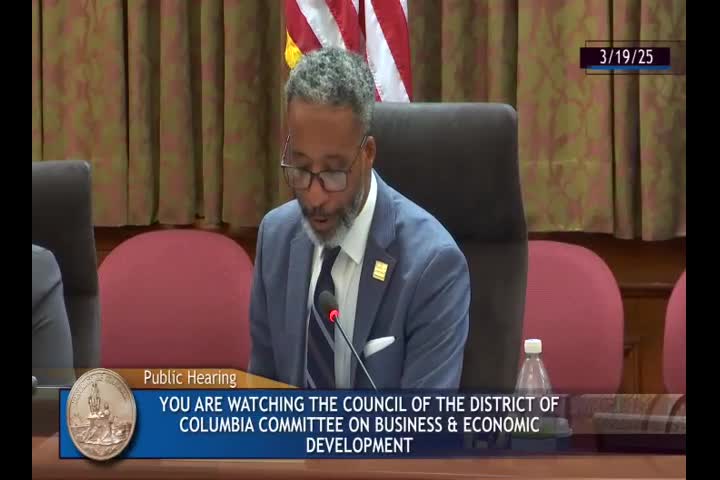
The Committee on Business and Economic Development convened a public hearing March 19, 2025, in the John A. Wilson Building and by Zoom to receive testimony on Bill B26-20, the Historic African American Burial Grounds Preservation Fund Amendment Act of 2025, which would establish the Paul E. Sloughby Sr. Preservation Fund to preserve, protect and maintain historic African American cemeteries and burial grounds in the District of Columbia.
The Committee on Business and Economic Development convened a public hearing March 19, 2025, in the John A. Wilson Building and by Zoom to receive testimony on Bill B26-20, the Historic African American Burial Grounds Preservation Fund Amendment Act of 2025, which would establish the Paul E. Sloughby Sr. Preservation Fund to pay for preservation, protection and maintenance of historic African American cemeteries and burial grounds in the District of Columbia.
Community members, historians and preservation officials urged passage and sustained funding, saying public appropriations, grants and donations should support sites that face erosion, flooding and decades of neglect.
Only four intact historic African American burial grounds remain in the District, witnesses said, and testimony at the hearing described conditions that speakers called urgent. Witnesses represented local preservation organizations, descendant-led volunteer groups and the D.C. Office of Planning. They recounted long familiarity with the sites, described archaeological and archival work, and pushed for a permanent funding stream and clear city stewardship.
Dr. Patricia Carter Sloughby, whose late husband Paul E. Sloughby Sr. is the bill's namesake, testified that her husband "used all that was in his power to help protect those in peaceful sleep from being disturbed," and that his work documented burial grounds and genealogies across the District. Lisa Fager, executive director of the Black Georgetown Foundation, told the committee that naming a dedicated fund for Sloughby "is not just fitting, it is necessary." She said Mount Zion and the Female Union Band Society cemeteries hold an estimated 8,000 to 10,000 interments and face damage from stormwater runoff that topples headstones and erodes burial plots.
Speakers described a range of local sites and histories. Antoinette White Richardson, president of the Woodlawn Cemetery Perpetual Care Association, said Woodlawn Cemetery covers roughly 22.5 acres and contains approximately 36,000 burials; she said preservation costs are high, noting a 2022 estimate of $88,000 for professional landscaping and stabilization work. Multiple witnesses documented historic disinterments and relocations: Courtney Morris and others cited Columbia/Harmony, Paine's and Graceland cemeteries among the many cemeteries that were removed or relocated over the nineteenth and twentieth centuries.
Volunteers and descendants stressed that long-term maintenance cannot rely on intermittent volunteer days. Susan Galbraith, Sheldon Ray and others described community-engagement projects, educational programming and arts-based efforts designed to connect residents and students to the sites. Mary Belcher, who works with the Walter Pierce Park archaeology project, described a multi-year effort that produced signage listing more than 8,400 names associated with Mount Pleasant Plains Cemetery and urged the committee to simplify grant rules so grassroots groups can apply.
David Maloney, State Historic Preservation Officer and Associate Director for Historic Preservation in the D.C. Office of Planning (OP), said OP "fully support[s] the creation of this fund, but for the reasons I will explain, recommend that it be administered by OP, instead of the Deputy Mayor for Planning and Economic Development." Maloney told the committee that OP maintains an internal spreadsheet and GIS database of known and possible burial sites—he described roughly 319 known and possible burial sites in D.C.—and said OP staff have the archeological and historical expertise to oversee grants and stewardship.
Witnesses also raised procedural and legal concerns. Testimony described an instance in which Rock Creek Park work uncovered burial-related artifacts and, according to witnesses, proceeded without appropriate archaeological oversight until community members intervened. One witness referred to "a federal law called Section 106" for consultation and protection when federal undertakings affect historic properties. Several witnesses pressed the committee to require cultural competence and community notification when public or private projects might disturb burial places.
Committee members asked witnesses for clarifications: Dr. Sloughby and others confirmed that four intact historic African American burial grounds remain—Mount Zion Cemetery, the Female Union Band Society Cemetery, the Union Burial Ground of Georgetown, and Woodlawn Cemetery—and they described additional, less-intact or relocated sites beneath modern developments. Committee members and witnesses discussed whether OP or the Deputy Mayor's office should administer the fund and how to ensure grant accessibility for small community groups.
The hearing produced no formal council action; members invited written testimony through March 28, 2025. The committee will use the testimony and agency advice to consider bill language and administrative arrangements, including whether OP should administer the fund and how the grant process should be structured to serve grassroots stewards as well as larger institutions.
Given the historic and genealogical material at stake, witnesses urged a permanent, adequately funded program to address erosion, long-term maintenance, archaeological oversight and public education so the sites are not lost to development, weather and deferred care.
Witnesses (selected): Dr. Patricia Carter Sloughby, Lisa Fager (Executive Director, Black Georgetown Foundation), Erica Berg (D.C. resident/volunteer), Antoinette White Richardson (President, Woodlawn Cemetery Perpetual Care Association), Susan Galbraith, Sheldon Ray, Courtney Morris, Mary Belcher (Walter Pierce Park Archaeology Project), Brenna Clark, Claire Harrison, David Maloney (State Historic Preservation Officer, D.C. Office of Planning).
The committee did not take a vote on B26-20 during the March 19 hearing; members asked for additional written materials and said they would consider clarifying language, administrative placement and grantmaking rules in later markup sessions.