Get Full Government Meeting Transcripts, Videos, & Alerts Forever!
Get email alerts on the Data Governance topic
No spam. Unsubscribe anytime.
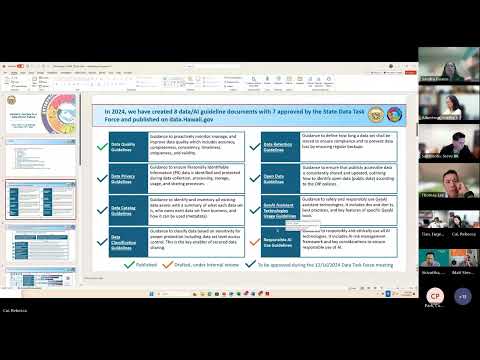
State data task force approves seven technical guidelines; generative-AI rules cleared pending two edits
Summary
The state Data Task Force, convened by the Office of Enterprise Technology Services (ETS), approved a package of technical data guidelines and conditionally approved generative AI assistant usage guidance with two follow-up edits. Members also discussed open-data automation and next steps to move guidelines toward enforceable standards.
The state Data Task Force, convened by the Office of Enterprise Technology Services (ETS), approved seven technical guidance documents and conditionally approved a generative-AI assistant usage guideline at a meeting where members also discussed open-data automation and how to turn voluntary guidance into enforceable standards. The meeting did not record a roll-call vote; approvals were carried by consensus.
The approvals included guidance on data privacy, data cataloging, data classification, data retention, open-data publication, and geospatial-data governance. The Gen AI assistant technology guideline was approved pending two specific edits: (1) add a short statement addressing intellectual property and copyright, and (2) clarify when published content should include an AI-disclosure/footnote.
Why it matters: the documents provide a common framework for how state departments should catalog, classify and publish data and how staff should handle content produced or assisted by generative AI tools. Task force members said the guidance is intended to improve data interoperability across siloed agencies, reduce stale public datasets on opendata.hawaii.gov, and establish incident-notification steps when nonpublic data is shared with free AI tools.
Key decisions and discussion
Standards vs. guidelines: Task force members described why the documents were labeled “guidelines” rather than enforceable standards: the group lacks statutory authority and the statewide toolset and staff capacity needed to enforce mandatory standards. As one presenter said, “we don't have the... legal authority to enforce it, and we don't have the... tools or resources to enforce it at this moment,” so the team converted proposed standards to guidance for now.
Gen AI assistant technology guidance: The group discussed wording and operational steps for handling inadvertent disclosures to third‑party AI tools. Under the revised text members agreed to require that: “if non public data is accidentally entered into a free Gen AI tool, notify your departmental IT lead, security lead, and PIO immediately. Departmental IT lead, security lead, and the PIO shall review the data impacted and follow existing procedures.” The presenter also summarized the guidance that “Gen AI users must review all contents generated by Gen AI tools before publishing.” Those two points were recorded as changes and will be incorporated before final publication.
Members also asked for two additions to the Gen AI guidance: a short, explicit bullet on intellectual property and copyright and a clarification that state‑licensed, walled‑garden AI tools (the committee’s working assumption) should not use departmental data to train external models; the draft will note that assumption.
Representative engagement and resources: Representative Peruso suggested exploring legislative avenues to fund staff and tools to move from voluntary guidance to enforceable standards and offered to consult with the chair of the legislative committee on economic development and technology. Task force members said they have requested data governance tools and budget resources in the coming budget cycle; ETS staff said tools were included in the governor’s budget request but staffing/resources were not.
Open data and SR 69: The group reviewed progress on a senate resolution (SR 69, 02/2024) that required departments to refresh datasets on opendata.hawaii.gov. ETS staff reported they have identified department data leads and are exploring automation so departments can publish recurring feeds that the statewide open-data platform ingests on a schedule. ETS staff said some departments already publish automatically (for example, through scheduled feeds to data users such as UHERO) while others listed zero planned datasets to update or marked “TBD.” ETS will ask departments to supply a clearer inventory of existing datasets and plans so the portal does not fall stale again.
Implementation and next steps: The presenter said the task force will add the IP/copyright bullet and the walled‑garden assumption to the Gen AI guideline, then circulate the revised draft for final approval; the committee recorded two action items tied to that update. The group also reported progress this year on a data-governance framework, a geospatial governance roadmap, a data-AI glossary published on data.hawaii.gov, and data-literacy training; AI-literacy training and a broader responsible-AI use guideline are expected for review at the March meeting.
Votes at a glance
- Approval: September meeting minutes — Outcome: approved by consensus; motion recorded but no roll-call tally. - Approval: Data privacy guidelines — Outcome: approved by consensus. - Approval: Data cataloging guidelines — Outcome: approved by consensus. - Approval: Data classification guidelines — Outcome: approved by consensus. - Approval: Data retention guidelines (prepared with the state archive) — Outcome: approved by consensus. - Approval: Open data guidelines (developed with OIPR and a data-flow decision tree) — Outcome: approved by consensus. - Approval: Geospatial data governance framework / related catalog approach — Outcome: approved by consensus. - Approval: Generative-AI assistant technology guideline — Outcome: approved pending incorporation of two edits (add IP/copyright language; clarify disclosure/footnote expectations for published AI-generated content). The task force recorded those two edits as action items; final sign-off will follow circulation of the revised draft.
Attributions and next meeting
Members repeatedly emphasized that data governance is a journey and that departments retain data ownership while ETS provides tools and standards. ETS staff said they will continue to explore automation for the open-data portal, seek staff resources in the next budget cycle, and circulate the Gen AI edits. The task force scheduled its next meeting in March and expects to present the responsible-AI use guideline and an update on AI-literacy training.
Ending note: ETS staff thanked the task force for “a very productive year” and said they hope to finalize the pending edits and bring the revised Gen AI guideline back for approval in the coming months.