Get Full Government Meeting Transcripts, Videos, & Alerts Forever!
Get email alerts on the Street Vending topic
No spam. Unsubscribe anytime.
Council hearing exposes tensions over street vending implementation, proposed recriminalization and enforcement in Columbia Heights
Summary
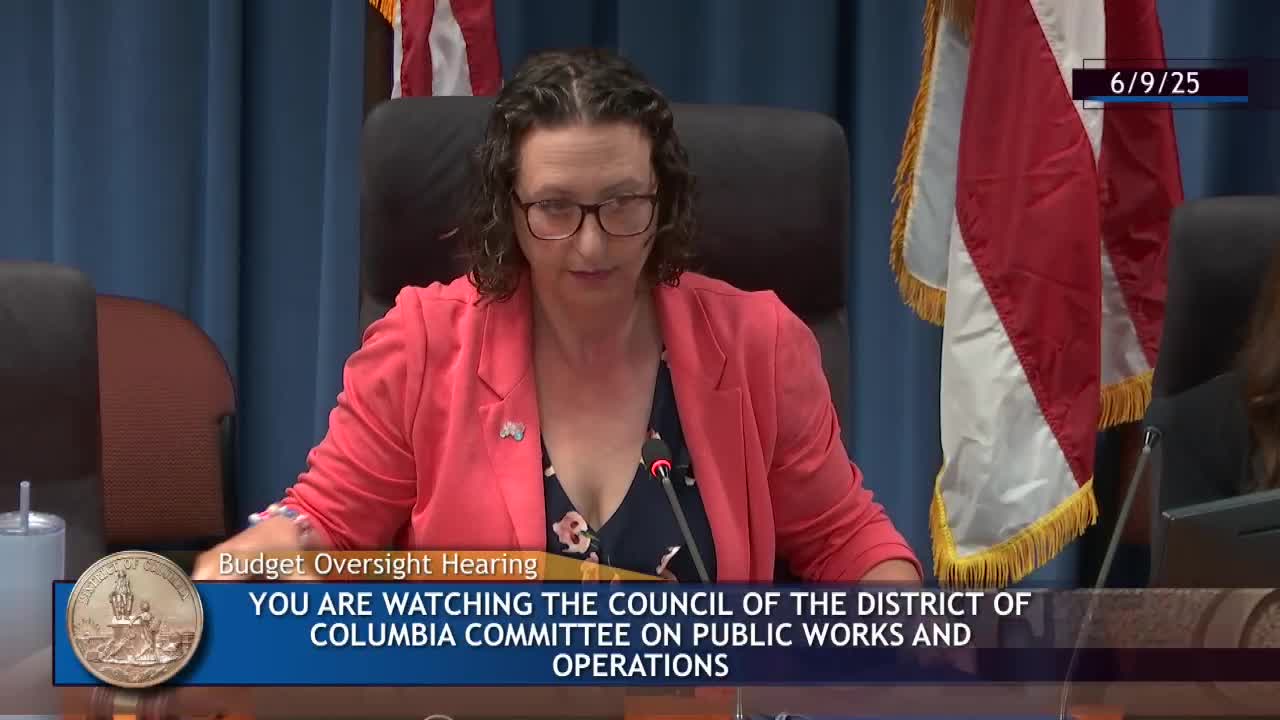
Chair Brianne Nadeau convened the Committee on Public Works and Operations’ June 9 hearing focused on DLCP’s FY 2026 budget; public testimony centered on implementation of the Street Vendor Advancement Amendment Act of 2023 in Columbia Heights and Mount Pleasant.
Chair Brianne Nadeau convened the Committee on Public Works and Operations’ June 9 budget oversight hearing on the Department of Licensing and Consumer Protection (DLCP) to examine FY 2026 funding and agency implementation of recent laws. Much of the public testimony and subsequent questioning focused on implementation of the Street Vendor Advancement Amendment Act of 2023 in the Columbia Heights–Mount Pleasant vending zone.
Advocates and neighborhood officials described a failure of DLCP to carry out the law’s site-management responsibilities and urged the committee to remove language in the mayor’s proposed Budget Support Act (BSA) that would recriminalize unlicensed vending and raise fines. Janneke Mictin, an organizer who works with street vendors, said inspectors have repeatedly shown up without translators and that “DLCP clocks more hours on the street harassing street vendors than in their office actually trying to give vendors their licenses.” Jeremy Sherman, an ANC 1A commissioner, told the committee that sidewalks at Fourteenth and Irving are “overcrowded” and that licensing and management changes promised after the 2023 law have produced “little to no changes in Columbia Heights.”
Legal and vendor advocates asked the council to preserve the 2023 law’s decriminalization. Jeff Gilbert of Beloved Community Incubator said the mayor’s draft budget includes “a street vending subtitle that's more than 25 pages long” that he described as effectively a new law inserted through the budget process. He warned that the mayor’s proposal would “recriminaliz[e] vending without a license and reinserting into the criminal code a misdemeanor offense for vending without a license punishable by up to 90 days in jail.” Gilbert said DLCP had repeatedly called MPD to assist enforcement in Columbia Heights after the law’s passage and that a vending zone manager contract required by the 2023 law has not been in place since December 2023.
DLCP Director Tiffany Crowe defended the agency’s work and framed the BSA language as a combination of steps to make vending “easier to vend in the city” while giving the agency additional enforcement tools for vendors who “present a health and safety risk.” Crowe told the committee the BSA would create two new licenses — “the sidewalk vending license and the mobile vending license” — and give DLCP grant-making authority to help vendors with startup costs such as carts and tables. She said DLCP is testing a permit model that would allow licensees to vend in any lawfully designated vending location rather than a single fixed spot, a change other cities use to spread vendors and reduce sidewalk congestion.
Committee members pressed DLCP on several operational points. Witnesses and council members said the vendor-zone manager contract was canceled in October 2024, after which outside applicants did not materialize. Gilbert and vendor organizers described the contract’s cancellation as a turning point that left the zone without a daily manager to allocate and coordinate site-sharing among vendors. DLCP has reposted the RFP and held a pre-bid conference, but the department reported zero applicants the most recent round; Director Crowe said the $125,000 currently allocated by the 2023 law is not sufficient for the scope of work required.
Advocates urged concrete administrative fixes. Suggestions included clearer, publicly posted site maps for the vending zone, hiring Spanish-speaking enforcement officers, marking approved vending spaces or kiosks on sidewalks, grants for uniform tables/carts, and stronger coordination with DDOT and Metro on high-traffic corners. Beloved Community Incubator said roughly 15 merchandise vendors have received vending badges after an administrative change earlier this year that stops attaching badges to a single specific site; the group said that change created confusion because site-assignment and crowding issues remain unresolved. Director Crowe said DLCP would post the vending map used in the application online and that the agency could take on intra-agency coordination more readily than an external nonprofit because DLCP already has relationships with OTR, DDOT, DPW and DC Health.
Public safety and police involvement were central tensions. Advocates accused DLCP of inappropriately calling MPD to enforcement actions and of showing up without translators, which they said intimidated vendors and violated the 2023 law’s spirit. Director Crowe responded that MPD has not been used for routine vending enforcement and that staff called MPD when investigators feared for their safety; she said the agency will investigate specific incidents raised in testimony (including a March incident and a recent Saturday enforcement action that drew multiple public complaints).
The committee asked DLCP to return with more detail about the scope of site marking, the status of the vending-zone manager hiring, whether grant funds for carts/tables are included in the FY 26 budget, and whether the mayor’s draft penalties and any proposed criminal sanctions are necessary and proportionate. The hearing record remains open through June 23 for written testimony.
Ending: Council members emphasized they want DLCP to produce an implementation plan and a public site map and asked for follow-up data on MPD calls, contractor applicants for the vending-zone manager, and the proposed budgetary impact of any changes to fines or criminal penalties.