Get AI Briefings, Transcripts & Alerts on Local & National Government Meetings — Forever.
Georgetown council reviews new 'Residential Mixed' zoning to allow smaller lots and varied housing
Summary
City staff presented a draft RM (residential mixed) zoning district to permit smaller detached lots, attached homes, duplexes, townhomes and courtyard homes; council directed staff to set a 20-acre maximum for straight rezoning and prioritize flexibility over strict mandatory mixes.
City of Georgetown planning staff presented a proposed Residential Mixed (RM) zoning district at a City Council workshop on Oct. 27, asking the council whether the draft purpose, allowed uses and dimensional standards would meet goals for infill, transitions and housing variety.
The draft RM zoning is intended to implement the city's 2030 plan by allowing a range of housing types on smaller lots and easing reliance on negotiated Planned Unit Developments (PUDs). Staff said the RM category would allow smaller single-family detached lots (proposed minimums as small as 40 feet front-loaded, 35 feet alley-loaded), single-family attached (condo/lot-and-block attached units), duplexes (proposed minimum lot area about 6,000 square feet front-loaded and 5,000 square feet alley-loaded) townhomes and courtyard homes that front a shared green rather than a public street.
"We are looking today at a new zoning category," city planner Sophia told council as she introduced the draft. She framed the RM district around six guiding principles the steering committee and staff have used during the Unified Development Code (UDC) update, including balancing certainty and flexibility and creating transitions between intensities.
Why it matters: the council and staff said the RM district is intended to give developers predictable standards so smaller-lot and attached housing can be built as-of-right in appropriate locations, rather than repeatedly relying on PUD negotiations for the same outcomes. That could speed approvals for infill projects but also raises concerns about uniformity, neighborhood character and where denser products should be allowed.
Key discussion points
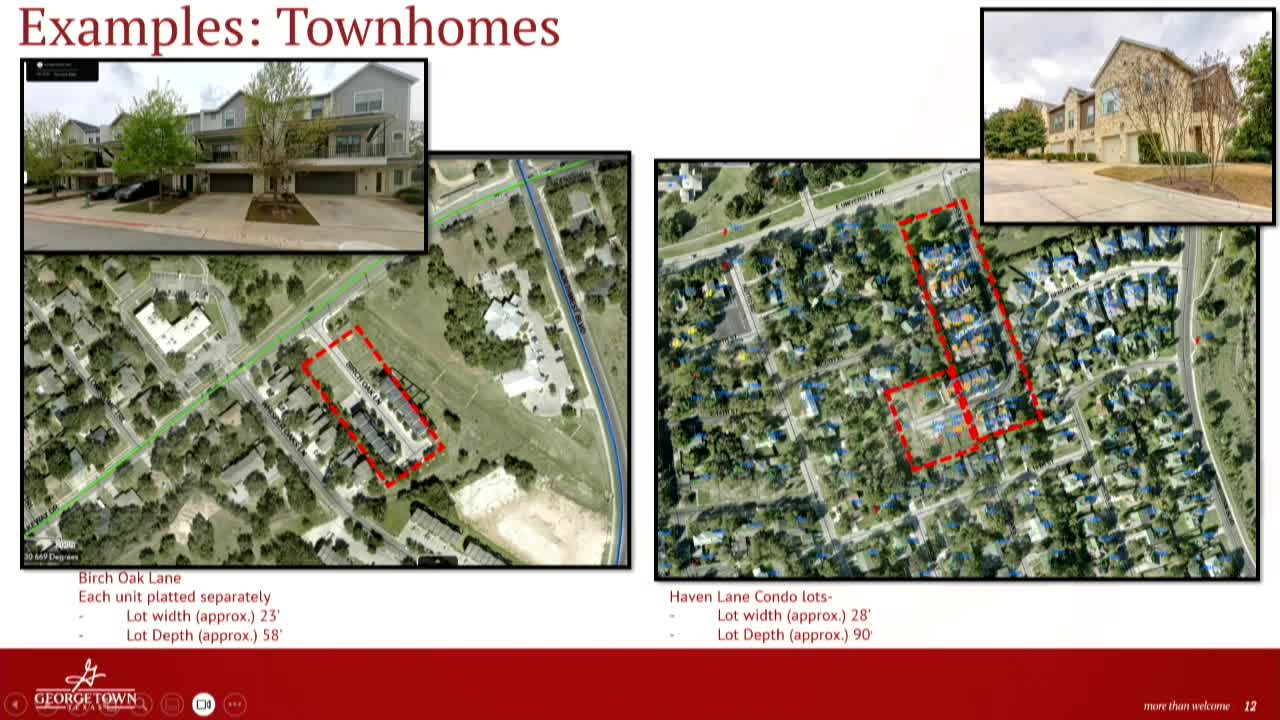
- Purpose and examples: Staff used Georgetown examples (Terra Vista/La Cantera, Saddle Creek, Birch Oak Lane, Adams Lane, Carlson Place, La Cantera North, Davidson Ranch and the Old Mill area) to show how lot widths and depths compare to the proposed standards and to illustrate how attached and stacked products have been created by condo plats or PUDs. Staff said some existing RS single-family standards (for example a 5,500-square-foot minimum in certain categories) make attached products unattractive under current code.
- Design and connectivity: Proposed RM standards include reduced intersection spacing to encourage a more connected street network, peripheral buffering requirements rather than interior buffering, and architectural similarity standards to discourage repetition of identical elevations on a block. Staff said townhomes and duplexes currently lack the variety standards that single-family residential zoning requires.
- Diversity requirement debate: Steering committee members recommended emphasizing flexibility over strict mandates. Council members debated whether to require a minimum percentage of housing types (for example, require at least one larger lot per X duplexes or mandate multiple product types per acreage). Concerns included avoiding a "sea of identical 42-foot lots" (as some council members described Davidson Ranch) while also not over-complicating the straight-zoning process so the district goes unused.
Council direction and next steps
Councilors and staff coalesced around two near-term directions: make the new RM district broadly permissive but limit the scale for straight rezoning, and monitor outcomes via the UDC advisory committee. "So we will work to create a max acreage of no more than 20 acres," Sophia said, summarizing staff's planned changes and committing to return the RM language with the acreage cap and additional drafting for the development table and advisory review.
Staff also said they will bring back proposed tables that link required diversity to acreage brackets (for example different requirements for parcels under 5 acres, 5—10 acres, and 10—20 acres), but the council left the exact ratios to be refined by staff and the UDC advisory committee after adoption. Council members said they expect the advisory committee and subsequent entitlements to reveal whether the flexibility approach yields the housing mix the city wants.
Ending
Staff will redraft the RM district to reflect council guidance (including a 20-acre maximum for straight rezoning), refine the lot-size and diversity tables and return the proposed UDC language to planning commission, the UDC advisory committee and council for further consideration and adoption.