Get Full Government Meeting Transcripts, Videos, & Alerts Forever!
Get email alerts on the Emergency Shelters topic
No spam. Unsubscribe anytime.
Puerto Rico education committee reviews bill to designate unused schools as shelters for people with medical needs
Summary
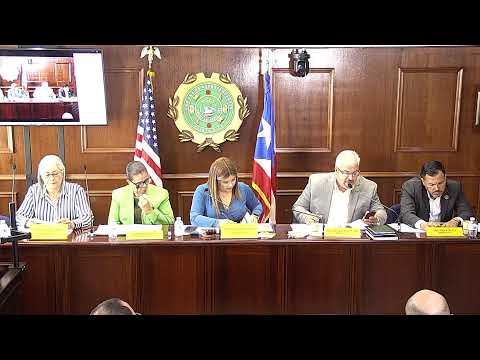
The Commission on Education of the House of Representatives of Puerto Rico held a public hearing Friday, March 7, on Proyecto de Cámara 32, a measure that would require the secretary named in the bill to evaluate public schools identified as "en desuso" (out of use) and designate at least one such school per municipality or emergency zone to serve as a shelter for families that include a person who needs special medical or health care.
The Commission on Education of the House of Representatives of Puerto Rico held a public hearing Friday, March 7, on Proyecto de Cámara 32, a measure that would require the secretary named in the bill to evaluate public schools identified as "en desuso" (out of use) and designate at least one such school per municipality or emergency zone to serve as a shelter for families that include a person who needs special medical or health care.
The Department of Health and other agencies offered technical recommendations but warned the committee that the proposal would require funding, staffing and interagency coordination to function as written. Víctor Ramos Otero, the secretary-designate of the Department of Health, said the department supports inclusive sheltering but cautioned that the facilities called for in the bill should not be treated as full medical shelters. "Al igual que las mejores prácticas para habilitar refugios de emergencia enfatizan que estos espacios deben ser inclusivos," Ramos Otero told the commission, adding that shelters must accommodate people with disabilities, people with pets or service animals, tourists and people regardless of immigration status.
Ramos Otero and Sherly Squiling, director of the Division of Preparedness and Coordination for Public Health Response, outlined practical requirements the bill would trigger. They recommended that designated sites be near neighborhoods at higher risk and not sited in areas prone to flooding, storm surge or landslides; that buildings meet accessibility standards such as the Americans with Disabilities Act (ADA); and that shelters possess reliable power and water sources (generators and cisterns) and an inventory of medical supplies including oxygen and chronic-care medications. Ramos Otero noted the department's central concern: staffing. "El departamento de salud no dispone del personal necesario para satisfacer las demandas que se pretenden...," he said, explaining that 24/7 clinical coverage at multiple specialized shelters would require recruitment and new funding.
The Department of Health recommended that any shelter designated primarily to support people with functional access needs be operated as a care-support shelter — not a substitute for hospital or CDT-level care — and that protocols be established for triage and transfer. Ramos Otero and Squiling emphasized that unstable patients should be moved to hospitals or CDT (primary care) centers; shelters should serve primarily people who are stable but require assistance with daily living or access support. Squiling said agencies must estimate staffing levels and costs before the program is expanded: "habría que identificar fondos... para poder identificar ese personal, reclutarlo y pues establecer..." she said.
Officials from the Department of Education and the Department of Transportation and Public Works (DTOP) described operational and property obstacles. César O. González Cordero, speaking for the Department of Education, said the department maintains emergency feeding responsibilities for schools designated as shelters and has been updating infrastructure: the department reported a $30 million investment program that has already installed about 106 new generators and plans to add generators at roughly 222 facilities by the end of the fiscal year. The department also said it has invested approximately $1.5 million to install cisterns and that some 344 schools are expected to benefit from cistern installations tied to federal restoration funds.
José A. Torres Aponte, director of the Office of Property Administration at DTOP, said DTOP is the custodian of titles for many closed-school properties and that the agency does not perform structural engineering studies as part of its routine property updates. He confirmed an inventory of unused schools exists and told the committee the agency would provide the list on request. He also noted that property titles are sometimes complicated: some schools sit on land recorded under different public authorities, and a portion of closed-school files may need deed or title clarification.
Committee members repeatedly pressed for costs, staffing estimates and the legal mechanism to implement the bill. Representative Luis Jiménez Torres and others asked whether the department could require people to evacuate to a hospital or designated setting in an emergency; Ramos Otero said governors may order mandatory evacuations but that, in practice, compliance varies and responders will attempt rescues when necessary. Several members asked whether municipalities have reliable data on electro-dependent or home-dialysis patients; Sherly Squiling described a data product the Department of Health shares with municipalities that aggregates federally supplied information on Medicare beneficiaries who are electrically dependent and other vulnerability indicators. Squiling said the department plans to deliver those "welcome package" snapshots to all municipalities by the end of April so local governments can use them for planning.
Education and DTOP officials also said that SETIC (the committee that evaluates disposition and rental or sale of public real estate) maintains a list of properties and that a January 9, 2025 listing submitted to the committee identified roughly 50 schools available for disposition. Representatives asked DTOP and Education to reconcile discrepancies between municipal knowledge of unused schools and the SETIC listing.
Requests and next steps. Committee members asked agencies to provide documentation and studies. The commission requested that DTOP and Education provide the inventory of schools in disuse within five to ten business days and asked the Department of Health to deliver existing plans and cited studies (including the MAVI study referenced by witnesses) and the department's current operational plan. Department officials agreed to supply the materials and a cost analysis for establishing sheltered facilities that include medical-support needs.
The hearing made clear that while the policy objective — identifying nearby shelter space for families with members who require special medical support — has bipartisan interest, implementing it would require new funding, clarified property titles, interagency agreements on maintenance and operations, and explicit staffing and liability arrangements. The commission recessed after the panel and set follow-up deadlines to receive inventories and plans.
Votes at a glance: No formal motions or votes on Proyecto de Cámara 32 were taken during this hearing; the session was a fact-finding and Q&A proceeding.