Get Full Government Meeting Transcripts, Videos, & Alerts Forever!
Get email alerts on the Executive Session topic
No spam. Unsubscribe anytime.
Board of Trustees votes to enter executive session under HRS section 92-5
Summary
The Board of Trustees voted to move into executive session pursuant to HRS section 92-5; roll call showed six trustees in favor and one excused. Trustees discussed excusing aides, noted no public sign-ups for the executive-session item and planned to return to open session after roughly 90 minutes.
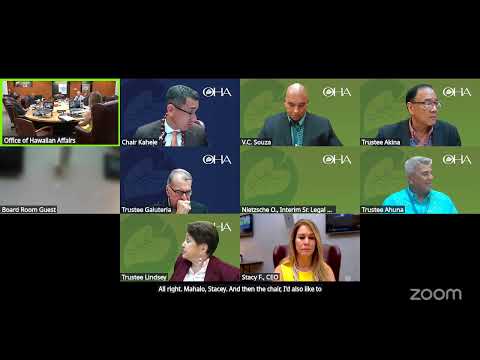
Chair Kahele announced that the Board of Trustees would move into an executive session under HRS section 92-5 at the start of its meeting, and a roll call showed six trustees in favor with one trustee excused.
The motion to recuse into executive session was made and seconded; after the roll call the chair said, “We have 6 trustees. We are moving into executive session.” Earlier in the meeting the chair also noted, “We have 7 trustees present. We have quorum.”
Board staff instructed remote attendees on how to provide testimony via Zoom for specific agenda items but said no members of the public had signed up to speak on the executive-session item. A trustee suggested that aides be excused during the executive session because of the sensitivity of the matters to be discussed; trustees did not object to that recommendation and the board’s chief of staff remained in the room at the chair’s request.
The board counsel, Richard Naivi Waterman, and Stacy Ferrer, introduced as the kaupohana and an on-site administrator for the meeting, were recognized before the board recessed into closed session. Trustees said they expected the executive session to last about an hour and a half and planned to resume the livestreamed open meeting at roughly 10:30 a.m.
No substantive policy debate or record of the executive-session discussion was made public in the transcript; the motion and its roll-call approval were recorded as the formal action that closed the open portion of the meeting.