Lifetime Citizen Portal Access — AI Briefings, Alerts & Unlimited Follows
Witnesses tell D.C. committee language-access failures leave Spanish-speaking and undocumented residents cut off from shelter and benefits
Loading...
Summary
Public witnesses at the Committee on Human Services oversight hearing described repeated failures by city-funded shelter and benefit programs to provide linguistically and culturally competent services, saying those gaps have left many Spanish-speaking and newly arrived residents unable to access emergency shelter, benefits, or critical casework.
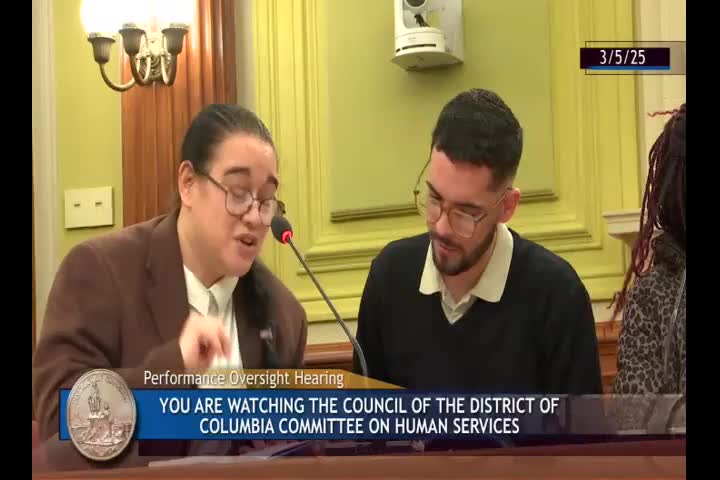
Dozens of Spanish-speaking residents and bilingual outreach workers told the D.C. Council Committee on Human Services on March 5 that language access failures across city-funded shelters, outreach and benefit programs are systematically excluding undocumented and limited-English residents from services.
The testimony came during the committee’s performance oversight hearing for the Department of Human Services and the Interagency Council on Homelessness. Witnesses described long waits, lost applications, and repeated need for bilingual advocates to do front-line translation work that city contractors should be providing.
“Shelters and service centers do not use the language line, and providers are routinely in violation of D.C. law,” said Sierra Barnado, program manager at the bilingual outreach program SMILE. “Between two people on our outreach team in the last year a privately funded street outreach program has served close to 500 undocumented and Spanish-speaking D.C. residents,” Barnado testified, calling for enforcement from the Office of Human Rights and for DHS oversight of contractors’ language-line use.
Several residents recounted medical, safety and housing problems that worsened when staff or hospitals failed to arrange interpreters. Jose Duarte and Kiara Zavala said they could not get timely hospital care, DMV help, or understand shelter rules until they were connected with bilingual social workers. Diana Lomelli and other transgender witnesses said they repeatedly faced discrimination that intensified when staff could not communicate in Spanish.
Bilingual outreach specialists and shelter workers told the committee they often act as ad hoc interpreters and caseworkers. “Outreach programs were provided grants to hire bilingual staff, but the existing staff chose not to serve these populations,” said Andres Mesa, a bilingual street outreach specialist, describing very large caseloads for bilingual workers and long delays for clients who lacked language access.
Nonprofit leaders and advocates asked the committee to require DHS and its grantees to: (1) enforce D.C. language-access law at shelters and intake sites, (2) require and monitor use of telephone or in-person interpretation at hospitals and service centers, (3) dedicate funding for culturally competent case management for undocumented residents, and (4) ensure public meeting notices and recaps are available in Spanish.
Committee chair Matt Fruman thanked witnesses and said the office will follow up with DHS leadership on language access and with the Office of Human Rights on enforcement and training.
Ending
Witnesses urged the council to pair enforcement with funding to expand bilingual staffing and to require DHS grantees to document use of language-line services and bilingual case management as a condition of city contracts.