Lifetime Citizen Portal Access — AI Briefings, Alerts & Unlimited Follows
Dentists warn Medicaid rates and staffing shortages are reducing access to oral health care
Loading...
Summary
Dental society leaders and practicing dentists told the Committee on Health that stagnant Medicaid fee schedules, long-standing workforce shortages (especially dental hygienists and assistants) and administrative barriers are limiting dental access in the District, increasing emergency-room visits and lengthening waits for care.
Dentists, dental society leaders and Board of Dentistry officials testified March 5 that the District is facing a shortage of dental providers, an outdated Medicaid fee schedule and workforce pipeline problems that together threaten access to care — particularly in Wards 7 and 8.
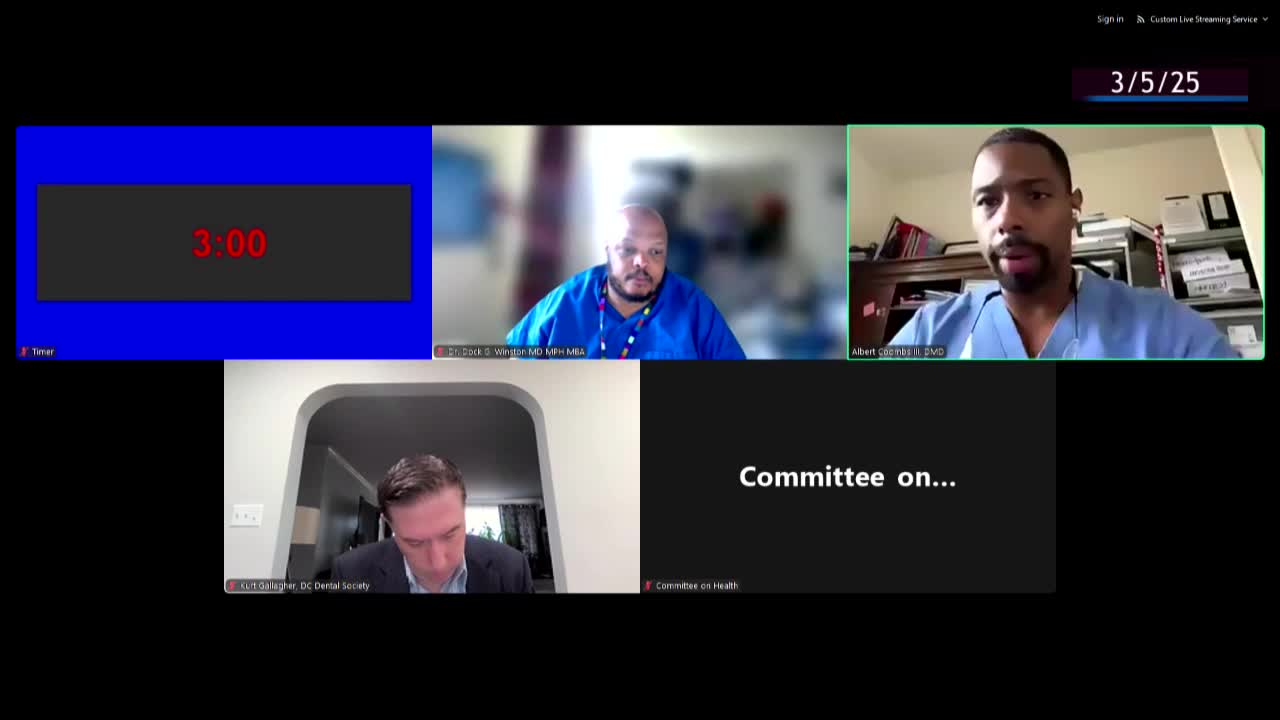
Dr. Albert Coombs, a practicing dentist and Medicaid provider, said reimbursement rates are frequently far below private insurance or the cost of delivering care. He told the committee a typical Medicaid payment for an anterior root canal is about $370, compared with roughly $1,000 from private insurance and up to $1,500–$1,600 out-of-pocket. "There are instances where we have 60% pay cuts on these procedures," Coombs said, adding that insufficient reimbursement drives providers out of the Medicaid network and forces patients to seek care in emergency rooms.
Kurt Gallagher, executive director of the DC Dental Society, cited workforce constraints as a core problem. He said hygiene and dental assistant shortages are nationwide but that some District policies make recruitment harder. Gallagher noted that Howard University recently shifted its hygienist program from a two-year to a four-year model, which has paused enrollment and reduced the pipeline. He also told the committee that DC requires registration of all dental assistants, while neighboring Maryland and Virginia require registration only for assistants performing expanded functions — a mismatch he said disadvantages District practices.
Board of Dentistry Chair Dr. Michelle La Tortue described several regulatory and administrative steps the board is taking to expand capacity. The board approved a level-3 dental assistant classification in regulations (and the Office of the State Superintendent of Education has approved at least one training provider), and the board is planning a second amnesty period (Jan. 1 to April 30, 2025) permitting unregistered dental assistants to register without large penalties. La Tortue also said the board issued 35 fines totaling $75,000 in FY24 and has collected prior-year fines; staff said they can provide the breakdown of fines and the reasons for disciplinary actions.
La Tortue and other witnesses warned that many shortage-designated dental health professional shortage areas in the District are in Wards 7 and 8, where access needs are greatest. Committee Chair Christina Henderson said she will continue follow-up with the Department of Health Care Finance (DHCF) about updating Medicaid reimbursement schedules and asked the boards to flag issues that require legislative fixes.
Ending: Dentists urged the committee to review Medicaid fee adequacy and to support pipeline development for hygienists and assistants, including targeted training partnerships and adjustments to registration requirements that mirror neighboring jurisdictions.