Get Full Government Meeting Transcripts, Videos, & Alerts Forever!
Get email alerts on the Nightlife Extended Hours topic
No spam. Unsubscribe anytime.
D.C. Council advances extended-hours bill after debate on public-safety and neighborhood impacts
Summary
The Council voted to waive committee rules and advance Bill 26-623, which would allow the ABC Board to extend alcohol service hours for qualifying events; Councilmember Pinto recorded a no vote citing public-safety and neighborhood concerns.
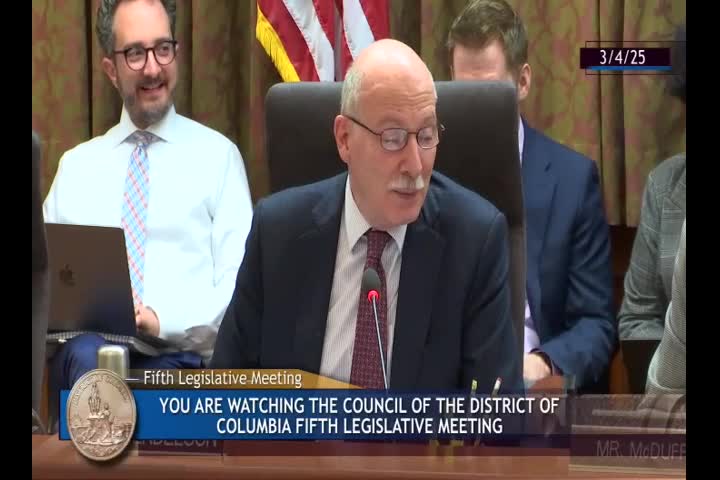
The Council of the District of Columbia on March 4 voted to waive Council Rule 2-31(C) and advanced Bill 26-623, the On Premises and On-site Extended Hours Program Amendment Act of 2025, for first reading. The bill would allow the Alcoholic Beverage Control (ABC) Board to extend hours for sales, service and consumption of alcoholic beverages at sporting and other qualifying events for licensees that register with the extended-hours program.
The measure, presented by Councilmember McDuffie, was reintroduced in Council Period 26 after an initial version in 2024. McDuffie said the Committee on Business and Economic Development held a public hearing and markup and that the committee print incorporates four recommendations from the Advisory Neighborhood Commission/Alcoholic Beverage Control stakeholders (APCA). McDuffie said the print adds a definition for “sporting event” and tightens definitions for “cultural event” and “tourism-related event.”
Councilmember Pinto said she would vote no on first reading and outlined concerns about the bill’s breadth and potential effects on neighborhoods and public safety. "The definition of qualifying events as currently written is very broad," Pinto said, adding that the cultural-event definition could cover everything from a weekend DJ to a small art show and that extending closing times to 4 a.m. could stretch Metropolitan Police Department resources. She also said existing settlement agreements between businesses and neighborhoods might be undermined, particularly where neighbors negotiated limits on late-night alcohol service.
Madam Budget Director advised the Council that funds were sufficient and that the measure had no fiscal impact. Madam General Counsel and the Secretary confirmed the measure was legally and technically sufficient and that the record was complete.
The Council first voted to waive Council Rule 2-31(C) so the bill could proceed without waiting the typical committee schedule; that waiver passed unanimously. The subsequent vote to move Bill 26-623 for first reading passed with the ayes prevailing; Councilmember Pinto was recorded as voting no.
The committee print and McDuffie’s presentation note that settlement agreements may already include language allowing specific events (for example New Year’s Eve or inaugurations) to qualify for extended hours, and that the bill does not change the law allowing settlement agreements to supersede participation in the program. McDuffie said APCA and the ABC Board sometimes receive letters from Advisory Neighborhood Commissions (ANCs) or other parties to settle agreements requesting that specific establishments be allowed to participate in extended-hours events.
The bill will return to the Council for second reading at a later date under the standard legislative schedule. Between first and second reading, McDuffie offered to work with colleagues on narrowing definitions and other technical edits; Pinto said she looked forward to that work but would register a no vote today.
The action recorded at the March 4 legislative meeting was a first-reading advancement of Bill 26-623; no final adoption or operational change takes effect until later votes, and McDuffie and Pinto both indicated they would continue negotiations before second reading.