Get Full Government Meeting Transcripts, Videos, & Alerts Forever!
Get email alerts on the Library Services topic
No spam. Unsubscribe anytime.
Colleyville library to open in-house makerspace in December after council work‑session update
Summary
Library Director Jack Pawlowski told the Colleyville City Council on July 1 that the library will build an in-house makerspace in a first‑floor alcove, detailing equipment, costs, a timeline and plans for training, reservations and modest cost recovery for consumables.
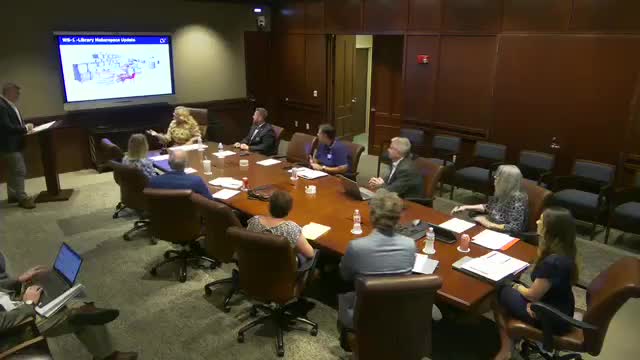
Jack Pawlowski, the Colleyville library director, told the City Council at a July 1 work session that the library will locate a makerspace in a first‑floor alcove that formerly housed audiovisual and periodical collections and plans to open the space in December 2025.
"Library Maker Space is a dedicated area within the library where patrons can access tools, technology, and resources to create, innovate, and collaborate on various projects," Pawlowski said, describing equipment that will include a 3‑D printer, a large‑format laser engraver, a Cricut cutting machine, a heat press, sewing machines and a laminator.
Pawlowski said the library considered an off‑site rental location but moved the project in‑house to reduce costs. He presented two cost scenarios the council: an off‑site rental plan and the in‑house build‑out, and a slide summarizing a first‑year comparison that, as presented, showed a larger one‑time and annual cost for the off‑site option.
As presented to the council, the off‑site startup numbers included roughly $70,000 for equipment, $70,000 for construction and $50,000 for furniture (a $190,000 subtotal shown on one slide), with recurring first‑year operating costs listed as rental of $70,000, staffing of $97,000 and $25,000 for programming. In the in‑house plan Pawlowski outlined, equipment was listed at $36,000, construction at $41,000 with an $8,000 contingency, and furniture at $30,000, yielding a lower startup total for the in‑house option. A later comparison slide the presenter used summarized the presenter’s calculation that doing the makerspace in the library would be several hundred thousand dollars less in the first year and yield substantial annual savings compared with the off‑site rental option, as shown in the presentation.
Pawlowski said the library will not add new staff at this time to operate the makerspace. "Doing it in house, there's not a need at this time for additional staff," he told the council. The project will rely on existing staff and use the library's existing facilities and meeting rooms for overflow programming if demand grows.
On operations, Pawlowski said the library will develop training and reservation procedures before public use. He described customary cost‑recovery practices for materials — for example, many libraries charge a per‑gram fee for 3‑D filament — and said the library will set fees to cover consumables and related costs. "A lot of places tend to do, like, initial training to make sure that you fully understand how the equipment works…" he said, noting the library already uses reservation software for computers and will adapt similar systems for makerspace bookings.
Pawlowski presented a project timeline: collection downsizing and reconfiguration took place in May and June; construction began June 12 and was expected to last one to two months; equipment and furniture were expected to arrive in August and September; staff training and policy development were planned for October and November; and a public opening was planned for December 2025.
Council members praised the decision to move the space in‑house. Council member Joey said the in‑house option ‘‘reduced the cost’’ and called the planned equipment mix a practical starting point. Pawlowski and council members said the layout and furnishings will be flexible and mobile so the room can be reconfigured if demand changes.
The library director also said the library used benchmarking — a survey of nine North Texas libraries and site visits to makerspaces in Grapevine, Lewisville, Flower Mound and North Richland Hills — to select equipment and to design the room layout.
Next steps the presenter described include finalizing reservation and training policies, determining consumables fees, completing the build‑out and receiving equipment deliveries. The council did not take a formal vote during the work session; the presentation recorded direction to proceed with the in‑house plan and to fund equipment from the library’s existing furniture and equipment budget, as described by staff.