Get Full Government Meeting Transcripts, Videos, & Alerts Forever!
Get email alerts on the Gaming Regulation topic
No spam. Unsubscribe anytime.
Casino Commission urges Legislature to reject governor—s executive order transferring gaming oversight to Lottery Commission
Summary
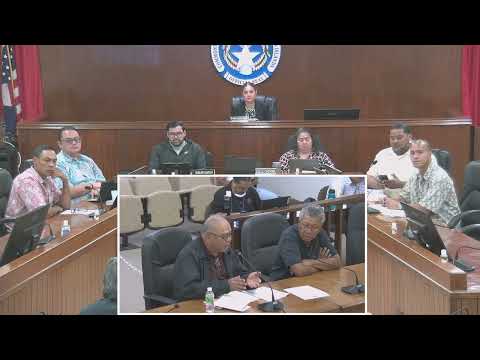
Edward De Leon Guerrero, chairman of the Commonwealth Casino Commission, told the Senate standing committee on gaming the commission wants the Legislature to reject Executive Order 2025-002, signed May 30, 2025, which would move casino oversight to the Lottery Commission.
Edward De Leon Guerrero, chairman of the Commonwealth Casino Commission, told the Senate standing committee on gaming on June that the commission is asking the Legislature to reject Governor—s Executive Order 2025-002, signed May 30, 2025, which transfers supervision of casino gaming from the Commonwealth Casino Commission (CCC) to the Commonwealth Lottery Commission.
The request came during a lengthy appearance at the committee—s Saipan hearing. De Leon Guerrero said the commission has built a regulatory structure since 2015 — including permanent licensing, enforcement and compliance divisions and a 300+ page minimum internal control standards (MICS) manual — and that the executive order would "delay the timely suitability review of the new operator" and "handicap the commission's ability to properly regulate the casino industry." He asked the committee to "reject executive order 2025 dash 0 0 2 within that 60 day period that's authorized by the constitution."
Why it matters: the executive order would dissolve the CCC—s supervisory role and shift responsibilities to the Lottery Commission, the commission said. CCC officials told senators that moving oversight during active litigation, bankruptcy proceedings, and a pending sale could interrupt ongoing license revocation work, complicate confidential investigative files and leave the Commonwealth exposed to operational and legal risk.
Commission history and enforcement actions
De Leon Guerrero outlined the commission—s enforcement history against the Imperial Pacific entities (referred to in the meeting as IPI or Imperial Pacific Resort), including administrative complaints for nonpayment of a license fee and regulatory fees, orders to reserve payroll, and an administrative fine originally set at $6,600,000 that the Commonwealth Supreme Court reduced to $5,000,000. He said the Superior Court and the Commonwealth Supreme Court upheld findings that IPI owed the commission a $15,000,000 license fee dating to 2020 and other regulatory amounts.
De Leon Guerrero described a sequence of legal steps taken after IPI disputed the commission—s enforcement: appeals to the courts, an arbitration directive from a federal judge that the commission later reversed in the Ninth Circuit, and a subsequent Chapter 11 bankruptcy filing by IPI that produced an automatic stay preventing the CCC from completing license-revocation proceedings. He said the commission considered asking the federal court to lift the stay but that the solicitor assigned to represent the Commonwealth, Robert Glass, declined to pursue that motion.
Representation and legal questions
The chairman told senators that the civil division of the Office of the Attorney General had previously assisted the CCC, but that representation changed after the bankruptcy. De Leon Guerrero said Chief of the Civil Division Lisonbee (Allison) Nelson and prior attorneys had worked with the commission; he identified Solicitor Robert Glass as the later attorney who, in his view, declined to seek relief from the bankruptcy stay and advised against certain negotiations. The commission told the committee it regards that refusal as a significant constraint on its ability to finish enforcement work.
Operational and financial issues affecting the casino
De Leon Guerrero recounted technical and operational details the commission oversees: the commission—s MICS (kept partly confidential because they include surveillance and cash‑handling details), anti‑money‑laundering training required for employees, and the commission—s training program with UNLV for regulators. He also recited license-agreement expectations set under Public Law 1856 and subsequent amendments, including a license agreement provision the commission said calls for 2,000 new five‑star hotel rooms and a $2,000,000,000 minimum investment tied to the integrated-resort model.
The chairman told senators that some license-agreement commitments, such as a $20,000,000 annual community benefit fund, were terms of the license agreement rather than statutory requirements and that such provisions may be unrealistic while construction and visitor traffic remain incomplete. He said the site currently contains a 329‑room hotel core and 15 villas, and that completion estimates have varied; he cited prior cost estimates of $300,000,000 and later more than $400,000,000, and said an additional $150,000,000–$200,000,000 might be needed to finish construction.
Bankruptcy, sale process and insurance
De Leon Guerrero described a bankruptcy-related auction process overseen by a firm named Intrepid, a reported winning bidder described as "Team King, CMI LLC" with a $12,900,000 winning bid "with assumption of certain liabilities," and ongoing negotiation with Public Land (DPL) over leasehold transfer terms. He told the committee he had asked whether the assumed liabilities included the license agreement, regulatory fees or fines and had received no clear response.
He also told senators a bankruptcy status conference had been postponed and that the facility—s liability insurance had lapsed; a federal judge had set deadlines for proof of renewed insurance, and failure to show coverage could put the Chapter 11 stay at risk and potentially lead to conversion to Chapter 7 liquidation. De Leon Guerrero said that if a Chapter 7 liquidation occurred, the CCC would be free to resume revocation deliberations because the federal stay would end.
Transition risks and staffing
The CCC informed the committee that since January 2023 the commission has had minimal paid staff and that the commissioners and a reduced roster of trained regulators have been volunteering to keep oversight functions alive. De Leon Guerrero said that transferring duties to the Lottery Commission raises multiple practical problems: access to confidential investigative files; the Lottery Commission—s current staffing and capacity to maintain 24/7 gaming regulation; and who would carry out technical MICS reviews and suitability investigations.
Senators' questions and commission requests
Senator Donald M. Magnolia asked the commission to explain the insurance situation and the timeline for possible outcomes; De Leon Guerrero answered that renewed insurance or a completed sale would reduce risk, but that without a buyer ready to close, the facility could face liquidation. Senator Carl R. King asked what specific challenges the commission foresaw in a transition of responsibilities; De Leon Guerrero said the Lottery Commission would need to hire or contract investigators and regulators and that significant confidential files and security controls could be exposed during an abrupt transfer of custody.
Action requested and next steps
The CCC asked the Senate gaming committee and the 24th Legislature to reject Executive Order 2025-002 during the constitutionally allowed 60‑day review period. Commissioners said they would be available to answer further questions when the committee reconvened. Committee members agreed to continue the discussion in an afternoon session and to invite Lottery Commission members to attend a follow-up.
Ending
The committee recessed and planned to resume later in the day to continue questions. For now, the CCC told senators the executive order would disrupt ongoing enforcement, may expose the Commonwealth to liability, and, in the commission's view, is not the appropriate mechanism to address regulatory or policy issues arising from the IPI matter.