Lifetime Citizen Portal Access — AI Briefings, Alerts & Unlimited Follows
Committee advances bill to raise audit threshold for small Minnesota local governments
Loading...
Summary
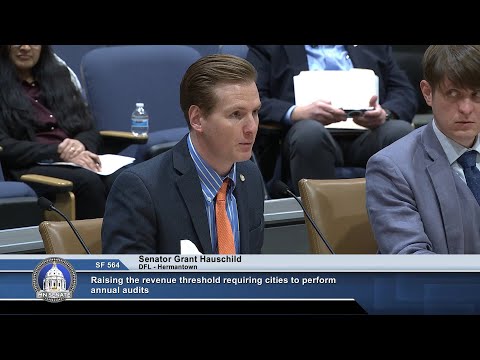
Senate File 564, which would raise the revenue threshold that triggers a required annual audit for many small Minnesota local governments, was discussed and amended at the State and Local Government Committee on Feb. 27, with members adopting two amendments and laying the bill over for possible inclusion in an omnibus package.
Senate File 564, which would raise the revenue threshold that triggers a required annual audit for many small Minnesota local governments, was discussed and amended at the State and Local Government Committee on Feb. 27, with members adopting two amendments and laying the bill over for possible inclusion in an omnibus package.
The bill’s author, Senator Erin Hauschildt, told the committee the change would ease a recurring financial burden for small entities across rural Minnesota, where annual audits often cost thousands of dollars. “Many small entities such as local special districts and townships often have very small annual budgets,” Hauschildt said. Under current law the audit threshold is indexed and is roughly in the mid-$200,000 range; the bill would raise the level to $1,000,000, while retaining annual financial reporting and an agreed-upon-procedures engagement every five years for entities below the new threshold.
The change is intended to reduce audit costs for small governments while preserving oversight. Graham Berg Moberg of the Minnesota Association of Townships said many township officers are unpaid volunteers and that audits can cost “$10,000 to $15,000 per year” for some small entities; he told the committee his association represents nearly all of Minnesota’s 1,776 townships and urged support for the compromise.
State Auditor Julie Blaha testified she and staff support raising the threshold as drafted but stressed the reporting requirement must remain a reliable “backstop.” Blaha described a multi‑year effort by her office to map reporting and oversight requirements across entity types and said the auditor’s office has been chasing nonreporting entities: “In 2022 about 12% were not reporting,” she said, and added her office is currently working to follow up with a set of townships that have not filed recent reports. Blaha said the proposal would preserve coverage of a large share of public funds while reducing workload on auditors and local governments.
An amendment offered by Senator Gustafson (the bill’s A2 amendment) added towns to the list of entities whose failure to file the annual financial report could result in a withholding of state aid tied to local government aid statutes; counsel explained the amendment connects reporting to existing local-aid certification and the existing appeal process for late filers. Committee members adopted that amendment by voice vote. An earlier A1 author’s amendment was also adopted.
The committee laid the bill over for possible inclusion in a future omnibus bill. The committee record shows the bill was discussed at length and includes testimony from state auditor staff who described the reporting form’s content (revenues, expenditures, debt, enterprise funds and employee counts) and said the form is available as a paper or Excel template with detailed instructions aimed at non‑accountants.
What the bill would do and key details
- Raise the statutory audit threshold (current, indexed threshold in the mid‑$200,000s) to $1,000,000 for required annual audits; entities below $1,000,000 would still file an annual financial reporting form with the State Auditor and complete an agreed‑upon‑procedures (AUP) engagement and report that AUP every five years. - A2 amendment: adds towns to the list of entities subject to local‑aid certification rules; a town that does not submit the required report could be ineligible for certain state aid until it complies (an appeal process for late filers was described by the auditor’s office). - Supporters say the measure reduces audit procurement burden (shortage of auditors and rising prices) while preserving reporting and periodic review; the State Auditor’s Office said the proposal reduces the number of required audits without substantially removing coverage of total revenue subject to audit.
Committee action and procedure
- A1 author’s amendment: moved by Senator Carlson and adopted by voice vote. - A2 amendment (adds towns to aid‑withholding provision): introduced by Senator Gustafson and adopted by voice vote. - Final disposition in committee: SF 564 as amended was laid over for possible inclusion in a future omnibus bill.
Context and concerns raised in committee
Members pressed the State Auditor’s Office on the number of nonreporting entities and on whether a change in threshold would materially increase risk to state funds. Auditor Blaha said the reporting requirement is the critical oversight backstop and described the office’s outreach (phone, email and a dedicated township specialist) to raise compliance. Several senators emphasized the volunteer nature of many township officers and the need to balance oversight with administrative burden.
The record includes specific, localized details from the Crane Lake and township testimony: townships typically have no paid staff and rely on volunteers; some cities and townships have had rising audit procurement costs or no responses to RFPs from auditors.
Next steps
The bill was laid over for possible inclusion in a future omnibus bill. Committee staff and the State Auditor’s Office indicated they will continue outreach to townships and local officers to promote compliance with the reporting requirement if the bill advances.