Cochise County supervisors discuss 2024 ballot errors, staffing, machines and process changes
Summary
At a Feb. 6 work session in Bisbee, Cochise County supervisors and elections staff reviewed errors from the 2024 general election and outlined steps to extend ballot proofing, improve communications, speed adjudication and consider new tabulation machines and facility changes.
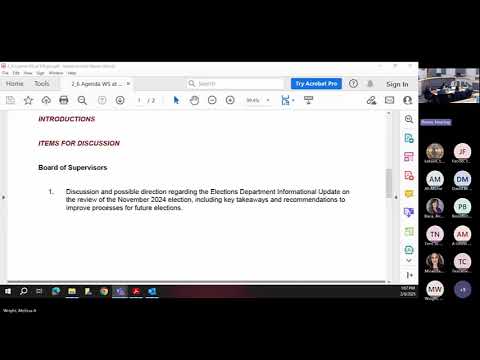
Cochise County Board of Supervisors members met in Bisbee on Feb. 6 for a work session on elections, during which interim elections officials described a mapping error that omitted a candidate from a precinct ballot in the November 2024 general election and proposed a set of procedural and equipment changes to reduce the chance of a repeat.
The discussion centered on three immediate problem areas: ballot proofing and vendor deadlines, mail-in/early ballot processing and adjudication bottlenecks, and tabulation equipment and staffing. The board heard a detailed timeline of the October incident, proposals to extend internal review time and allow candidate inspection of full ballot decks, plans to recruit more early-board staff or draw on county employees, and a request to fund new tabulators and office remodels.
"We had a very condensed timeline for that general election where we only had 3 days to go through 700 plus pages of ballots," said Mr. Hayes, an elections staff member, describing how the short proofing window contributed to errors. Hayes said staff will require at least five working days for internal review going forward, even if vendors pressure earlier deadlines.
Monique Juan Renteria, identified in the meeting as the interim elections director, reviewed the sequence after staff learned of the mapping error that left a candidate off one precinct's ballot. Renteria said she called the recorder's office during poll worker training, the vendor ES&S confirmed the mapping error, and the vendor provided a corrected ballot proof and printed replacement ballots the same day. "They shipped us the paper ballots ... that was Tuesday," she said. Renteria told the board she will add steps to staff procedures so candidates may inspect a full printed deck in the elections office during a designated review window and that party chairs already receive proofs.
Board members pressed staff on communications to affected voters and candidates. A supervisor said many rural voters receive mail infrequently and suggested that any replacement ballot mailed because of an error be marked prominently (for example, "Not a duplicate — please open") so recipients would not discard it as a duplicate. Elections staff said they used social media and newspaper notices after the incident and that the recorder's office and election staff made outreach attempts, but that rural contact information is uneven and some voters lack reliable internet or phone service.
The board also discussed security and distribution of digital ballot images. Renteria said vendors provide PDF proofs but not security watermarks, and large file sizes can complicate emailing full decks to candidates. Staff said they will explore posting precinct-by-precinct images or offering on-site inspection at the elections office to limit security risk while improving transparency.
On machines and counting, elections staff said they are requesting two additional DS950 tabulators — roughly $150,000 each by staff estimate, or about $300,000 total — to replace older equipment and improve throughput. Staff suggested keeping one existing ES&S 850 as a backup while retiring older, slower tabulators. "We are requesting 2 additional DS950s," a staff member said during the meeting; staff presented options including buying one new tabulator and using existing units as backups.
The meeting included an extended discussion of whether to move toward more hand counts at the precinct level and how to pilot such a change without risking post-election legal challenges. Legal principles referenced included the Purcell doctrine, and board members asked county legal staff to prepare a timeline and research cases and statutory constraints before making procedural changes close to an election. A board member summarized the legal risk in court challenges near election dates and urged the board to vet any changes well ahead of an election.
Elections operations and staffing drew sustained attention. Staff and supervisors agreed the early-board process had become a bottleneck: opening envelopes, scanning and re-scanning ballots for the public-facing website and addressing stray marks or torn ballots slowed processing. Staff reported increases in mail ballots processed during the 2024 cycle and noted that the office currently scans ballots twice under recent legislative changes (once at receipt for the ballot-tracking system and again after verification), which increases workload. Staff said they plan to recruit and train more early-board members, expand internal cross‑department backup teams, increase inspector/judge training, and explore modest pay increases and staffing incentives to reduce shortages for weekend and extended-day operations.
Signature verification training, now codified in state statute according to elections staff in the meeting, received attention. Staff reported a small number of county-certified signature verifiers and said additional training sessions will be scheduled to expand capacity.
Operations and security changes under consideration include office layout and ballot storage reconfiguration, a more visible tabulation area with glass walls to allow in-person observation, and contingency planning for continuity of operations. Staff said they will work with facilities to produce cost estimates for remodeling and will bring budget amendment requests to the board. Staff noted any purchase or remodeling and any interfund transfers would come back to the board for approval.
No formal votes or ordinances were recorded at the work session; supervisors directed staff to return with agenda items, cost estimates and legal research. The board scheduled follow-up work to refine a multi-step plan that includes expanded proofing time, candidate access to ballot decks for inspection, additional certified adjudication tools to speed vote adjudication, equipment purchases or leases, and targeted recruitment for early-board and poll-worker staffing.
The meeting closed with supervisors and staff agreeing to pursue the listed changes and to report back with specific agenda items and budget requests for board approval.
AI generated
The text on this page is AI generated. Summaries, highlights, analysis, and video transcripts are all produced from the original source material.
AI can make mistakes, so if you spot one, and we will fix it for everyone.
Note: the source content is unaltered by us. Any content source we link to, be it a video, an audio recording, or a document, is presented exactly as its publisher released it. That publisher is usually a government body, sometimes an individual official or another organisation.