Get email alerts on the Land Development Code topic
No spam. Unsubscribe anytime.
Austin staff outlines 2025 timeline for Land Development Code amendments
Summary
City planning staff presented a detailed Gantt-chart timeline of Land Development Code (LDC) amendments due in 2025, noting scheduled reviews of short-term rentals, equitable transit‑oriented development (eTOD) phases, landscaping, tree preservation and neighborhood overlays and explaining the timeline is a living document.
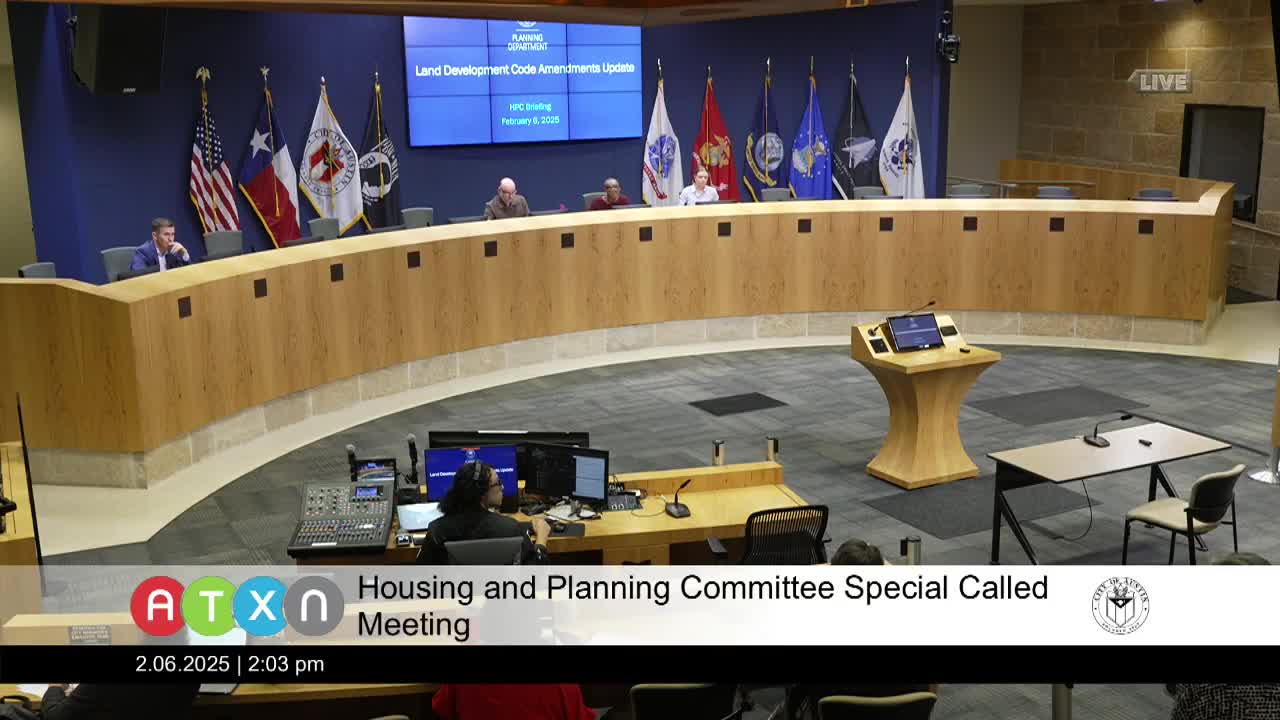
City of Austin planning staff laid out a detailed 2025 timeline for proposed amendments to the Land Development Code during the Housing and Planning Committee meeting on Feb. 6.
Stevie Greathouse, division manager in the City of Austin Planning Department, said the committee’s packet includes a January 2025 Gantt chart that staff use to “daylight” and prioritize LDC amendments. Greathouse told the committee several items have moved since December and described specific dates staff currently expect for public hearings and council consideration.
Greathouse said City Council adopted safety-bollard-related code amendments Dec. 12 and that Development Services–led amendments to the site-plan-lite program (phase 2) were scheduled for the Feb. 13 council meeting. Watershed Protection Department–led amendments related to Colorado River protections were scheduled for Planning Commission Feb. 25 and City Council in March. “Council is also scheduled to consider changes to the regulations that apply to short-term rentals this month,” Greathouse said, and noted those amendments had been presented at a joint Planning Commission–City Council session earlier in the week.
The timeline also anticipates a procedural amendment to create an amendment process for equitable TOD station area plans and coordinated consideration of North Lamar and South Congress station-area plans. Greathouse said staff currently anticipate bringing the procedural code amendment, the plans and related neighborhood-plan amendments to Planning Commission on March 25 and to City Council on April 24.
Greathouse described additional items on the chart: Article 9 (landscaping) amendments that Development Services hopes to bring to Planning Commission on March 25 and Council April 24; a joint April meeting to discuss proposed updates to preservation-bonus provisions of the HOME program; a University Neighborhood Overlay update and related engagement planned before Planning Commission consideration on April 22 and City Council on May 8; and anticipated smart-housing updates to go to Planning Commission April 22 and Council May 22.
Looking further ahead, Greathouse said staff expect to return to Council June 5 with phase 2 of the equitable TOD overlay to extend tools to corridors served by rapid bus and additional rail lines, and that staff do not currently anticipate recommending automatic rezonings in that June action. She also said Development Services expects to propose changes to tree preservation and planting requirements in July and that the department will pursue multiple updates to density-bonus programs, including work on the East Riverside Corridor Regulating Plan and a downtown density-bonus program update informed by a comprehensive density-bonus analysis presented later in the meeting.
Greathouse acknowledged the timeline is “ambitious” and reiterated it is a “living, breathing document” whose dates will be adjusted as projects advance and as staff identify specific review and adoption dates. For the latest version of the chart, she directed the public to speakupaustin.org/ldcupdates.
Discussion during the committee included questions about how staff factor uncertainty in Project Connect funding and timing into plans for station-area or TOD updates, and whether community engagement would be delayed if transit investments were delayed. Greathouse said land-use work responds to changing investments and that some station-area planning focuses on existing, high-ridership corridors as well as planned transit investments.
Committee members also discussed Crestview and East Riverside TOD updates; Greathouse said staff are still determining the best approach for Crestview because an existing regulating plan is out of sync with eTOD and density-bonus provisions. Staff will continue refining the schedule and bringing proposed dates to committee and council.
AI generated
The text on this page is AI generated. Summaries, highlights, analysis, and video transcripts are all produced from the original source material.
AI can make mistakes, so if you spot one, and we will fix it for everyone.
Note: the source content is unaltered by us. Any content source we link to, be it a video, an audio recording, or a document, is presented exactly as its publisher released it. That publisher is usually a government body, sometimes an individual official or another organisation.