Get Full Government Meeting Transcripts, Videos, & Alerts Forever!
Get email alerts on the Trees Cultural Landmarks topic
No spam. Unsubscribe anytime.
City Council upholds appeal to protect Italian stone pines on Anapamu Street; HLC members call for clearer rules on landmark trees
Summary
Santa Barbara City Council unanimously upheld an appeal to preserve the Italian stone pines on Anapamu Street after public commenters and commissioners argued the trees are culturally significant and that the municipal code lacks clear guidance for living, non‑structural landmarks.
Santa Barbara City Council unanimously upheld an appeal to preserve the Italian stone pines along Anapamu Street, a decision commissioners and staff said reflected unusually strong public comment and concerns about how the municipal code treats living, non‑structural cultural resources.
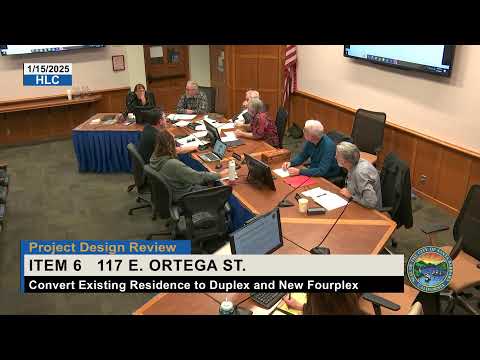
Public commenters and commission staff said the council’s decision — announced after the appeal hearing — affirms an intent that replacements for removed Italian stone pines should be the same species (Italian stone pine) whenever possible. Ellen Kokkin, the city’s design review supervisor, told the commission the council vote was unanimous (Council Member Sneddon absent) and that staff expects a council resolution that will state the city’s intent to maintain Italian stone pines in place and, where a tree is lost, to replace it in kind.
Why it matters: Commission members and members of the public framed the case as more than a disagreement over street trees. Commenters and several commissioners said the episode showed municipal rules are focused on built, architectural landmarks and lack clear guidance for living cultural resources such as landmark trees and canopies. That lack of clarity, they said, led to prolonged review and an appeal to the council.
What speakers told the commission - Rick Clawson and Sherry Ray, two public commenters who filed speaker slips, credited public input and the written record with persuading council members to uphold the appeal. Clawson supplied an appeal record and public comment materials to the commission. Sherry Ray urged creation of an Office of Historic Preservation to provide a standing voice and to help coordinate historical and cultural expertise earlier in disputes. - Ellen Kokkin (Design Review Supervisor) told commissioners that the council found the appellants’ presentation persuasive and said staff will prepare a council resolution to clarify that the Italian stone pine is the intended species for replacement when a designated tree is lost. - Multiple commissioners said the case exposed a gray area in the Santa Barbara Municipal Code: while buildings and structures are well defined, cultural resources that are living (trees, landscapes) are not spelled out consistently and need clearer standards. Commissioner Enzberg noted the commission has only a handful of designated landmark trees — she stated “we have 7 trees, basically” — and said the city needs rules about what happens when a landmark tree dies or must be removed.
What the commission will do next: Staff said it will prepare an agenda item to open a discussion on “cultural landscapes and biological heritage,” including training resources and possibly new guidance or a supplemental chapter in the commission’s guidelines. Commissioners suggested consulting national guidance on cultural landscapes and bringing relevant experts to inform local policy.
Context and limits: The commission emphasized the council decision addressed the Anapamu appeal and does not itself create citywide code changes. Several speakers noted that the Secretary of the Interior’s guidance on cultural landscapes exists but often lacks the level of detail needed to resolve tree‑by‑tree disagreements at the local level.
Ending: Commissioners and staff said the issue revealed an immediate technical need — clearer local procedures and definitions for living cultural resources — and a longer term policy task: whether to create local enforcement, monitoring, or a specialist office (an Office of Historic Preservation) to coordinate decisions that cross Parks, Public Works, and historic preservation responsibilities.