Get AI Briefings, Transcripts & Alerts on Local & National Government Meetings — Forever.
Santa Barbara staff lay out Safe Streets action plan, propose raised bike lanes and pilot street changes
Loading...
Summary
City staff presented a draft Safe Streets action plan focused on 10 priority corridors on the high-injury network, proposed a mix of raised bike lanes, widened sidewalks and lighting upgrades, and said most projects are unfunded and will require competitive grants; an open house and council hearings are scheduled.
Jessica Grant, the city’s supervising transportation planner, presented a draft Safe Streets action plan and a set of concept-level infrastructure proposals aimed at reducing traffic fatalities and serious injuries on Santa Barbara’s high-injury network.
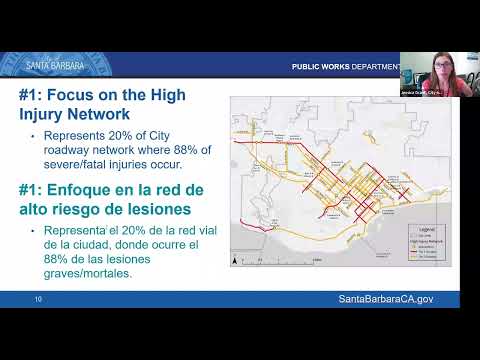
Grant said the plan, produced to meet federal Safe Streets for All grant requirements, maps a high-injury network that covers about 20% of the city’s road miles but concentrates a large share of the city’s most severe crashes. The draft action plan outlines mandated chapters including leadership and goal setting, safety analysis, community engagement, equity, policy changes and project selection; an appendix lists countermeasures and where they are typically applied.
The presentation walked through concept sheets for 10 priority corridors. For Bath Street (Alamar to Mission), staff recommended more midblock lighting and noted on-street parking demand prevents an immediate bike-lane conversion, so an on-street bike lane is documented as a long-term vision. For a busy Calle Real corridor adjacent to Highway 101, staff proposed a new 12-foot-wide widened sidewalk/path separated by a parkway while retaining on-street lanes for faster cyclists. Near downtown and at Chapala, staff proposed additional on-street bike lanes where parking can be retained, signal-head visibility improvements, countdown timers and targeted lighting.
At Upper State Street, staff showed concepts for raised bike lanes elevated to sidewalk level to separate cyclists from vehicle traffic while leaving vehicular lane configurations largely intact. Jessica Grant said raising bike facilities would improve comfort for less-confident cyclists but would require driveway treatments and some median narrowing. Derek Bailey, the city’s traffic safety engineer, cautioned that moving the bike path to the inner side of the parkway would “require removal of all Parkway trees on Upper State Street,” a trade-off staff said would make sense only in redevelopment blocks.
Staff proposed a pilot striping project on De La Vina near Cottage Hospital to test a lane-reduction and on-street bike lane using temporary paint during scheduled pavement work, with a one-year evaluation and a return to council to consider permanency if the pilot is successful. For Las Positas Road, staff proposed a two-way separated bike facility and additional sidewalk and lighting to connect to the Las Positas–Modoc multiuse path.
Grant stressed the plan mainly identifies unfunded needs. "We have to receive grant funding," she said, noting grant programs are competitive and can take one to three years from application to award and then additional years for implementation. She also cited the city’s history of securing state active-transportation funds but said pavement-maintenance funding fluctuates and the city cannot always publish a multi-year paving schedule.
During a Q&A, a webinar participant urged attention to visibility at Chapala and Pueblo crosswalks and flagged poor pavement between Chipotle and De La Vina; staff invited follow-up by email and said operational fixes like vegetation clearance are handled by traffic engineering. Staff announced an in-person open house at the Faulkner Gallery (5:30–6:45 p.m.), a council briefing on May 12 to seek support for grant applications for the Castillo undercrossing, a draft plan review by City Council on June 16 and a final adoption hearing scheduled for July 28.
The draft plan and full materials (including appendix E with countermeasure descriptions) are posted on the city project webpage; staff asked residents to review the materials and submit comments via email or attend the open house.