Get Full Government Meeting Transcripts, Videos, & Alerts Forever!
Get email alerts on the Land Use Development topic
No spam. Unsubscribe anytime.
Cedar Park planners reject North Fork plan development after commissioners cite mismatch with comprehensive plan
Summary
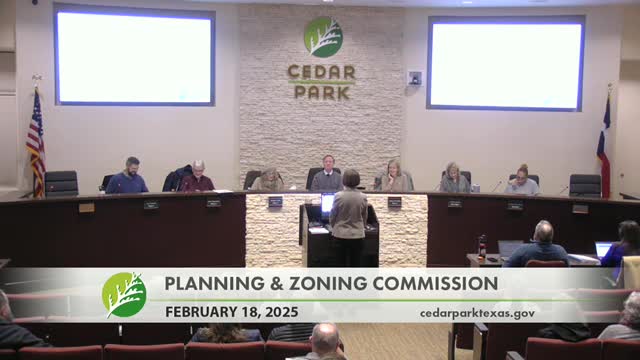
The Planning & Zoning Commission voted 6–1 to recommend denial of the North Fork plan development, siding with staff concerns that the proposal’s large residential footprint and industrial components conflict with the city’s ‘missing places’ vision for the Whitestone/Palmer corridor.
Amy Lang, director of Development Services, told the Planning and Zoning Commission that the North Fork plan development covers roughly 233 acres along East Whitestone Boulevard and West Palmer Lane and proposes rezoning the entire property to a plan development with a general business base district. The proposal would allow as many as 1,500 residential units, with 500 units allowed “by right,” and includes seven distinct land areas allowing a mix of nonresidential uses and residential components. Lang said the developers added a 250-foot building setback from the centerline of Brushy Creek for certain industrial uses in Land Area B, committed to at least 10 acres of open space, and allocated a minimum of $250,000 for park improvements but did not specify locations.
The commission’s staff recommendation was to deny. Lang said staff’s analysis found major discrepancies between the PD and the city’s comprehensive-plan “missing places” objectives: more than half of the northern tract and about 60% of Planning Area E would be available for apartments and townhomes, which staff said did not create the concentrated, mixed‑use, walkable nodes the comprehensive plan envisions. Lang also noted that warehouse and distribution uses proposed in Planning Area G would not meet the intent of a business park or other identified missing places.
Stephen Swan of Riverside Resources, the applicant’s representative, said the company had worked with economic development and city staff to attract employers to the corridor and described Brushy Creek as an asset. Swan said the team added a contiguous 10-acre open-space corridor along the creek, committed to trail connections and park improvements, limited areas where apartments may be located and removed a special‑use permit mechanism that would have allowed more than 1,500 units. He said the developer plans to provide trail connections and that the layout of the open space will be reviewed at the preliminary‑plan stage.
Public commenters and the Cedar Park Chamber of Commerce expressed concerns that the project had too much residential and not enough commercial/employment use to deliver the “destination” planning-area outcomes the comprehensive plan targeted. Commissioner remarks during deliberation echoed staff concerns: commissioners described the plan as compartmentalized, said the parcel is one of the city’s most valuable remaining tracts, and repeatedly pressed for stronger commercial assurances, binding park-location commitments, and limits on industrial/warehouse uses near the creek.
After deliberation Commissioner Bob Ingram moved that the commission reject the PD application; Commissioner Brandon Donnell seconded. The roll-call vote was 6–1 to recommend denial to City Council. The record shows staff received letters in opposition from a homeowners’ association and an adjacent property owner and that the applicant may pursue council consideration; a supermajority would be required for council to override the commission’s recommendation.
Commissioners and staff said the proposal could be reconsidered if the developer returns with a PD more tightly aligned to the comprehensive plan’s mixed‑use, destination objectives and with clearer, binding commitments on park location, phasing that ensures commercial delivery, and reduced industrial exposure to Brushy Creek.