Get Full Government Meeting Transcripts, Videos, & Alerts Forever!
Get email alerts on the Religious Land Use topic
No spam. Unsubscribe anytime.
Cambridge planning board pauses petition to treat religious uses like recent housing zoning changes, asks city solicitor for legal opinion
Summary
The Cambridge Planning Board on May 20 heard a citizen petition asking the city to amend multiple sections of the zoning ordinance to expand exemptions and dimensional allowances for religious uses so they match recent changes made for residential development.
The Cambridge Planning Board on May 20 heard a citizen petition asking the city to amend multiple sections of the zoning ordinance to expand exemptions and dimensional allowances for religious uses so they match recent changes made for residential development.
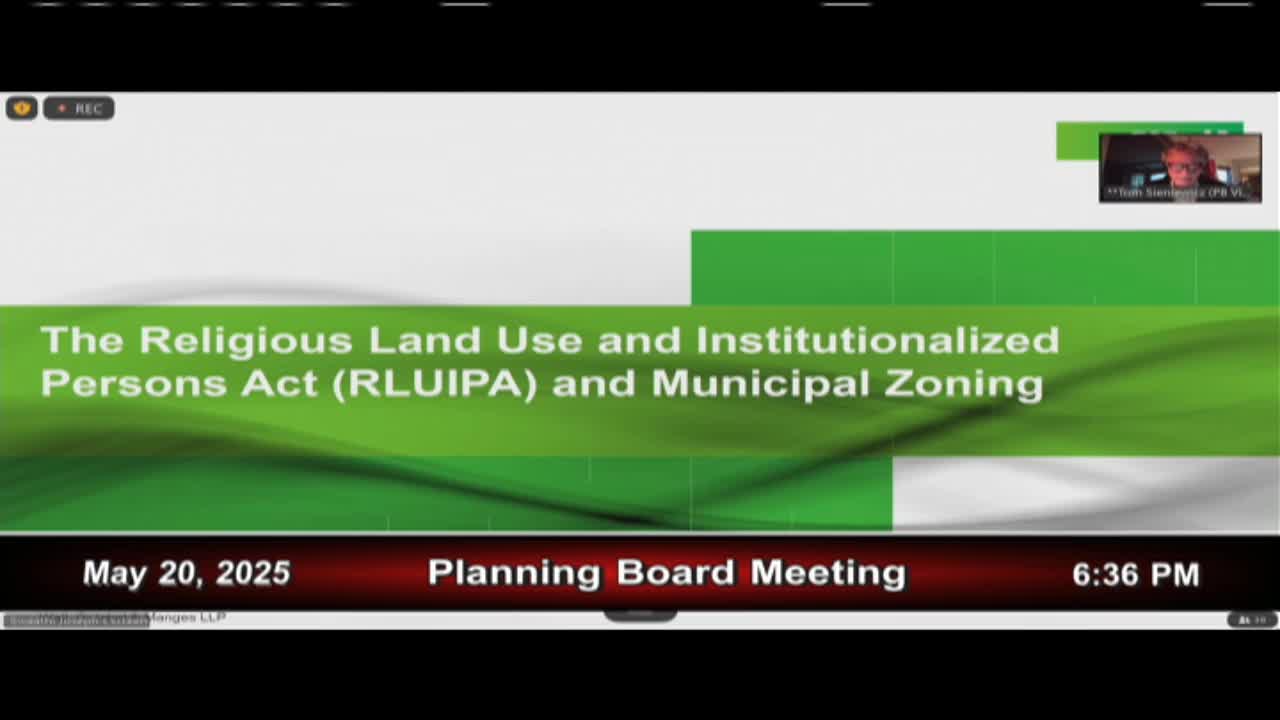
The petitioners — represented by attorney Ben Tymon and pro bono counsel Yehuda Buckweitz — asked the board to add “religious purpose uses” to the same GFA/FAR exemptions, prior-nonconforming expansion rules, and dimensional allowances (including six‑story/74‑foot height allowances) the city recently adopted for housing. Yehuda Buckweitz told the board that “RLUOPA protects religious rights in 3 ways,” and argued the changes would reduce the risk that local zoning decisions violate the federal Religious Land Use and Institutionalized Persons Act (RLUIPA).
Why the board paused the petition
The hearing included focused presentations from the petitioners, followed by nine public commenters who opposed the change and cited concerns about neighborhood scale, loss of housing, notification, and the Dover Amendment. Opponents argued the petition would let religious institutions build larger, higher, and more intensive uses across residential neighborhoods without inclusionary-housing requirements or neighbor notice. Alan Jocelyn, a Bank Street resident, said he and hundreds of neighbors “strongly oppose this proposed zoning amendment [to] remove critical size and scale restrictions on the construction of religious use projects citywide.”
Planning staff told the board the ordinance committee had held this matter “in committee” earlier the same day and requested a legal opinion from the city law department. Multiple board members also said the questions raised were legal in nature and outgrew typical planning-only review. At the end of the discussion the board voted to continue the item and to request a written opinion from the city solicitor addressing how RLUIPA, the Massachusetts Dover Amendment, and Cambridge’s institutional-use authorities interact.
What the petition would change (as presented)
- Exempt religious uses from gross floor area (GFA) and floor area ratio (FAR) limits, as was done for multifamily housing. - Allow additions to prior nonconforming structures for religious uses without the usual special-permit analysis of substantial detriment, mirroring a residential exemption in recent housing amendments. - Place religious uses in the same dimensional table slot that allows up to six stories (74 feet) by right in certain residential districts, while asking that some residence‑specific provisos (for example, inclusionary-housing requirements) apply only to “primarily residential” uses and not to religious purpose uses. - Exempt religious uses from a consultative, nonbinding Planning Board advisory process in the dimensional-footnote (footnote 37), which petitioners said could be susceptible to RLUIPA challenges.
Petition-related context cited at the hearing
Petitioners said the proposed changes would benefit any religion citywide and would reduce litigation risk; they noted a specific project filed for the BZA (Bank Street) with a hearing scheduled June 12. Staff said the petition was filed by a resident group (at least 10 registered voters) and that several related zoning petitions (affordable housing overlay, height amendments, floodplain amendments, cannabis amendments) recently cleared first readings or were before the City Council. Speakers also referenced Cambridge’s prior Home Rule legislation that had made the city exempt from aspects of the Dover Amendment and the city’s institutional-use regulations.
Board action and next steps
Planning Board member Ted Cohen moved and Carolyn Zurn seconded a motion that the board continue the hearing and request a written legal opinion from the city solicitor on the interaction of RLUIPA, the Dover Amendment, and Cambridge’s institutional regulations. The roll-call vote was 6–0 in favor (Ted Cohen, Mary Liedecker, Diego Macias, Ashley Tan, Carolyn Zurn, and Tom Sanovich voting yes). The board will reconvene the matter after the law department provides the requested legal analysis.
Community views and outstanding issues
Speakers opposing the petition repeatedly raised housing-loss and neighborhood-scale concerns, citing specific local impacts they anticipate (for example, the Bank Street project’s effect on existing dwelling units). Other commenters asked the board to wait for the outcome of the petitioners’ ongoing litigation and the city solicitor’s advice before transmitting a recommendation to the City Council. Petitioners and their counsel emphasized RLUIPA’s protections and said the amendments would avoid future federal claims and would be consistent with state law principles.
The board and staff flagged several specific legal questions to the law department, including whether RLUIPA would preclude particular dimensional or notification requirements, what kinds of regulations remain permissible in the service of compelling government interests (for example, public safety or flood-resiliency requirements), and whether adopting the petition would unintentionally broaden institutional exemptions to nonreligious educational institutions.
The petition remains open. The planning board did not adopt or recommend any zoning change at the May 20 hearing; it voted to pause and solicit the city solicitor’s written opinion before further action.