Get email alerts on the Drainage And Open Space topic
No spam. Unsubscribe anytime.
Watershed Protection outlines drainage priorities, problem‑score approach and open‑space strategy
Summary
Watershed Protection presented its problem‑score strategic approach to prioritize drainage, erosion and water quality projects and described a joint open‑space land acquisition strategy with Austin Water and other departments.
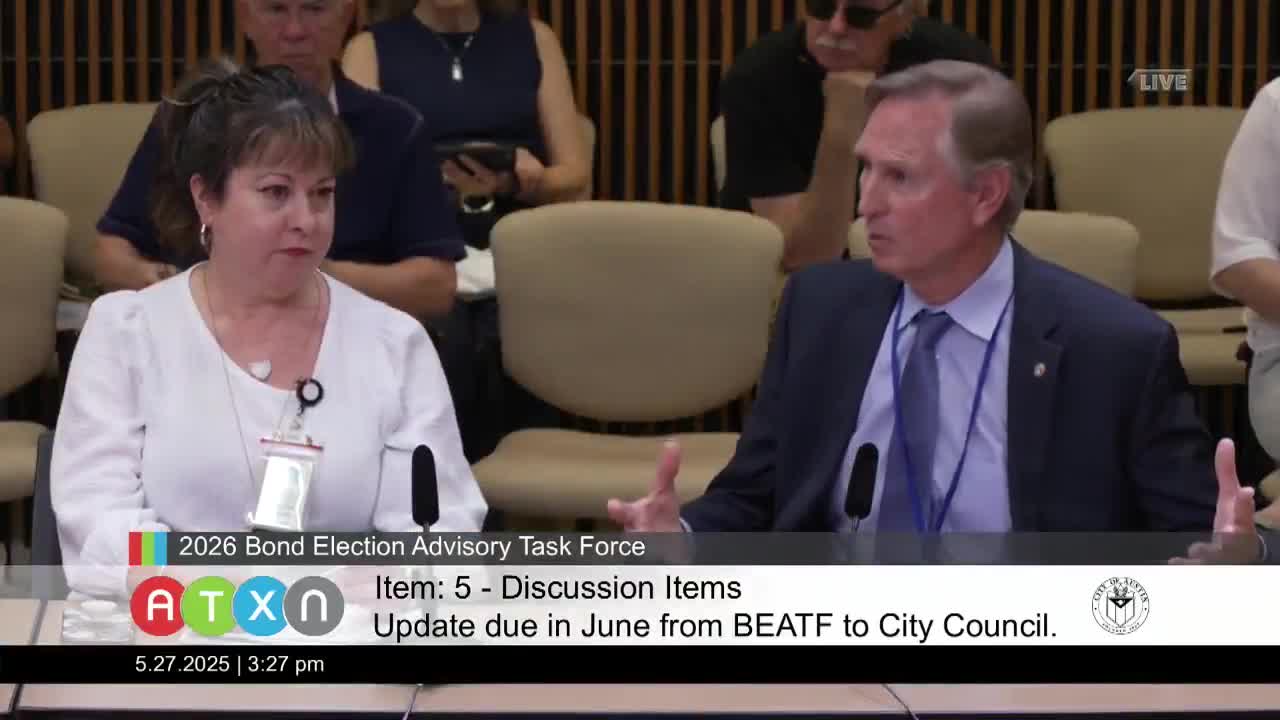
Assistant Director Jenny Spence and colleagues from Watershed Protection presented department priorities for drainage, erosion and water quality and described how they will score capital projects for the bond.
Spence said Watershed Protection uses a problem‑score approach that ranks locations by flood, erosion and water quality risk and that the department's strategic plan identifies more than $2 billion in needs across operations, maintenance and capacity upgrades. The department proposed technical criteria that weigh proactive prevention most heavily (40 points), customer trust/relationships (25), equity (15), affordability (15) and sustainability/resiliency (5) for CIP project prioritization.
On open space, Watershed described an interdepartmental land acquisition strategy jointly led with Austin Water, Parks and the Office of Real Estate to protect acres that contribute to water quality, Barton Springs and the Colorado River. Spence said prior bond programs protected about 35,000 acres and that roughly $30 million of the 2018 open space allocation remains to be spent on ten projects now in preconstruction or construction.
Why it matters: Watershed framed drainage and open space spending as risk‑reduction for flood safety, erosion control and water‑quality protection. The department told the task force it will present land‑acquisition criteria to the parkland and open space working group and asked for coordination across departments when scoring projects.
Next steps: Watershed said it will continue updating the Rain to River strategic plan and will bring prioritized CIP projects and open‑space criteria forward for the task force and working groups to review.
AI generated
The text on this page is AI generated. Summaries, highlights, analysis, and video transcripts are all produced from the original source material.
AI can make mistakes, so if you spot one, and we will fix it for everyone.
Note: the source content is unaltered by us. Any content source we link to, be it a video, an audio recording, or a document, is presented exactly as its publisher released it. That publisher is usually a government body, sometimes an individual official or another organisation.