Lifetime Citizen Portal Access — AI Briefings, Alerts & Unlimited Follows
OLRCB cites negotiated contracts, new document management and need for in‑house labor economist
Loading...
Summary
The Office of Labor Relations and Collective Bargaining reported negotiating or administering 25 compensation agreements, staffing 20 FTEs and plans to implement a searchable document management system and hire a labor economist to speed contract analysis and costing.
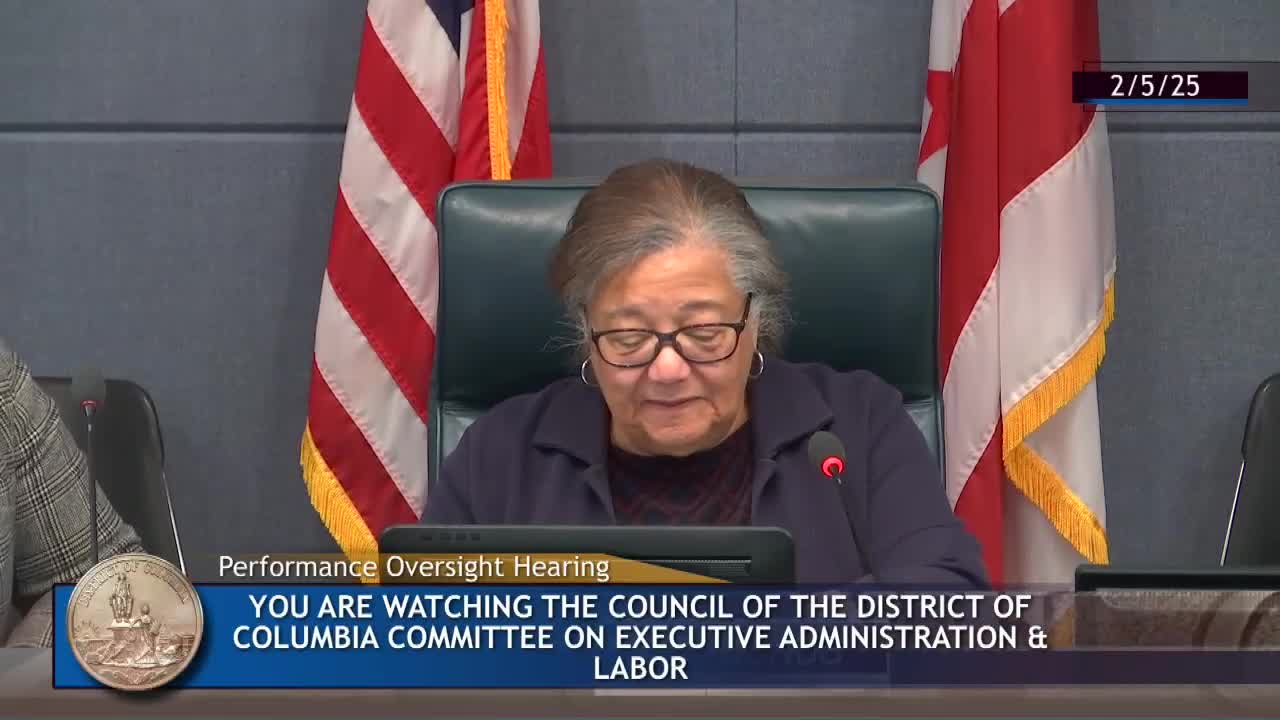
E. Lindsey Mitchell II, director of the District’s Office of Labor Relations and Collective Bargaining, told the Committee on Executive Administration and Labor on Feb. 5 that OLRCB manages collective bargaining for about 75% of the unionized District workforce, administers 25 compensation agreements and operates with 20 full‑time equivalent staff.
Mitchell described the office’s three units — negotiations and contract administration, litigation, and administrative support — and said attorneys at OLRCB collectively handled negotiations, arbitration and representation matters. He told the committee that in FY 2024 the office negotiated the successor contract with the Washington Teachers’ Union (WTU) and a CBA for AFGE Local 1403 (government attorneys), and that those agreements were completed in what he described as record time.
Mitchell said OLRCB has 20 FTEs, including 11 attorney positions, and that the office is building an electronic, searchable document management system to catalog litigation, negotiations and advisement documents. "Having our documents electronically cataloged and fully searchable by OLRCB employees enhances our efficiency, transparency, and accessibility," he said.
Committee members pressed OLRCB on negotiation timelines, how offers are costed and whether the office has in‑house capacity to produce fiscal analyses. Mitchell said OLRCB currently relies on the Office of the City Administrator’s budget staff and the Department of Human Resources (DCHR) for costing and comparator research, and that the office would benefit from an in‑house labor economist to perform market comparisons and help cost counteroffers more quickly. His chief of staff described the economist’s role as guiding competitiveness research and supporting faster, internally generated counteroffers.
Mitchell also described OLRCB’s approach to bargaining (working closely with agencies and the city administrator’s office, seeking staggered contract expirations) and noted the office negotiates both working‑conditions only agreements and combined compensation/conditions agreements. He said OLRCB administered 25 separate CBAs and anticipated handling roughly eight to ten active negotiations during FY 2025.
Ending — follow up requests: Committee members requested a list of the 25 covered CBAs, counts of arbitration review requests and records on NEAP (the negotiated employee assistance home purchase program). OLRCB said it would provide the requested lists and numbers to the committee.