Get Full Government Meeting Transcripts, Videos, & Alerts Forever!
Get email alerts on the Land Use Signs topic
No spam. Unsubscribe anytime.
Tulsa planning staff seeks code change to allow electronic message centers
Summary
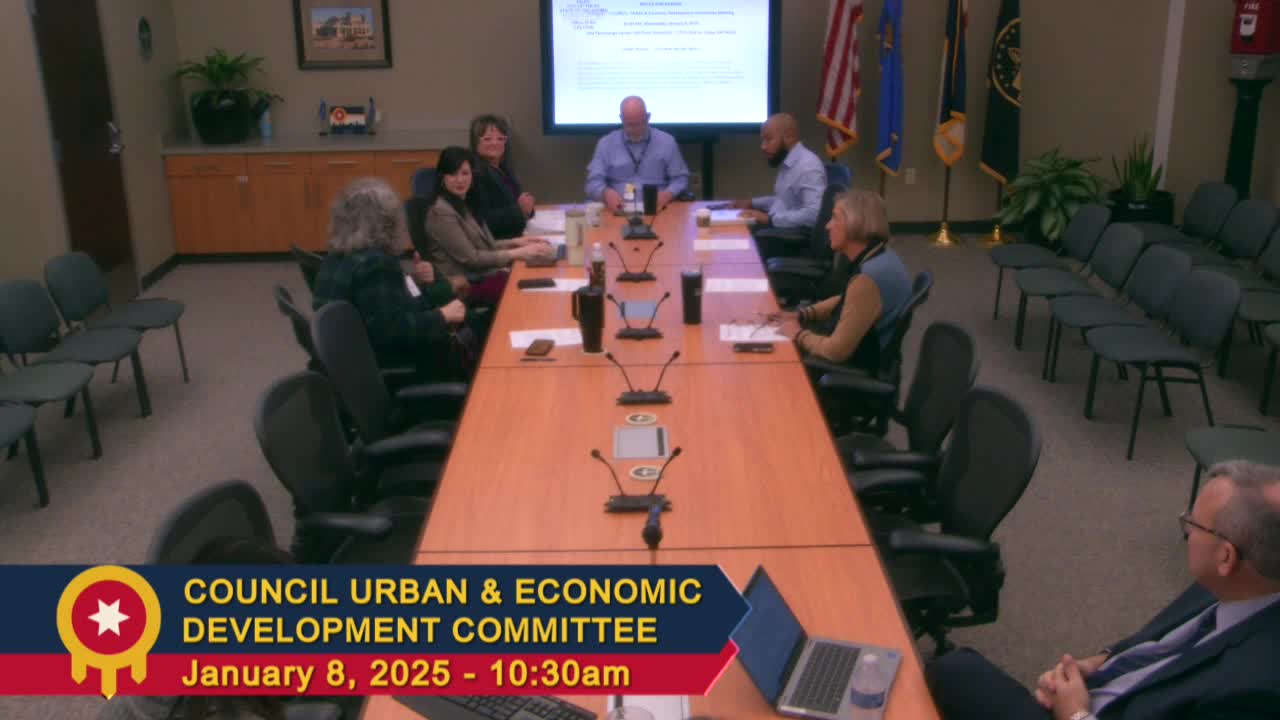
The Urban and Economic Development Committee was briefed on an ordinance, ECA 32, to amend the City of Tulsa zoning code to allow electronic message centers.
The Urban and Economic Development Committee was briefed on an ordinance, ECA 32, to amend the City of Tulsa zoning code to allow electronic message centers.
Planning staff said the text amendment would explicitly allow electronic message centers — digital signs that display changeable text such as gas prices, time or temperature — rather than treating them as higher‑impact digital display signs. “This is a zoning code text amendment to allow for electronic message centers,” the staff presentation said, noting the city’s 2016 code update did not carry forward the older electronic‑message provision.
The staff presentation compared the proposed rules to current standards: required separation distances from residential districts, minimum distance from driving surfaces, and limits on square footage so the electronic message area counts toward a sign’s total allowed area rather than adding new signage. Staff also said the draft treats some cases differently from dynamic displays — for example, allowing more than one permitted electronic message sign on a lot in some configurations, an accommodation that has previously required a Board of Adjustment variance for multi‑frontage sites such as some QuikTrip locations.
Council members asked about brightness and safety. “I see there on the brightness standards … sometimes those new LED lights are so bright, they’re hurting me. I mean, do we have some sort of standard?” a council member asked. Planning staff replied the sign chapter contains brightness rules measured in foot‑candles — “constant light is not to exceed … 70 foot‑candles measured at a distance of 2 feet from the face of the sign” — but said the brightness language is in a different part of the code and staff would confirm the exact cross‑references before the measure returns for a vote.
The draft also includes a minimum display period. Staff said electronic messages must remain static without animation or special effects for at least five minutes before changing, preventing rapid flashing or continuous animation that can distract drivers.
The committee directed staff to return next week with follow‑up on the brightness and lighting cross‑references so members could review the precise standards before final action.
The ordinance remains in committee; no formal committee vote was recorded in the transcript.