Lifetime Citizen Portal Access — AI Briefings, Alerts & Unlimited Follows
UNOPS says fuel deliveries and clearance work have scaled under ceasefire; urges rapid move to early recovery
Loading...
Summary
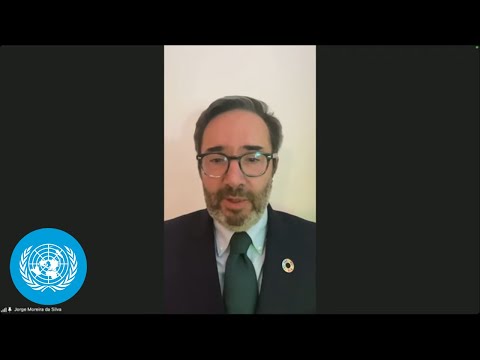
Jorge Moreira da Silva, Executive Director of the UN Office for Project Services (UNOPS), said at a remote briefing from East Jerusalem that UNOPS has sharply expanded fuel deliveries and is managing a Security Council–mandated mechanism to speed humanitarian aid into Gaza, and he urged immediate steps toward early recovery and rubble removal.
Jorge Moreira da Silva, Executive Director of the UN Office for Project Services (UNOPS), said at a remote briefing from East Jerusalem that UNOPS has sharply expanded fuel deliveries and is managing a Security Council–mandated mechanism to speed humanitarian aid into Gaza, and he urged immediate steps toward early recovery and rubble removal.
The ceasefire has "offered a much needed respite, but there is simply no time to lose," Moreira da Silva said. He told reporters that before the ceasefire UNOPS was delivering about 100,000 liters of fuel per day and that deliveries have risen to about 1,300,000 liters per day, a scale-up he described as a breakthrough for hospitals, bakeries and other critical services.
The nut graf: UNOPS is responsible for infrastructure, procurement and project management work in support of the wider UN response. The agency is managing the so-called UN 2720 mechanism—which Moreira da Silva said was created by a Security Council resolution—to approve, coordinate and track consignments into Gaza. He said the mechanism had facilitated close to 78,000 metric tons of aid as of Feb. 13 and that about 70% of approvals had occurred in less than 24 hours.
Moreira da Silva framed three main UNOPS roles in Gaza: procurement and delivery, monitoring and distribution of fuel, and clearance/support for mine- and unexploded-ordnance (UXO)-risk mitigation in partnership with UN Mine Action. "Our team has completed almost 400 assessments and accompanied 400 high-risk convoys to vulnerable areas," he said, citing UNOPS field work to enable humanitarian access.
On the scale of destruction, Moreira da Silva gave several estimates drawn from UN and World Bank assessments: roughly 70% of infrastructure destroyed, about 60% of houses destroyed, and roughly 65% of roads destroyed. He cited an estimated 40–50 million tons of rubble and said the damage assessment figure commonly cited is about $30,000,000,000; he noted that the cost of recovery and reconstruction could be higher.
Moreira da Silva gave on-the-ground examples to illustrate urgent needs: the European Hospital near Khan Younis had relied on solar power before the war but lost panels and, before the ceasefire, lacked fuel and spare parts to run generators; he said clinicians reported surgeries without anesthesia and three infant deaths linked to lack of electricity for incubators. "Electricity, energy, and water is fundamental," he said.
He also addressed questions about UN roles and partners. Moreira da Silva said UNOPS is not replacing UNRWA in food distribution; rather, UNOPS focuses on logistics, monitoring and managing the 2720 mechanism and on infrastructure- and procurement-related tasks. He said UNOPS has operated in Gaza for 14–15 years and currently has about 100 staff there, while the agency has some 6,000 personnel globally and works in roughly 100 countries.
On accountability and transparency, Moreira da Silva pointed reporters to the mechanism's public information: "If you go to the website, 2720.org, you will know the amount of aid that has been brought and what was rejected and why it was rejected," he said. He described UNOPS monitors riding on distribution trucks and tracking fuel use to confirm deliveries reach intended facilities.
Asked about displacement proposals and forced movement, he reiterated the UN position that "forced displacement is not consistent with international law" and said the immediate priority is to avoid a return to large-scale hostilities that would worsen civilian suffering.
On reconstruction timing and requirements, Moreira da Silva said early recovery must begin with rubble removal, waste management, roads and restoring electricity and water so that reconstruction can follow. He called for broad international mobilization and partnership, saying "UNOPS cannot do it alone" and urging donors and states to coordinate on early-recovery funding and planning.
Ending: Moreira da Silva emphasized that the ceasefire provides an opening to expand aid and begin early recovery work. He urged member states, donors and partners to use the current conditions to accelerate humanitarian access and planning for rubble removal and the rehabilitation of shelters, hospitals, schools, roads and water systems.